Showing posts with label pius xii. Show all posts

Sunday, 21 June 2026

Pope Pius XI and the Order of the White Eagle


Polish Government officials have been playing politics with the Order of the White Eagle since it’s reconstitution in resurrected Poland in February 1921. Emblematic of this is the incident the occurred with the Vatican Ambassador, the Apostolic Nuncio, in April of that same year.

At the end of the First World War, Poland regained its independence after having been partitioned by the imperial powers of Russia, Prussia, and Austria between 1772 and 1793. A Polish State had been declared independent several times by one or more of the major European powers since 1793. In November 1918, under the charismatic revolutionary Józef Piłsudski, Poland achieved independence on its own, even before the victorious Entente could concede it. A wave of national pride ensued that sometimes exceeded the bounds of ordinary patriotism. Throughout the coming two decades, it often manifested itself as form of national chauvinism that parallelled the ethno-nationalisms which would spread across Europe and eventually engulfed Germany.

            A few months prior to independence, in May 1918, the Holy See had dispatched the Prefect of the Vatican Library, Monsignor Achille Ratti, as envoy (Apostolic Visitor) to reconstruct the Catholic Church and its hierarchy which had been reduced to a sorry state under Prussia and Russia. Ratti was to recommend candidates for the largely vacant episcopal sees, take stock of the situation, and return to Rome before Christmas. His itinerary had to be modified following Polish independence. The interim government asked for Ratti to be named Apostolic Nuncio, the first papal ambassador to Poland since 1796. In the meantime, he had fallen in love with Poland and, to further good relations, chose to be consecrated a bishop in Warsaw on 19 October 1919. On the invitations, he wrote that, by the power of the Holy Spirit, he was being reborn as a Pole: Non sine Sanctissimi Patris beneplacito, cui placuit ut qua Episcopis certo quodam modo Polonus in Spiritu Sancto renascar.

           Ratti had been chosen for the Polish assignment because he was perceived to be neutral, and he quickly established an excellent raport with the Church hierarchy and with Piłsudski and his ministers. His popularity reached an apex in August 1920, when the Bolsheviks drove Piłsudski’s conquering army out of Ukraine all the way back to the gates of Warsaw. This highly mythologized episode is known in Polish history as “The Miracle of the Vistula.”  

During the crisis, Ratti received the diplomatic corps daily at the Apostolic Nunciature to discuss the deteriorating situation. The Nuncio received orders from the Vatican to accompany the Government, as it prepared to abandon the capital. The entire diplomatic corps got on a special train to Poznań, but Ratti ordered his staff to take refuge in Vienna. As to himself, he remained in Warsaw with the last member of the Government, the Foreign Minister, Prince Eustachy Sapieha. By the time the Red Army was driven back and the city saved, the Nuncio’s prestige had been considerably strengthened. He had been the only member of the diplomatic corps to have remained.

Ratti was enamored by Polish culture and religious piety but because critical of Polish chauvinism during its conflicts with Lithuania and Western Ukraine. The old fashioned values preached by the social elites and the demonstrative piety of the simple folk stood in stark contrast with the rising ethno-nationalism preached by Roman Dmowski and his National Democratic Party (ND or Endecja). By the time the Polish borders were settled in 1921, the population was made up of two third ethnic Poles and one third ethnic minorities (mainly Ukrainians, Jews and Germans). Piłsudski sought to anchor this diverse national identity in loyalty to the Polish State, while Dmowski and the Endeks sought to assimilate the minorities. When social prejudice and legal discrimination did not work, they resorted to violence.

            Neither Ratti nor the nuncios who succeeded him could do much to mitigate this intolerance. Polish chauvinism became a constant preoccupation for the nuncio and his reports, especially from the middle of 1919 onward, are full of concern for its consequences for the Catholic Church and the nation. The Holy See were worried that, through exaggeration and reprisals, Poland might create too many enemies within and without, thus endangering its very survival.

Archbishop Ratti succeeded only in mitigating the worst reprisals but endemic abuse and discrimination was destined to become more violent in the coming decade. The “hypersensitive” Poles (in Ratti and his secretary’s own words) demanded unconditional support from the Holy See and even interpreted church decisions according to political paradigms. 

A wave of patriotic outrage brought an end to Achille Ratti’s mission in Poland. The occasion were plebiscites ordered by the Versailles Treaty for territories with a mixed German and Polish population, especially Upper Silesia. An Allied Commission had been appointed to monitor the plebiscite as the situation in Upper Silesia deteriorated into warfare. The Polish Episcopate also asked the Holy See to appoint an “ecclesiastical commissioner” because the higher clergy and social elites of the region were almost all German whereas the lower clergy and general population was mostly Polish. After considering several candidates, the Vatican Secretary of State, Cardinal Pietro Gasparri, settled on the Nuncio. 

Ratti was supposed to remain an impartial observer and coordinate the Church’s response with the local Archbishop, Cardinal Bertram, who was a German. Ratti’s warnings to Rome of the “gravity of the situation and the unreliability of Bertram” went unheeded.  Bertram published a decree limiting the participation of the lower clergy (mostly Poles) and claimed he had done so with the blessing of the Nuncio. Outmaneuvered, Ratti returned to Warsaw and sought to save the nunciature’s credibility by issuing a clarification. From the Vatican, Gasparri refused to allow this, fearing that this would only inflame the situation.

Both Germans and Poles accused Ratti of being favourable to the opposing side and he was violently attacked in the Polish press. A motion was brought forward in Polish Parliament to expel the nuncio but was defeated. Even the Polish hierarchy privately expressed bitter disappointment, believing that Ratti had not properly informed the Holy See or impeded Bertram from acting against Polish interests. 

Ratti dispatched a strongly worded letter to Gasparri, offering to act as a scape goat if it would preserve the honour of the Holy See. At the same time, he astutely sent his secretary to Rome to clarify his conduct. Gasparri accepted that Ratti had only followed instructions and accepted responsibility himself. Pope Benedict XV wrote a very personal letter to Ratti, in an intimate style that was virtually unknown between pontiffs and their underlings: 


My Dear Monsignor, I heartily reciprocate your good wishes. Your letter, however, was tinged with sadness, not for personal reasons – indeed, I admired your ability to spiritualize even very earthly events – but for reasons that were almost official. Unfortunately, it’s true that your situation has become delicate and difficult. I would never have believed that the Poles had such a cavalier character as to surpass that of the French. Perhaps this is because they had become unaccustomed to governing. They appear excessively reverential yet particularly distrustful of the Holy See, which has done so much for them. I therefore understand your current sorrow, but I believe that time will dissipate the clouds, because Deus et dies [God and time] are the best comforts. In any case, even if some people show that they no longer appreciate you, you can count on Our esteem and benevolence. May the Lord bless you all.

Yours most affectionately

Benedictus PP. XV

From the Vatican, 6 January 1921


The attacks did not end there. When Gasparri’s responsibility became known, the Government asked the Catholic Episcopate to intervene. Archbishop Teodorowicz and Prince-Bishop Sapieha bitterly attacked Gasparri’s handling of the incident. Teodorowicz also attacked Ratti in the Polish Senate. A wave of anti-Vatican sentiment reached its apex, even in the Catholic press.  

Despite the many voices of support, Achille Ratti’s position had become irreparably compromised. As the Polish historian, Monsignor Walerian Meysztowicz, commented: “In the summer of 1921, the great popularity that Archbishop Ratti had gained in Poland, less than a year before, was no more.”  He had become a persona non grata in the eyes of Church and State, because they saw him as having failed to take the side of the nation which had accepted him as one of their own. And the future Cardinal Hlond wrote: "Notwithstanding the benevolent and most courteous appearances, Monsignor Ratti has left, neither rehabilitated in public opinion nor in the judgment of the very episcopate which owes to him its own reconstruction."

In spite of his loss of popularity in Poland, Achille Ratti’s firmess and fidelity had brought him a great deal merit in the eyes of the Pope, who intended to save him by promoting him, or promoveatur ut admoveatur as is said in Vatican circles.  On 18 April 1921, the Nuncio received a telegram from the Cardinal Secretary of State announcing that Pope Benedict was appointing him Archbishop of Milan. On 17 May, another telegram informed him that the Pope intended to elevate him to the cardinalate in June. His departure on 4 June was accorded the customary formalities but with a lack of warmth or special gratitude. Noticeable was the fact that the government had not decorated him with Poland’s highest honour, the Order of the White Eagle.

A strange corollary to this episode occurred eight months later, on the eve of the conclave that followed the death of Benedict XV in January 1922. After Ratti’s name appeared among possible candidates, the Polish Government hastily conferred the White Eagle upon him, presenting him the insignia the day before he entered the conclave. Elected as Pope Pius XI on 6 February 1922, he never forgot the lessons he learned while serving as the nuncio in Warsaw, especially the danger to Church interests posed by nationalist chauvinism. 

Throughout the next 17 years, he waged a battle of wills with the statesmen and churchmen alike, in an attempt to counter the chauvinistic inclinations in Polish society. Piłsudski, who became dictator in 1926, constantly complained about the disloyalty of the Catholic episcopacy. Cardinal Hlond, the Primate of Poland's analysis of the ideological conflicts between Church and state, contained in a secret report to the Vatican in 1932, makes very interesting reading. 

The relations between Poland and the Holy See deteriorated after the strongman’s death in 1935. Emblematic of this was the fact that the position of Polish Ambassador to the Holy See was left vacant during the last fourteen months of Pius XI’s pontificate. The government sent lengthy memoranda to the Vatican denouncing the Catholic clergy of both Latin and Greek Rites and began expelling foreign-born priests and religious. The unenviable situation ended only with the outbreak of the Second World War and the demise of the Second Republic, in September 1939. 

Only one other Pope was destined to receive the White Eagle. John Paul II (Karol Wojtyła) became the first recipient of the Order after it was reestablished in 1993 by the post-communist Third Republic.

Tuesday, 18 March 2025

Pius XII Against Forced Repatriation


Letter of Bishop Ivan Buchko to Pope Pius XII

Pax Christi in Regno Christi!

Rome, December 16, 1945.

Most Holy Father,

prostrate at the feet of Your Holiness, I humbly implore Your most benevolent paternal intercession with the American military authorities in Germany on behalf of the Soviet Ukrainian refugees, who, despite repeated assurances given by the aforementioned authorities that they will no longer be subject to forced repatriation, are being forced in these very days to that unwanted repatriation on the basis of an order given to all refugees of former Soviet citizenship, who are in the American occupation zone, to move by the 8th of December to concentration camps under Soviet command in Neunkirchen and Stuttgart and to surrender themselves into the hands of the Bolsheviks. Today, within the  hour, I received an urgent telegram from the Ukrainian Aid Committee in Malines, Belgium, which informed us that 22,000 (twenty-two thousand) refugees are threatened with forced repatriation, to whom the American command has already refused to give food and lodging in the American camps. The recalcitrant Ukrainian refugees, refusing to surrender to the Soviet command and preferring death, have asked for 15 days of delay or postponement to be able to prepare for a Christian death. The postponement was granted by the friendly officials but the deadline expires on the 23rd of December. In the meantime, refugees in the Hannai camp, refusing to be transferred to the Soviet camps in Stuttgart and Neunkirchen, have committed suicide. Those who are still alive have only hope in the paternal benevolence of Your Holiness, whose powerful intercession and most benevolent paternal protection could still save their lives. On behalf of those unfortunate beings, as a most humble son of Your Holiness, I have permitted myself to submit before the feet of Your Holiness this my most humble supplication, imploring at the same time for them and for myself the most benevolent paternal Apostolic Blessing.

 Audience of Cardinal Eugène Tisserant with Pope Pius XII

Msgr. Bučko informed the Sacred Congregation that he had humbly placed in the hands of the Holy Father through His Excellency Msgr. Montini a petition aimed at obtaining the intervention of His Holiness with the American authorities in order to prevent the forced handover to the Soviets of 22,000 Ukrainian refugees from their zone of occupation, a handover that would be carried out despite the assurances given to the contrary.

The Sacred Congregation is profoundly grateful to the Holy Father for all that has already been done and will be done to avoid the forced repatriation of those refugees, who prefer death by suicide to handover to the Soviets.

Ex audientia Sanctissimi 22 December 1945

The Holy Father expressed His desire to see all Ukrainian refugees spared and to assist them in every way.

Thursday, 2 March 2023

75th Anniversary of Edmonton and Toronto Eparchies


The 3rd of March marks the seventy-fifth anniversary of the foundation of the Edmonton and Toronto Eparchies (formerly designated exarchates). On 3 March 1948, the Apostolic See of Rome divided the Ukrainian Greek-Catholic bishopric for Canada into three, creating Apostolic Exarchates of Western Canada (Edmonton), Central Canada (Winnipeg), and Eastern Canada (Toronto). 

From the outset, when the Ukrainian (Greek-) Catholic Church in Canada (UGCC) was canonically established in July 1912, it was understood that the task of shepherding a flock spread in settlements across the country, from the Atlantic to the Pacific, would be too onerous for a single bishop. Bishop Nykyta Budka was based in Winnipeg, which then had the largest Ukrainian population. He requested an auxiliary bishop in 1914, 1916, 1923, and 1927, but was repeatedly refused. When his health finally broke down, the Apostolic Delegate, Archbishop Andrea Cassulo, recommended that at least one more bishop be named and the territory divided between 2 or three jurisdictions with additional bases in the west and east of the country. In 1928, Rome decided to replace the exhausted and bankrupt Budka with two younger men, an ordinary and an auxiliary, but only one could be prevailed upon to accept. After three years of constant travels across the vast dominion, in December 1933, Bishop Vasyliy Ladyka requested that his ordinariate be divided, with additional bishops in Edmonton and Toronto. Cassulo seconded this request but, in the meantime, Pope Pius XI decided that Ladyka was to appoint a Vicar General for Eastern Canada. The impoverished UGCC in Canada was unable to support itself and a second bishopric would be too costly. Meanwhile, the Archbishop of Quebec, Cardinal Villeneuve, has offered to support a Ladyka’s Vicar General in his diocese.

By the onset of the Second World War, the Ukrainian Catholic population in Canada had almost doubled reaching 300,000. Ladyka’s health was also deteriorating and an auxiliary bishop had become necessary. But the candidates presented were found wanting and Pope Pius XII asked for additional names to be added. The new Apostolic Delegate, Idelbrando Antoniutti, began collecting testimonials on various candidates but the War disbarred those residing in Europe. Antoniutti turned to the Basilians and the Redemptorists, asking their general councils to provide a list. The Basilians submitted 3 names, while the Redemptorists declined for lack of a suitable candidate. 

After submitting a terna of two Basilians and one secular priest, on 29 March 1943, the cardinals of the Oriental Congregation settled upon the candidacy of Basilian hieromonk Nil Savaryn. Born in Austrian Galicia (Western Ukraine) in 1905, Savaryn was reared in a  a pious family of farmers. He had entered the Basilian Order in 1922 and was ordained a priest in 1931. The following year, he volunteered for service in Canada, where the Order was asked to expand its mission under a newly appointed Bishop Ladyka, himself a Basilian.

In 1932, Basilian mission in Canada was raised the status of an autonomous province of the Order with its own provincial superior.  Henceforth, Canadian monks would no longer be sent to Europe but train inhouse at the Mundare Monastery. For this purpose, additional priests were recruited from Galicia to serve as teachers of philosophy and theology. As Nil Savaryn had excelled in his studies, he enlisted as one of those recruits, boarding the Cunard ship Ausonia bound for Canada in September 1932.  

During his decade service at the Mundare Monastery, Savaryn became renowned for his piety and was well liked as a professor by the fledgeling monks. In addition to teaching, he served a number of churches in the surrounding area. On the negative side he was sometimes given to melencholy, timid and reluctant to take counsel with others, preferring to write and be alone. As a result, his English conversational skills were poor. In 1938, he was appointed superior of the monastery by the Provincial Superior and pioneer missionary Navkratiy (Naucratius) Kryzhanovsky. 

Bishop Ladyka considered Savaryn worthy but gave preference to another Basilian, Father Mykola Kohut, but the latter was deemed to be too young. The Basilian General Curia in Rome as well as Apostolic Delegate Antoniutti indicated Savaryn as the principal candidate. After a lively discussion of all the options, the Cardinals who were members of the Eastern Congregation unanimously proposed Savaryn to the Pope.


The Pope accepted the cardinal’s choice and appointed Father Nil Savaryn as auxiliary bishop of Ladyka on 3 April 1943. He was informed by the Apostolic Delegate of his appointment on 23 April and telegraphed his acceptance to Ottawa. The new bishop also wrote a personal letter thanking the Pope on 11 August but, as Rome was under Nazi occupation, the letter did not reach the Vatican until 7 months later. Bishop Nil’s consecration took place in Toronto on 1 July 1943 but, since the local Saint Josaphat’s Church was too small, the ceremony was held at Saint Michael’s Roman Catholic Cathedral, so that a large number of faithful could attend.

The number of churches and missions had increased in the 1940s along with a new generation of homegrown religious vocations. The UGCC enjoyed greater financial stability due to aid from the Roman Catholic Church and its charitable organizations, and with its own faithful becoming more established. Sisters Servants of Mary Immaculate, Redemptorist Fathers and Brothers of Christian Schools established schools, academies, and hospitals. And the children of the first immigrants began to take their place in the Ukrainian community and in Canadian society. They were instrumental in the foundation of organizations such as the Ukrainian Catholic Women’s League, Ukrainian Catholic Brotherhood, Ukrainian Catholic Youth, and other organizations and institutions. From a missionary entity, the Ukrainian Catholic had matured into an established national community.

Bishop Savaryn had had to move to Winnipeg in 1943 and the problem of the lack of command centres in the west and east of the country remained unresolved. Bishop Ladyka became ill again in 1945 and, following the war, a large influx of Ukrainian refugees swelled the ranks of the UGCC faithful. Rome began to ask Bishop Ladyka in Canada and Bishop Bohachevsky in USA to accept large numbers of refugee clergy. The increased number priests, faithful, and organizations, coupled with the great distances that the two bishops were required to travel, warranted a new arrangement. 

To inspect the terrain, the head of the Oriental Congregation, Cardinal Eugène Tisserant, made a trip to USA and Canada in the spring of 1947. Based on his first-hand observations, together with the views of Canadian Catholic bishops (who told him that Ukrainians formed almost half of the Catholic population), on 19 July Tisserant asked Archbishop Antoniutti to lay out a detailed plan for the division of the Ordinariate into three apostolic exarchates. Ladyka was to remain in Winnipeg and continue to serve the Provinces of Saskatchewan and Manitoba. But two candidates were required to become bishops in Edmonton (serving Alberta and British Columbia) and Toronto (serving Ontario, Quebec, and the Maritimes). 

Ladyka’s auxiliary, Bishop Savaryn, war earmarked for the west, where 33 out of 34 priests belonged to his own Basilian Order. Having served in the Mundare district, before becoming a bishop, he was very familiar with the Ukrainian community in Alberta. For five years, he had faithfully carried out his duties as auxiliary bishop, was beloved of the faithful and respected by the clergy and hierarchy. Gerald Murray, Coadjutor-Archbishop of Winnipeg, considered him to be one of most edifying churchmen that he had he ever met. 

The parish priest of Saint Josaphat’s Church in Toronto, Father Isidore Boretsky, was chosen for Eastern Canada. And as a new auxiliary to Ladyka, who was too frail to manage alone, Father Andrew Roborecky, also from Toronto, was listed. Apostolic Delegate Antoniutti submitted a map with the proposed division and Pius XII approved the creation of the exarchates on 19 January 1948. Savaryn and Boretsky were asked whether they would accept their appointments. However, Roborecky had not been universally recommended and the Pope ordered a further investigation into his suitability. Antoniutti asked that the announcement of all the appointments be made at the same time, so the canonical creation of the new exarchates had to be delayed until the appointment of Ladyka’s auxiliary was finalized. After all three candidates had indicated their acceptance, the Oriental Congregation issued a decree, on 3 March 1948, creating three apostolic exarchates for Western, Central, and Eastern Canada, naming Savaryn, Ladyka, and Boretsky as Apostolic Exarchs, and Roboretsky as auxiliary to Ladyka.


Cardinal James McGuigan (the de-facto primate of English-speaking Catholics in Canada) was deputized to install Bishop Savaryn as Exarch of Western Canada. The ceremony The ceremony took place on 13 April 1948 at Saint Josaphat’s in Edmonton, which was designated as the Western Exarchate’s new cathedral church. In attendance were 27 eparchial priests, 6 archbishops, 19 bishops (one from Africa, one from China and from Japan), 1 Abbot-nullius, 140 priests, and Sisters from various orders. McGuigan performed the act of enthronement, Bishop Ladyka preached Ukrainian, Archbishop MacDonald of Edmonton preached in English. 120 clergymen attended a luncheon at the MacDonald Hotel, and a reception for 400 parish and organizations representatives was held at the same venue, in the evening. Basilian Provincial Superior, Father Benjamin Baranyk, read the papal bull in Latin, Father Nestor Drohomyretsky read a Ukrainian translation of it, and Father Hryhoriychuk an English version. Ukrainian Catholic clergy attended from Saskatchewan, Manitoba, and even Ontario. 


Fathers Boretsky and Roboretsky were consecrated bishops on 27 May 1948 at Saint Michael’s Cathedral in Toronto. Cardinal McGuigan also issued a pastoral letter Canadian Catholics about the division, dated 6 May. In this letter, he affirmed that the migration of Ukrainians to North America had had a profound significance on the Catholic Church for having brought the Byzantine Rite to the new world. The cardinal contrasted the flourishing Ukrainian Catholic Church in Canada with the persecuted Church in behind the Iron Curtain, noting that, among the imprisoned clergy was the first Ukrainian bishop of Canada, Nykyta Budka. McGuigan concluded that the Russian Orthodox Church had become an instrument of the Communist dictatorship in persecuting and absorbing Greek-Catholics into their ranks.

The division into three exarchates was a step towards a more definitive ecclesial structure. On 17 June 1948, the four bishops held their first joint assembly and petitioned the Apostolic See to expedite the process and raise the status of the Church an ecclesiastical province headed by a metropolitan. But Cardinal Tisserant felt this was premature and Ladyka was granted instead the personal honour of titular Archbishop.

As the elder among the new exarchs, it was assumed by many that Nil Savaryn would one day succeed Ladyka. A plan to appoint him administrator of the Winnipeg Exarchate was rejected by Rome and, in his stead, in 1951, Redemptorist Father Maxim Hermaniuk was named Ladyka’s auxiliary, while Bishop Roboretsky was transferred to Saskatoon to head an exarchate for the Province of Saskatchewan. In 1956, the exarchates were raised to the status of eparchies and Hermaniuk was named the first Metropolitan. 


Hermaniuk, Savaryn, Boretsky and Roboretsky all served as “Fathers” of the Second Vatican Council. Although, Hermaniuk was most involved in its preparation and work, Savaryn made a significant number of interventions during the Council sessions: three on the Blessed Virgin Mary, three on the Eastern Catholic Churches, four on the office of bishops in the Church, and eleven proposals concerning religious orders. In his observations which the Vatican had elicited before the opening of the Council, in 1959, Savaryn touched on the problem of the Church calendar and feast days that were working days for the faithful.

Nil Savaryn served as exarch and later eparch of Edmonton until his death on 8 January 1986. After the release of Cardinal Yosyf Slipyi from the Soviet Gulag, Savaryn strongly supported him in his quest for a Ukrainian Catholic Patriarchate. During the last two years, the eparchy was administered by his successor, Bishop Demetrius Martin Greschuk.

Monday, 20 December 2021

Exsul Familia – A Family in Exile


Last August, a 68-year-old document was extracted from decades of dust into the light of the present and republished in Italian by the Vatican press. It was Pius XII’s Apostolic Constitution, Exsul Familia Nazarethana, or the Nazarene (Holy) Family in Exile, first issued on 1 August 1952. 

An Apostolic Constitution is the most solemn form of legislation issued by the popes, in the form of a bulla (led-sealed parchment). The background to this was that the Second World War had forced 12.6 million displaced persons (DPs) to seek refuge in various western European countries. Over 3 million of them were Ukrainian. These refugees asked to be ministered to by clergy that spoke their native languages and understood their customs and cultures. Many bishops asked Rome to issue guidelines, the result of which was the first systematic reflection on human migration in the papal magisterium.

Pius XII noted that displaced persons lose much of their security and human dignity, and help up the example of the Holy Family from Nazareth (Jesus, Mary, and Joseph) as an example for migrants of every age. The document also outlined the nature and extent of papal charitable works in favour of millions of DPs, during and after the war (from which Ukrainian religious and cultural entities also benefited). It called for greater, more specified pastoral care of refugees, mandating that ethnic, linguistic, and ritual traditions be supported by local Catholic hierarchs. For its extensive substance and provisions, Exsul Familia became known as the magna carta of migration.

The papal charter was also significant for offering a reflection, not merely on the migration of ethnicities, but also of rites. It provided indications on how the powerful Latin Church should deal with the smaller, more vulnerable Particular Churches. Bishoprics established in the twentieth century for Byzantine-Rite Catholics in Canada, USA, Brazil, and even Italy, were cited as examples of papal solicitude. For the Ukrainian Catholic Church, which had been violently suppressed by the Soviets in countries within their “sphere of influence,” this confirmed the pope’s promise to protect it and restore it in the lands of immigration.

The teaching of Exsul Familia was supposed to serve as a buttress against resourceless Eastern Catholics being forced to assimilate to predominant Latin Rite in their countries of refuge. It was also expected that that Eastern-Catholic missionaries would henceforth be given a freer hand by local Latin hierarchs. Surprisingly, the opposite happened. Exsul Familia laid down principals but its implementation had been entrusted to Roman Curial department known as the Consistorial Congregation. The juridical norms issued by that department replaced existing apostolic visitations to ethnic and linguistic groups with priest-delegates responsible to the Consistorial.


From the moment these norms appeared, diocesan functionaries began to question the authority of Archbishop Ivan Buchko, the Apostolic Visitor for Ukrainian Catholics, who had been granted direct authority over the clergy and faithful throughout western Europe. The wording of the norms made it appear that the papal constitution had also supressed Buchko’s jurisdiction. Chancery functionaries told Buchko’s officials that they would have to apply to become ethnic delegates under Latin diocesan structures. Buchko appealed to the Congregation Pro Ecclesia Orientali to resolve the issue. On 16 November 1953, that Congregation's head, Cardinal Eugène Tisserant, addressed an official letter to Archbishop Buchko, clarifying that Exsul Familia and its accompanying norms did not pertain to the Eastern Rites. 

The Latin Particular Church has long had issues with ritual and spiritual diversity within the Catholic Communion and, historically, has very often mistaken itself to be the unique expression of Catholicism. Having experienced this first-hand, at home and in exile, Buchko acted quickly to have more permanent structures put in place. Following the Exsul debate, he petitioned the Oriental Congregation replace his visitation with apostolic exarchates. These were indeed established: in Britain, in 1957; in Germany, 1959; and in France in 1960. 


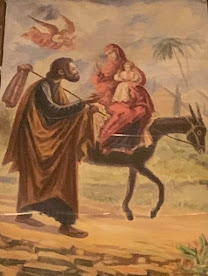
Hieromonk Parteniy Pavlyk's 
the Holy Family's Flight into Egypt
 
In August 1962. on the eve of the Second Vatican Council, a conference was held in Rome to commemorate the tenth anniversary of Exsul Familia. In attendance was Augustine Hornyak, Auxiliary Bishop and soon to be Exarch for Ukrainian Catholics in Britain. The conference and perhaps even more so the papal charter made a  great impression on the freshly-minted bishop, whose flock identified as скитальці or post-war political “exiles.” When seeking financial assistance for a suitable cathedral church, he pleaded with the papal representative in London: “I am asking for a part of the Universal Church of Christ, for an Exsul Familia, which wants to survive here and sustain the ‘Church of Silence’ in our homeland.” After receiving a large subsidy, Hornyak surprised everyone by christening his new cathedral “Holy Family in Exile” after Pius XII’s Apostolic Constitution. The name “Пресвята Родина в Скиталю” was also intended as a reminder to his flock that the Almighty, who had temporarily permitted the Holy Family’s exile, would, one day, allow exiled Ukrainians to return to their own native land.


The year 2022 will mark two important anniversaries: the seventy fifth anniversary of the canonical establishment of the Ukrainian Catholic Church in Britain (3 March 1947), and the seventieth anniversary of Pius XII’s Exsul Familia (1 August 1952). In an introduction contained in its new edition, Professor Andrea Tornielli of Vatican Communications notes that Pope Francis’ teachings on migrants have their roots in Exsul Familia. What many in Rome and elsewhere will be surprised to learn is that a cathedral in London, the spiritual Nazareth of thousands of migrant workers today, stands as a living witness to the first Catholic migrants’ charter.

Monday, 19 July 2021

The Union of Brest at 425


The UNION of Brest (1595–1596) aimed to heal the lack of canonical unity between the Churches. In the spirit of the 1439 Florentine Union, the Orthodox Church of Kievan Metropolia (today's Ukraine and Belarus) sought to rekindle ecclesial union with the Roman Apostolic See. Prominent Roman theologians and curialists made theological, canonical, disciplinary, and liturgical arguments why they should be forced to conform to the prevailing Roman Rite. Instead, Clement VIII achieved an authentic, enduring unity by confirming their ancient customs and particularities. 


Even after the Union, the bishops-delegates were interrogated by curial cardinals as to why they were not wearing the 'proper' vestments. Unity was achieved in diversity, although not all accepted union and "Uniates" were often treated a second-class Catholics.

When Eastern Catholic migrants came to the Americas and western Europe, similar arguments were made, that multiple Rites an Disciplines within the same territory would harm the unity of the Church. Local Roman bishops cited the newcomers' aversion to the majority Rite as proof of the inauthenticity of their Catholicism. They were accused of disobedience, divisiveness, and having schismatic proclivities. One curial cardinal even cited the Fourth Lateran Council.

On closer examination, those fears were more to do with controversies within the local Churches (such as conflicts with Protestants) than going to the peripheries and casting their nets into the deep waters.

Pope Leo XIII (in the 1890s) and Pope Pius XII (after the Second World War) intervened for the marginalised, when the local Churches were too beholden to their own interests to foster unity in diversity. Thus, their names are written in golden letters in the history of the Eastern Catholic Churches.

After 130 years, the Congregation for the Eastern Churches issued a document admitting that earlier curial policies had not properly provided for the early émigré minorities. Significantly, it also admitted that, as a result of those mistakes, 100,000 faithful abandoned the Catholic Communion.

The means used to achieve unity at Brest were far from perfect. Nevertheless, despite every hindrance from tyrants, churchmen, fastidious theologians, and positivist canonists alike, today the Ukrainian Greek-Catholic Church is a Church in its own right (ecclesia sui iuris), with an international hierarchy and more than 6 million faithful on 5 continents. 

Ut unum sint!

Saturday, 8 May 2021

General Pavlo Shandruk to Pope Pius XII

Shandruk in Polish uniform


 Your Holiness! 

            On the solemn day, for the whole world of 80th Birthday Jubilee of Your Holiness,

On behalf of 20,000 soldiers of the 1st Ukrainian Division of the Ukrainian National Army and tens of thousands of their relations, I bend my knee in reverence with deepest gratitude before Your Holiness for having saved those soldiers from certain death.

Those soldiers, and thousands of others of that Division who perished at [the Battle of] Brody were the finest sons of the Ukrainian Nation.

They joined the 1st Ukrainian Division to arm themselves in the hope that, at the opportune moment, they would drive out the old enemy of our beautiful yet somehow unfortunate Ukrainian homeland. And 90% were the flower of the Ukrainian intelligentsia.

 Red Moscow [The Communist Kremlin] demanded their repatriation and the Western Allies, ignorant of the Ukrainian people’s struggle for freedom and independence, were on the verge of handing them over.

At that moment, the one and only hope for us all was the profound faith that only the intervention of Your Holiness could rescue all of those brave patriots. It was with this hope that I, along with delegations from those very soldiers, approached our beloved Prince of the Church, Archbishop Ivan [Buchko], to plead with Your Holiness for help and deliverance.

Your Holiness,

as the Great Patron and Protector of all who are sorrowful and oppressed, You did not refuse His Excellency Archbishop Ivan. We were all saved by the Apostolic See of Your Holiness. And I, their commander, prostrate in filial humility before the Greatest, Worthiest, and Holiest Figure of Your Holiness, we have the greatest honour and good fortune on the day of the 80th jubilee of Your Holiness, to beg the Merciful Saviour and His Most Holy Mother, to bestow endless gifts upon Your Holiness, long life and excellent health for the good of all humanity. All of us without exception will always offer our humble prayers for Your Holiness. We beseech Your Holiness for Your Apostolic Care and intercession before the Throne of the Most High on behalf of our poor humiliated Nation. 

            Prostrate in profoundest respect and endless gratitude          

                        Pavlo Shandruk

Lieutenant-General

Ex-commander of the Ukrainian National Army

May 1956 Anno Domini


Documentation from the reign of Pius XII (1939–1958) was opened to scholars in March 2020. Shortly after this, I discovered an Italian translation of the above letter, made by Archbishop Ivan Buchko, in the Archive of the Congregation for the Eastern Churches. The original letter, written in Ukrainian, was only discovered last month in the Vatican Apostolic Archive.

            Finally, scholars will be able to clarify the role played by the Apostolic/Holy See, through its various officials and representatives, in rescuing the Ukrainian Division from being repatriated to the Soviet Union, as demanded by Joseph Stalin. Several books and many articles have been written on the Division but the role of the Pope and his Curia have hitherto been shadowed in mystery and innuendo, since the relative source documents were not accessible. My friend, Professor Myroslav Shkandrij, will touch on this question in his upcoming book on this controversial topic. 

Buhcko visits the Division 1946

          Bishop Buchko brought the desiderata of Ukrainians refugees to the Pope directly and via his Roman Curia, especially through the Congregation which was then called Pro Ecclesia Orientali (today it is Congregation of the Eastern Churches), headed by the indomitable Cardinal Eugène Tisserant. The refugees included both Catholic and Orthodox Christians, and the Apostolic See assisted all of them without discrimination. Among these was the future Metropolitan Ilarion Ohienko, who requested help with research in Switzerland. Buchko asked Tisserant to intervene and the latter obtained access for Ohienko to the University of Fribourg. In arranging this, Tisserant wrote to the Nuncio in Switzerland, in June 1946: “It is the wish of Holy Father that the Oriental Congregation also takes an interest in the material and moral wellbeing of the Orthodox Bishops, in seeking to help them and to assist them with all their just requests.”

In the Spring of 1945, Bishop Buchko wrote to the Pope, to Cardinal Tisserant, and to Monsignors Montini and Tardini of the Papal Secretariat of State. As a Frenchman in Italy who had made his sympathies clear during the War, Tisserant was highly respected by the victors. He lobbied his Allied political and military contacts and the Papal Secretariat of State, which in turn lobbied Allied authorities all over Europe not to forcibly repatriate Ukrainians to the Soviet Union. The Division was only one among several groups in danger of repatriation. Tisserant also brought the Ukrainians’ appeals to the Pope in an audience of 14 and 28 July 1945 and on subsequent occasions.

On 30 September 1955, a general letter of homage was sent to the Pope by the Association of ex-members of the Division. On 15 June 1956, Buchko entrusted Shandruk’s private letter to Cardinal Tisserant, who sent it to the Pope via the Secretariat of State. At the time, the ex-general was residing in Trenton, Ohio, as indicated on Buchko’s Italian translation of the letter (where he substituted “Trenton” for  “травень” (May) 1956. Buchko also airbrushed himself out and substituted the passages referring to himself with thanks to the Oriental Congregation. Although Shandruk had not made that reference in his original letter, Buchko was aware that, without Cardinal Tisserant’s dogged perseverance (as evidenced by internal notes between Tisserant and his own officials), the papal Secretariat of State would not have intervened so vigorously for the Ukrainian prisoners and refugees. In response, the Pope ordered his underlings to thank the old General and to assure him of the Pope’s enduring concern for the “severely tried” Ukrainian people.

Shandruk in UNR uniform
            
General Shandruk was an Orthodox Christian from Volyn. In the First World War he served as a officer in the Russian Army and later in the army of the Ukrainian National Republic. After the war he continued his association with the UNR in Exile. In 1936, he joined the Polish Army and fought to defend the Second Republic against the German Invasion of September 1939 (for which he was posthumously decorated by the Polish Government-in-Exile, in 1965.) In February 1945, he was appointed commander of  a Ukrainian National Army and was dispatched to Austria to organize the former Galicia Division, for that purpose. On 8 May 1945, he surrendered the Ukrainian Army to the British and American Allies. There has been talk of the intervention of Polish General Anders, but it is clear that Shandruk attributed the salvation of his men, at the most critical moment, to the intervention of the Pope.
 
Shandruk mentioned the papal intervention on p. 291 of his 1959 book Arms of Valor.

Saturday, 17 April 2021

The Jesuit Refoundation of Saint Paul’s in Winnipeg


Saint Paul's at Ellice & Vaughan
An Alma Mater nourishes both the intellectual and the spiritual sides of man. Two of the educational institutions I attended were run by the Society of Jesus, known as the Jesuits. One of the archives which I had always intended to consult was their central archive in Rome, Archivium Romanum Societatis Iesu (ARSI), and last month I had the privilege of doing so. ARSI is well organized and administered and each researcher is assigned an assistant. The organization of the files reveal the top-down military structure of the Jesuit chain-of-command. For instance, the files of the “Vice-Province of Upper Canada” contain scheduled annual reports by superiors, advisory counsellors, rectors, pastors. All of these were sent directly to the General Superior, who made all of the final decisions. 

The building which houses ARSI is also home to a number of outdoor cats, which I photographed through the glass corridors leading from the entrance on Borgo Santo Spirito, about 250 stairs up a hill overlooking the Vatican. Cats and historians are curious creatures. I had gone there to look for documents pertaining to Jesuit missions in eastern Europe. Nevertheless, I also found a letter from the first Archbishop of Winnipeg regarding Saint Paul’s College-High School. My curiosity led me to trace the correspondence to its source. What I discovered was a compelling story of how the Jesuits transformed Saint Paul’s from a failure into a success.

Saint Paul’s College

The Archdiocese of Saint Boniface already had its own institution of higher learning run by the French-speaking Jesuits. Discussions for establishing a college for English speakers began in 1911. In 1915, Saint Boniface was divided in two, with the western portion becoming the Archdiocese of Winnipeg.  In 1926, the first Archbishop, Alfred Arthur Sinnott, founded Saint Paul’s College for his own archdiocese. 

To assume the direction of the College, Sinnott turned to the Oblates of Mary Immaculate (OMI) only after the English-speaking Jesuits declined to take up his offer. As a result of their refusal, he became cold toward the Jesuits, and there was even talk of their leaving Winnipeg altogether. Father Erle G. Bartlett, stationed at Saint Ignatius Parish, helped to heal that rift. Bartlett befriended the Archbishop and encouraged him in his plans to improve the College. 

After five years, the Oblates left and Sinnott entrusted the direction of Saint Paul’s to his diocesan clergy. He also moved it from a modest Selkirk Avenue building to the corner of Ellice Avenue and Vaughan Street, a centrally located campus with large playing fields. The magnificent Manitoba College building had been built by wealthy Presbyterians as a training centre for their ministers. When Presbyterians and Methodists joined to form the United Church of Canada, they pooled their resources at the nearby Wesley College, making Manitoba College redundant. 


William Hingston, SJ
After two years of administration by the secular clergy, the college was on the verge of collapse. The Society of Jesus was famous for its pedagogical skills and organizational methods, which had produced many of the finest universities and schools across the globe. With this in mind, Sinnott wrote to the Provincial Superior of the English-speaking Jesuits (Province of Upper Canada), Father William Hingston (son of the famous physician, senator, and Montreal mayor, Sir William Hales Hingston.) In his letter of April 1933, Sinnott asked Hingston for the Jesuits to assume the direction of Saint Paul’s. He did not hide the fact that the institution was burdened with a large debt ($178,000) but promised that the diocese would help. 

Wealthy hotelier and brewer Patrick Shea had already contributed toward an modern annex to the building, named in memory of his son Paul Ignatius, who had been a student at the Jesuit-run Fordham University in New York. Shea was terminally ill and further benefactions were expected in his will. Sinnott kept pressuring Father Hingston who, looking toward his order’s future, was adverse to refuse a second time and possibly lose their Winnipeg base, “the key to the west and capital of prairie provinces.”
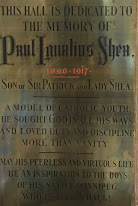
 

from SPHS Archive
Father General advised the Provincial to proceed with caution but the Archbishop, anxious to have the Jesuits assume the administration for the 1933–1934 school year, gave Hingston to understand that they could expect $10,000 annually from the Shea estate. In response to an urgent telegram asking for permission to accept the Archbishop’s offer, on 14 August 1933, Ledóchowski cabled Hingston from Zurich: “affirmative, consultoribus consentientibus (affirmative, with the consent of your council of consulters.” On 26 August, Hingston signed a contract to transfer the administration and property of the College from the Archdiocese to the Jesuit Province of Upper Canada.


Father Holland’s Team


Archbishop Sinnott had wanted Father Bartlett to lead the College but the Jesuit superiors made a careful selection of four priests, each intended to compliment the others. More intellectually gifted, Bartlett was named Dean of Studies. John Samuel Holland, rector of Campion College in Regina, was chosen to be rector of Saint Paul’s. This office also included the responsibility of acting as superior over his four confreres. Joseph McDonald became Prefect of Discipline, and Christopher Keating professor of Philosophy and spiritual director.


While Bartlett and others wrote to the Father General in Latin, Holland addressed his superior in his native English. Holland’s letters to Ledóchowski were atypical among the Jesuits’ reports to Rome. Rather than focusing on the internal aspects of their mission, Holland focused foremostly on people, making them the subject rather than the object. His reports from Regina began by describing the material condition of his flock, expressing concern for farmers’ failed crops and that 75% of the people were living on relief. Yet, even in such dire straits, Holland, a consummate optimist, saw “much to be thankful for.” 

On 12 January 1934, four months after assuming the rectorship of Saint Paul’s, Father Holland penned his first letter to the General Superior:

from SPHS Archive
“I dreaded coming here as rector knowing the conditions that prevailed here during the past two years. The finances were in bad shape as little attention was paid to economy; the studies were greatly neglected though lack of firmness of the part of those in charge and lack of interest on the part of the teachers; and discipline was an unknown quantity. Besides there existed little or no union among the members of the faculty.  Thank God conditions have improved and we are getting along much better than I had anticipated. We have been able to meet our current expenses so far… There is a marked improvement also in the studies but it will take time before the results will be satisfactory…”

At the end of February 1934, the Provincial Superior made his first canonical visitation (inspection) of the College to observe the progress of his confrères first-hand. He had the occasion, in his letter to the Father General of 12 March, not to regret his choice of Holland, whom he described (in Latin) as 

“extremely patient and supremely kind to Ours [Jesuits], to the students and their parents and to the other priest and lay teachers. Because of him, they submitted to the new regime and freely accepted greater burdens than previously. He is sufficiently firm but never excessively nor does he anger easily. The qualities which perhaps he lacks are found in the other Fathers. The Archbishop, who wanted Father Bartlett, now sees the wisdom of the Society in appointing Father Holland as rector.”


The other members of the Jesuit team were also playing essential roles. McDonald “successfully introduced discipline which hitherto had never existed.” A new spirit had begun: “everyone is teaching better, the students are working harder, and this was accomplished by only four Fathers who have already given the College a Jesuit aspect.” This “aspect” included the setting up of a Marian Sodality, the Apostleship of Prayer, and the practice of frequent Communion.

College Debt

In their first year, Jesuits were successful in improving the morale at Saint Paul’s, but financial problems were more difficult to resolve. And Father Hingston would live to regret his words of two years previously:  “Financially the prospect is not exorbitantly rosy… perhaps I should have driven a harder bargain with the Archbishop.” Although the Jesuits managed to reduce expenses and cover expenditures, by frugality and efficiency, the college debt continued to grow. 


Now that the Jesuits had a second mission in Winnipeg, Hingston wanted to give up Saint Ignatius Parish. Holland and his locals confrères opposed this. They warned the Father General that it would be a grave error, since the College needed local friends and benefactors and could not exist as a stands-alone affair. Holland believed that, if the parishioners of Saint Ignatius would take up the cause of the College, their attitude would spread to the other parishes of the Winnipeg Archdiocese.


In the spring of 1935, a loophole was discovered which served as a bargaining tool: Although Sinnott had transferred to college according to civil law, he had failed to secure the necessary approval from Rome, required by Canon Law. Sinnott had sent the request to the Papal Embassy (Apostolic Delegation) in Ottawa which forgot to send it on to Rome. On 4 April, the Father General wrote Cardinal Bilsetti (in charge of the Vatican education department) explaining that Hingston had been remiss about this and other matters, so he sent a priest directly from England to replace him.


In May 1935, the new Provincial Superior, Father Henry Keane, confessed to the Archbishop that the Jesuits would have to withdraw, as they were unable to continue at the College under the current circumstances. Sinnott responded furiously, on 10 June, that he wanted them to fulfil their contractual obligations:


 “I shall be very sorry to see the Jesuit Fathers leave St. Paul’s College, for they have done excellent work and I am much pleased with them. But with regard to the financial situation I have been grievously disappointed.” 


The College’s creditors had forced the Archbishop to pay the interest on one of the loans, and Sinnott demanded a decision from the Jesuits within three weeks.


Keane advised Ledóchowski to obtain Vatican permission to leave the College unless Sinnott helped with the debt. The Provincial did not think the Archbishop would let them go because, as he wrote to the General, “under our direction the College has flourished, the number of students has increased, it recovered its fame, it has achieved successful exam results once more.” 


On 4 July, the General responded to the Provincial that one could manage such a debt under the conditions of the Great Depression and told him to remind Sinnott of his promises of $10,000 annual support. The Jesuits were prepared to remain but not to shoulder the whole debt. Ledóchowski even expressed doubts about civil legalities because, under English Common Law, a contract was invalid if one of the conditions (i.e. annual support) was not met. When questioned, however, Father Hingston was vague about exactly what Sinnott had “guaranteed” in the way of financial support. 


Keane increased the number of priests at Saint Paul's from 4 to 7.   In the meantime, the conflict over the College soured relations between the Archdiocese and the Winnipeg Jesuits. After a year of studies in Montreal, Winnipeg seminarian John Hanley had entered the Society of Jesus. Sinnott subsequently dispatched the bill for Hanley’s studies to Keane, which he was advised to pay without protest by Ledóchowski, so as not to make relations even worse.

On 26 September 1935, the College Rector sent his annual report to the General in which he touched the misunderstanding between the Provincial and the Archbishop. John Holland explained that Sinnott was poor and his cathedral was in heavy debt. The Archbishop was under a false assumption that the Upper Canada Jesuits were wealthy and would take care of the debt. And Father Hingston had been led to believe that the Patrick Shea had made a large bequest to the College. 


Holland identified the root of the problem in the expectations placed upon the Sheas' on-going generosity. He felt that the Archbishop had been too forceful with the Sheas before the Jesuits assumed the college mantle. It was Margaret Byrne Shea, rather than her late husband, who given to charitable works and who had taken an interest in Saint Paul’s. Although she had cooled toward Sinnott, she continued to be close to the Jesuits and promised $25,000 for the College, provided that none of it went to the Archbishop.

A Mistake to Give it up

With the debt looming, the Jesuits had to carefully consider their permanence at the College. In the autumn of 1935, several Canadian Jesuits sent their views to the General Superior. On 26 September, John Holland wrote: 


“The Fathers who are here are all convinced that there is a splendid future for St. Paul’s College and that it would be a mistake to give it up. They are willing to make every sacrifice, as they have been doing, to retain it. … The enrolment has increased considerably this year…The College is becoming increasingly known and especially its reputation for order and discipline being spread. … The Archbishop is very anxious that the Jesuits keep the College. He has been quite pleased with the progress that has been made and  has shown himself ready to help us all he can.”


On 17 November, Father James Carlin, Prefect of Studies, told of Holland’s extraordinary skills: 


“The Reverend Rector shows great wisdom and discretion in all his dealing and due to his untiring efforts, the College is being spoken of most highly by the people of Winnipeg and especially by His Grace [Sinnott].” 


Carlin had a great vision for the College’s future, which included a training centre for Jesuit recruits: 


“To my mind this is the very best opening we have in Canada. We are making every possible effort and sacrifice to finance and we can do so, if given time. … Our affiliation with the University permits a theological faculty with degrees of Divinity. If we established this course we would become the Innsbruck of Western Canada. A Canisianum would prove most popular to the western bishops who are trying hard to conduct small seminaries of their own. The West is our field, if we establish immediately.”


Father Adélard Dugré, the “Assistant” (regional delegate) advised that the Jesuits accept the College but ask for a new contract, freeing them of some of the debt. And, finally, the Apostolic Delegate (papal representative), Archbishop Andrea Cassulo, said that the only way to guarantee a prosperous future for the College would be for the Jesuits to stay with it.


Refinancing and Reconciliation


At the beginning of 1936, the clouds that had been hovering over Saint Paul’s began to clear. In January, the Provincial wrote to the General that Margaret Shea had donated $6,000 to pay off one of the banks. And the Jesuits had succeeded in refinancing a loan, at a lower rate of interest.

In May, Father Keane came from Toronto to make an official visitation. In his report to Rome, he noted that, in spite of many difficulties, the College had increased enrolment and had been successful with exam results and with human formation. In addition, “religious formation and solid teaching of Christian doctrine were constantly required “neque negligatur ad veram et christianam urbanitatem institutio (so that formation of true Christian manners be not neglected) –Letters of Saint Ignatius Loyola, 386.” He believed that “the experiment [of running Saint Paul’s] promises to be a solid success in every way.”

In his 22 May letter to Father Ledóchowski, Father Keane recounted an event incident that had occurred a few days previously. The Jesuits had invited Archbishop Sinnott to lunch and, the following day, Sinnott returned the compliment, after which he had a long conversation with the Jesuit Provincial. The Archbishop behaved very amicably, never waning in his praise for the College and the Jesuits. “Above all, he praised Fathers Holland, Kelly, and McDonald, who had “transformed the students for the better,” which had result in an increase of financial support from their families. These positive results bode well for the College’s future.

Keane was given the opportunity to explain the financial situation, which greatly surprised Sinnott. While the Jesuits were not in a position to pay the debts, the Provincial Superior argued that, given time and with a new loan, they would be able to do so. The Archbishop “begged and pleaded” for the Jesuits not to leave the College, which he characterized as “the greatest misfortune.” As to Vatican permission for the canonical transfer of the institution, Sinnott laughed and said that the matter had been bungled by the Apostolic Delegate. The Jesuits did not need to be concerned because “they cannot refuse to grant it.”

In September 1936, Father Holland sent his annual report to the Father Ledóchowski. Father Carlin’s death had dealt “a great blow to the College,” Holland described his late confrère as “a splendid religious, a capable Prefect of Studies and a tremendous worker.” From his deathbed, Carlin expressed but one regret: that he would not be able to help the College by carrying out his beloved duties. On a positive note, friendly relations with Archbishop Sinnott had been completely restored, as the Rector noted: 


“He has done a great deal for us and he is certainly interested in the welfare of the college. I think that the interview that Reverend Father Provincial had with him during the visitation helped to clear away certain misunderstandings which had existed up to that time.”

Material and Spiritual

Charles Kelly, SJ
The Jesuits had completed their fourth year at Saint Paul’s in 1937. The College had weathered the storm and had begun to really flourish. During the summer vacation, the Rector, the Provincial Superior, Fathers Charles J. Kelly and James.G. McGarry, submitted their reports to Father General Ledóchowski. These touched on three topics: finances, the Archbishop, and the religious community. 


According to these reports, the financial standing was improving and, for the first time, the interest on the loans was paid in full. Over half of the 271 students were receiving discounts, bursaries, or scholarships. Relations with Archbishop Sinnott were very good, according to McGarry, largely “due to the prudence of Father Rector.” Sinnott took an interest in the College and helped in various ways, including a Diocesan collection on Pentecost Sunday, to pay the College taxes. Father Kelly wrote that Sinnott “is more of a help to us than any other Archbishop or Bishop is to any of the other Jesuit Colleges in Canada.” But he was very conscious of his position and dignity: “he wishes all and sundry to realize that he is the Archbishop of Winnipeg.” Sinnott could be impatient but also magnanimous and expected others to show him gratitude.


The internal spirit of the Jesuit community was of primary importance to the order. Indeed, engendering a positive, united, and religious attitude was Holland’s recipe for a successful endeavour. Both he and Keane wrote that the “spirit of observance of the rule, laboriousness, charity, and cooperation abide.” Kelly could not “commend too highly the spirit of charity and piety that marks the life of the Community. … The spirit and mutual trust among the Community at St. Paul’s is noted in this Vice-Province and we wish to keep it that way.” And finally, in his 31 December report, McGarry noted: “Gubernatio hujus domus suavis est, sed non ut in laxitatem labatur. (This community is governed lightly but not in a way that falls into laxity.) Indeed, Holland monitored religious discipline daily so that that Jesuit community life remained a concrete reality. 

Sinnott blesses Shea Hall cornerstone, 1932

Sinnott’s Vision

As its founder, Alfred Sinnott considered Saint Paul’s as his own and the Jesuits his administrative agents. By the end of the decade, the buildings at Ellice and Vaughan had become too small for the needs of a college and high school with resident staff and student borders. In the spring of 1939, Sinnott commissioned an architectural plan for a major expansion which would add additional classrooms and a new dormitory to Paul Shea Hall. Without consulting the Jesuit superiors, he began a fundraising campaign and published a drawing in the Winnipeg Free Press

Father Keane’s successor as Provincial Superior, Father Thomas Mullaly, informed the General Superior that he and his counsellors were opposed to the expansion unless $100,000 could be found to cover the costs. Meanwhile, the Archbishop went to Rome to perform his ad limina visit and to present his plans to the new Pope, Pius XII, and the Roman Curia. First, he met with Monsignor Ruffini of the Vatican education department, then with the Jesuit General, who approved the matter in principle. On 11 June 1939, Sinnott addressed two letters letter to the Pope. In the first letter, he sought the Pontiff’s blessing for the expansion of the College upon which he lavished high praise:


“This College is my joy and my pride. It is now under the care and direction of the Jesuit Fathers and I am thoroughly satisfied with their work. I am wholeheartedly behind them and I will not be content until every Catholic boy under my jurisdiction receives his higher education in this institution.”


The Archbishop asked for the Jesuits be allowed to borrow $100,000 to finance the venture, and the Pope entrusted the matter to his Secretariat of State. On 8 July, Monsignor Giovanni Battista Montini (the future Pope Paul VI) asked the Jesuit General to accede to Sinnott’s desire, provided that he thought it “wise and opportune.”


Meanwhile, the Winnipeg Jesuits came up with a counter-offer. Instead of a large and costly extension, they proposed adding six classrooms which would require only $45,000. Sinnott agreed to the more modest extension and gave his solemn assurance that he would help with fundraising. On 6 June 1939, Father Ledóchowski approved the revised plan after obtaining permission from the Vatican department for religious orders. On 15 July, he informed the Secretariat of State that the matter was arranged, and Montini gave Sinnott the good news on 21 July.


Alfred Sinnott’s second letter to the Pope, presented on 11 June 1939, was also connected with his plans for Saint Paul’s. He was looking for a mark of success and a visible sign that the institution (and its founder) enjoyed papal approval. The Archbishop wrote:


“I crave a mark of benevolence and paternal encouragement that will never be forgotten in the years to come. I ask that Your Holiness will make a gift to the College of an oil painting of the great apostle St. Paul. I do not desire an original, but rather a copy of an existing picture which will be inspiring to the young men who frequent the institution.”


Della Porta's original
A few days after receiving this letter, Monsignor Montini contacted the Director of the Vatican Museums, Professor Bartolomeo Nogara. The latter commissioned a copy by an artist named De Simone, of a painting by Renaissance master, Fra Bartolommeo della Porta. On 1 August, Montini wrote to inform Sinnott that Pius XII had acceded to his request:


“It was with particular pleasure that the August Pontiff learned of the growth of the College and it is His confident hope that this gift which He deigns to bestow at this time,  […] may, indeed, be a source of real inspiration to the students of the College.”


The additional classrooms were completed by the end of 1939. In December, Sinnott sent effusive thanks to the Pope “for the magnificent painting,” together with a notably large “Peter’s Pence” offering for that year. He also agreed to a new contract with Jesuits, which came into effect in April of 1940, in time for his episcopal silver jubilee. 


Even with the additional classrooms, with almost 400 students, Saint Paul’s was outgrowing its downtown campus on more than one level. Father Francis Smith’s report, from the summer of 1938, noted that Holland, who had been marvelous in dealing with the problems of the early years, was lacking a vision for the future. Holland, Kelly, and McDonald were not intellectuals and placed a great deal of emphasis on sporting activities. Also, the students of the High School were excelling at greater rate than those of the College, perhaps because the Rector himself taught the former and subconsciously gave them preference. It was time for a change if the College was to progress. Accordingly, in 1941, Holland was replaced as rector, though he continued to teach in the high school. 

St. Paul's with extended Paul Shea Hall

Abiding Spirit

John Holland had proven to be a second founder of Saint Paul’s. Despite several changes in leadership and personnel, the good spirit which he painstakingly cultivated continued to characterize the College and High School. The reports of visitations from the late 1950s testify to this fact. In 1955, Provincial Superior George E. Nunan, wrote to General Superior Jean-Baptiste Janssens, that: 


“The fidelity of the members of the Community to spiritual duties and their generosity in doing the work assigned them is gratifying. For these divine blessings and that of mutual union, the Community should be thankful to God.” 


And in 1957 Nunan said: “the charity and zeal of the members of this community is remarkable.”


Father St. Clair Monaghan, the principal of the High School, observed that “the spirit of union and religious charity existing in the community is worthy of praise and commendation.” Clemens J. Crusoe noted that “ the community’s spirit of good will and basic contentment is reflected in their work.” In 1958, future librarian Father Harold J. Drake said, “Our community here is considered to be one of the luckiest and happiest ones in the Province.”


In their reports from 1956 to 1958, Fathers Nunan, Crusoe, and Sheridan praised the High School Principal, Father Monaghan, and his assistant, Father Barry Connelly, for their “firmness in direction of studies and discipline.” Father Clarence Lynch, assisted by Jesuit Scholastic (seminarian) John English, had obtained good results with religious sodalities. And Crusoe defined Father Hanley’s course in speech as “outstanding.” Sheridan observed that the boys, who were observing a stricter dress code of jackets and ties, manifested “a more serious approach to studies and a wider interest in things spiritual.” 

Old Wine in New Wineskins

Archbishop Sinnott did not live to see his vision for Saint Paul’s become a reality. In 1954, the year of his death, the University of Manitoba extended an invitation to relocate to its Fort Garry campus, offering cost free land on a renewable 99 year lease. The College would have to find the money to construct a building. After much discussion, in the spring of 1956, the Jesuits accepted the offer.


In order to ensure the future of the College, on 18 May 1956, several Jesuits, led by College Rector Cecil C. Ryan, asked the General Superior for permission to establish a lay advisory board. This was to bring prestige to the institution by the association of prominent citizens, Catholic and non-Catholic alike, from Winnipeg business and professional sectors.  In addition to funds received from private donors, the Province of Manitoba provided $100,000 toward the construction of the new Saint Paul’s.


Cecil Ryan, SJ
In December of 1957, Nunan quoted Sinnott’s successor, Archbishop Philip Pocock, as saying that “the transfer of the College to the university campus is the greatest thing that has happened to the Archdiocese since his arrival.” Construction was on schedule, thanks to the efficient handling of the project by Father Ryan. Father Drake quoted the Archbishop’s words of praise at a clergy dinner, held in January 1958 at the old buildings: “Father Ryan has done a magnificent job of public relations for the College during his term of office, and he wished there was some loophole that would allow an even further extension of that term.” 
In fact, Ryan’s term had already been extended a year to oversee the completion of the new College. The new Provincial Superior, Father George F. Gordon, obtained further permission to delay the announcement of the new rector until after the opening ceremony, because Pocock wanted Ryan remain in office until that event took place. In a report to the General, Gordon described the October 1958 inauguration as “a very notable event in the history of Catholic education in Canada.”


In 1964, the High School relocated to its a new building of its own, taking with it the painting which Pius XII gave Archbishop Sinnott for Saint Paul’s. Originally displayed in the main foyer, it has since been moved to the entrance of the new chapel. Bartolommeo della Porta’s renaissance original has been located in the papal antechamber, the Sala del Tronetto, where it hangs on the oppose wall of the artist's painting of his fellow apostle of Rome, Saint Peter. Documents pertaining to the Winnipeg copy were discovered in the Vatican Apostolic (formerly know as the “Secret”) Archive, only weeks after the papers on Saint Paul’s were unearthed in ARSI.

Father Holland’s Corner

Father Drake wrote that “the story of Saint Paul’s is a good one, and has to be told.” The same goes for the story of its refounder and his Jesuit team. The decision to appoint Holland to lead Saint Paul’s was fortuitous. He began his mission by accompanying young men in a search for wisdom to its Source. And in retirement, he continued to accompany alumni and friends and share news, making use of his prodigious memory. His care for the Saint Paul’s family, past and present, was epitomized in his column, “Father Holland’s Corner.” 

John Samuel Holland ended his earthly mission in November 1987, at his beloved Saint Paul’s. Both High School and College communities prayed over his bones, invoking the Divine Mercy in thanksgiving for his care. Now it is time for us alumni to care for his memory and that of the schools he helped transfigure.


To presume to eulogise one man is to pipe up for a whole generation.
– The Poet Laureate, The Patriarchs, 17 April 2021

A·M·D·G