Showing posts with label Ivan Buchko. Show all posts

Thursday, 7 May 2026

Exiles: Hnizdovsky in the Vatican Archive


Jacques Hnizdovsky is well known among Ukrainian communities on five continents for his delightful engravings and artwork. I have always admired his graphic arts especially his woodcuts of cats and sheep. So, what a delight it was to find him, a few months ago, in the Vatican Archive. I say “find him” because he was not only mentioned in correspondence to the Apostolic See but there is also a sample of his art in the files. 

Since December, I have been working on a project centred around DP (Displaced Persons) that emigrated to western Canada at the end of the 1940s. Among these were a group of Ukrainian Greek Catholic priests with their wives and children. Sometimes they were also preceded or followed by parents and siblings. These families were caught up in the great population displacement that occurred due to invading Soviet and Nazi armies that caused the Second World War. The conflict left destroyed and displaced entire communities, families, and individuals, and ended with the re-drawing of the interwar European national borders. 

The Soviet Union advanced westward to encompass most ethnographic Ukrainian and Belarusian territories. Minorities on all sides of the Iron Curtain were moved and ethnically cleansed to reflect the agreements concluded at Yalta in Crimea between Stalin and the western Allies. Ukrainians who had fled Russian occupation were threatened by the Allies with forced repatriation to the “Soviet Motherland,” which would result in their execution or, at best, imprisonment in the vast Gulag. Even those who had come from Ukrainian SSR most often sought asylum in the West. Such clemency was contingent upon the willingness of western governments to accept these refugees and in their ability to find gainful employment.

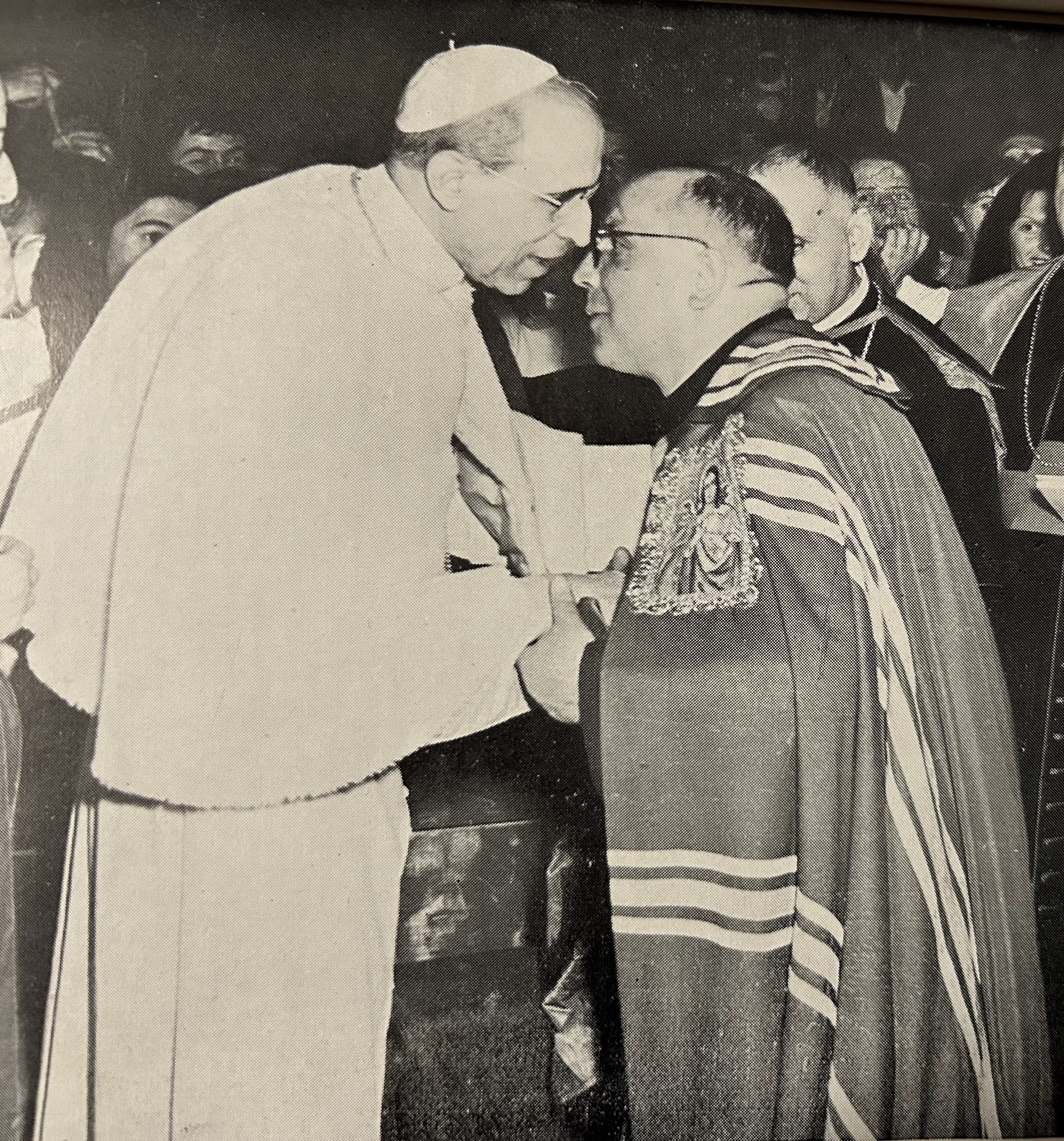
The Auxiliary Bishop of Lviv, Kyr Ivan Buchko, was himself a Displaced Person. He had been stranded in Rome since 1941, when the Nazis refused him permission to return to Lviv from a fact-finding mission in South America. From his residence at the Ukrainian seminary atop the Janiculum Hill, he dedicated himself to the spiritual and material interests of Ukrainian refugees before the Apostolic See (Vatican). At the Vatican’s behest, Buchko founded a Ukrainian Refugee Committee for Italy at the end of the war. A few months later, Pope Pius XII appointed him “Apostolic Visitor” over Ukrainian DPs in Italy and, a year later, to most of the countries of Western Europe. 

Buchko’s first task was to visit DP camps and hostels and establish networks of pastoral ministry in at least eight European countries. He advocated for clergy and laity and succeeded in gaining Vatican aid and assistance for individuals, groups, and funding for various cultural and educational ventures (such as the Shevchenko Scientific Society in Munich and Paris, subsidized entirely by the Holy See). Buchko sought to intercede for each person who approach him for help regardless of their religious affiliations, and a number of Orthodox bishops, clergy, and laity became the recipients of his kindness. Most sought to emigrate from refugee camps to the Americas and Australia. After Kyr Ivan’s jurisdiction was extended to include Germany, he spent three months visiting the camps and hostels in Germany and Austria, from May to August 1948. Upon his return to Rome, he submitted a report on the 700,000 Ukrainians still living in refugee camps of those countries.  

In 1946, in a refugee camp near Munich, 33-year-old Ukrainian artist Yakiv (Jacques) Hnizdovsky attempted to express and remember the life of Ukrainian DPs in a painting which he called Скитальці (Exiles). Lithographs made of the it that same year give the title of the painting in English as "Homeless." This painting came to symbolise the plight of Ukrainian DPs and was eventually reproduced on the cover of CIUS's 1992 The Ukrainian Refugee Experience.

Unable to adequately describe the harrowing life of his fellow countrymen in the camps, Buchko included a coloured lithographic reproduction of Hnizdovsky’s painting. In his letter to the Pope, Buchko also mentioned Hnizdovsky by name. And in a cover letter addressed to Monsignor Giovanni Battista Montini (the future Paul VI), the bishop lambasted the treatment of his people by the I.R.O. and complained that the Holy See was poorly represented at that organization’s headquarters. Both letters, written in Italian, are reproduced here in translation.


Hnozdovsky painting "Exiles"


Bishop Ivan Buchko to Pope Pius XII


Rome, 2 August 1948


A new appeal to Christian charity on behalf of refugees.


Most Holy Father,


Following the august command of Your Holiness given to me at the last audience of 27 July, I take the liberty of reproducing in writing my most humble suggestion regarding the fervent desire of the refugees residing in Germany and Austria, together with their plea that Your Holiness deign to once again direct a paternal appeal to Christian charity on their behalf, and to the extent possible, during this coming October, when the Apostolate of Prayer, in accordance with the intention approved by Your Holiness, will pray for the spiritual assistance of the emigrees.

As an expression of the Ukrainian refugees’ feelings of filial love and profound gratitude to Your Holiness, I have only briefly touched on the misery they endure in the camps, and even worse, outside the camps, as I personally witnessed during the last three months of my Apostolic Visit to Germany and Austria. Among the approximately 700,000 Ukrainian refugees who have so far been unable to emigrate to find a new homeland, work, and peace, it would be difficult for me to attempt to describe the living conditions of the refugees in the camps; indeed, it would be entirely impossible to paint in all their colours their state of mind, their fear, and their desperation. I would like to add here a copy of a painting by a Ukrainian painter, Mr. Jacques Hnizdowskyj, illustrating the life of refugees in the camps in the evening. This painting gives an idea of ​​the common living conditions experienced by the majority of refugees, which have been going on for three years now, and for some of them even twice as long, that is, since 1942, when they were transported to Germany for forced labour. 

It is true that refugees are not allowed to starve, especially those living in camps administered by the I.R.O., from which they earn the bare minimum of a living, but such a life is becoming increasingly unbearable. Thus, as their desperation grows, especially in light of the rumours of impending war, cases of nervous illnesses and complete exhaustion are multiplying, which sometimes end in suicide in those with little religious foundations.

For two years now, the emigration of refugees from German and Austrian territories to Western European countries and the Americas has been ongoing, and this emigration seems to be accelerating in recent times. However, it is a shame to humanity that this so-called “aid” for refugees is not based on the principles of Christian charity, but rather on the principles of commerce, where human feelings are trampled upon. The adapted system is called labour recruitment, under which the agencies of the various countries, under agreements with the employment authorities, have the right to select from among the so-called displaced persons (D.P.s) the most physically fit individuals for physical labour in the given country. It is true that under this system preference is given to single, unmarried people, but it is also true that a large portion of the married people were recruited and left from Germany and Austria, leaving their families in the camps or outside the camps. As a result, there are often cases where the groom or bride, having arrived at their new destination, forget their obligations to the abandoned families and live a concubinary life. Reports from Western European countries (Belgium, England) are very sad in this regard. Recently, the Australian government has been recruiting men to provide labour in Australia under the express condition that the families must remain in Europe until the housing problem in Australia is resolved. There is no doubt that if this system continues – a large portion of the refugee families will be ruined, and the dependents of the migrant workers will be condemned to certain and rapid death in the poorhouses in Germany or Austria.

Of course, the refugee problem is difficult and complicated. It is certain that every government, beyond the desire to come to the aid of the poor refugees, will also have the interests of its own nation before its eyes and consequently has the right to admit individuals into its country whose presence will contribute to the development of that country. It would be asking too much of governments to open the doors of their countries to all refugees, even individuals.

But on the other hand, it is true that the precarious nature of the problem arises from the international situation, and consequently human society should grant refugees unfit for repatriation some asylum and protection combined with humane treatment and stop treating them as objects of merchandise based on the principles of selfishness. The divine commandment to love one's neighbour applies today as it has always applied to every man, including those in government.

An excellent solution to the problem would be to allow immigration from some of the countries where all refugees of one nationality are present. If, however, this solution is not feasible for any reason, the principle of family consideration should be at least unconditionally observed, allowing the recruited worker to take with him all dependent family members—not only the wife and children, but also the parents and minor siblings, both on his and his wife's side. It is absolutely necessary to permanently break the current system of separating family members; a system brutally practiced in the Soviet Union.

It is equally essential to consider the spiritual needs of the recruited worker, ensuring he receives spiritual assistance during travel and at the workplace. Each group of 100 workers should be joined by a priest, if not several members of the intellectual class, to assist the immigrants in their religious and cultural needs. Christian charity will certainly find a way to help the emigration of intellectuals and professionals who are not suited to physical labour, nor will it leave without help the most unfortunate victims of war: invalids, the elderly, widows, orphans.

The refugees are confident that Your Holiness's paternal appeal will awaken Christian consciences and open the hearts of the wealthy to their unfortunate brothers who have lost everything, including their homeland, in order to save their lives and the Catholic faith.

Your Holiness, during my last trip on the Apostolic Visit of the Ukrainians to Germany and Austria, I heard complaints from the refugees that the Catholics of various wealthy countries—especially those overseas—have shown little interest in the matter, compared to the activities of the various Protestant Churches on behalf of the refugees. To dispel these rumours, I would like to suggest one more thing, which, in addition to Your Holiness's Fatherly Message, would also be very effective in sparking the interest of Catholics around the world in the refugee problem, while also bringing great consolation to the refugees themselves. I most humbly ask Your Holiness to convene an international congress of charitable organizations in Rome, together with the Apostleship of Prayer, on the occasion mentioned above, that is, next October, for the purpose of deliberating and seeking ways to resolve the refugee problem according to the principles of Christian charity. 

Prostrate at the feet of Your Holiness, I beg your Paternal Apostolic Blessing for my Ukrainian people, so sorely tried, especially for that portion in exile scattered across almost all the countries of the world, and I profess to be

Your Holiness’ most devoted, most humble, most respected son

+Ivan Bučko, Titular Bishop of Cadi

Apostolic Visitor


Bishop Ivan Buchko to Monsignor Giovanni Battista Montini


Rome, 2 August 1948


Your Excellency,


I humbly beg Your Excellency to present at the feet of His Holiness my attached letter, concerning the refugees’ plea for a new appeal from the Holy Father on their behalf.

            On this occasion, I feel it is my duty in conscience to inform Your Excellency more precisely about the refugees’ complaints, as if the assistance provided thus far by Catholic organizations on their behalf was grossly inadequate compared to the charitable work of Protestant organizations, not to mention Jewish organizations.

I have heard the same objection from Catholic members of the British Military Government in Germany (Colonel Anthony Coventry). In particular, these objections are made against the Vatican Migration Office with its headquarters in Geneva, under the direction of the Most Reverend Father Edward Killion, CSSR. His news of the creation of the aforementioned Office by the Holy See was of great comfort to the refugees, but subsequent realities would have demonstrated that too much trust on the part of the refugees was illusory – these are the words of the refugees who turned to the aforementioned Office in their cases.

I do not know exactly what form the Vatican Migration Office would have, but I could guess that the purpose of creating such an Office would have been close contact with the I.R.O. Headquarters in Geneva, the care of the interests of the emigration refugees, especially in cases of appeal made by a given refugee from the unjust decision of the I.R.O. employees. In Germany and Austria, or in other countries, the majority of whose employees are non-Catholic; there are also pro-Communists among them who dare to insult Catholic refugees. Sometimes their decisions are to the material and moral detriment of the refugees.

It was clear that the Office's primary concern would be to ensure the spiritual assistance of individual groups of refugees traveling as workers both in European and overseas countries, and the I.R.O. refused to transport them if the agencies recruiting the labour force did not consider this, so important in the refugees' lives. Generally speaking, the Vatican Migration Office should have served as the Centre for Emigration Affairs, which operates on-site in the individual military occupation zones of Germany and Austria.

            On my return from my trip, I found myself in Geneva to consult with the heads of the I.R.O. on matters concerning the fate of the Ukrainian refugees. On that occasion, I paid a respectful visit to the Most Reverend Father Killion, CSSR, Director of the Office in question, at his headquarters, namely the Wilson Palace. To be honest, I found this Office very modest, perhaps too much so compared to other similar offices. It occupies a single small room, in which the Most Reverend Father Director works, employing a typist who, in addition, is in poor health and must be absent frequently. From the friendly conversation I had with the Most Reverend Father Director, I learned that, despite his excellent will, he is not capable of attending to and handling all the business assigned to his Office. The very authority of the Holy See, whose name the Office bears, would require the Office to be somewhat more fully equipped. He feels the lack of some employee who could replace him, at least during office hours, when he himself must travel to the headquarters of the I.R.O. Heads.

I humbly ask Your Most Reverend Excellency to accept on this occasion the expressions of my profound veneration and respect, with which I am grateful to be able to reaffirm myself as always,

Your Excellency’s most devoted Servant


[Note: Father Killion and the Vatican representation at the I.R.O. had interceded successfully for Ukrainian refugees on many occasions since July 1947].

Saturday, 20 December 2025

Christmas in Liberated Rome: Ukrainian Allied Soldiers Celebrate in 1945


            Until the twentieth century, the Ukrainian population of Rome consisted in a handful of seminarians and priests who studied at the Greek College. A separate Ruthenian College (as Ukrainians were then known) was founded in 1897. In 1904, its direction was entrusted to Ukrainian priests of the Basilian Order. The College was re-christened Saint Josaphat's in 1932, upon moving to a new building on the Janiculum Hill. At that time, the Sisters Servants of Mary Immaculate took charge of its kitchen. The Basilians transferred their international headquarters from Galicia to Rome and moved into the former college building next to the Church of Saints Sergius and Bachus. 

The few Ukrainian lay people in Rome were mostly political refugees from the failed struggle for independence, or dissidents from the Soviet Union. During the Second World War, the most prominent were: Yevhen and Nina Onatsky and their daughter Nastya, Olha Konovalets (the widow of OUN leader Evhen) and their son Yurko, the mezzo soprano Evheniya Zarytska (Zareska), Professor I. Hrynenko and family, Messers Federonchuk, Kozlovsky, Chernytsya, a student named Shevchenko, the painter Faliev and his wife, Nestor and Ida Small-Stotsky, former UNR diplomat Jan Tokarzewski-Karasziewicz and his wife Oksana, daughter of Oleksander Lototsky.

Bishop Ivan Buchko had studied in Rome before and after the First World War (the seminary had to leave from 1915 to 1920). In 1929, he was named Auxiliary Bishop to Metropolitan Sheptytsky. A decade later, in the summer of 1939, he was dispatched to Brazil and Argentina on an apostolic visitation (fact finding mission). Due to the outbreak of war and ensuing occupations, he was prevented from returning to Lviv. At first, he was assigned to assist the Ukrainian Bishop in USA and serve as parish priest of the floundering Saint George's Parish in Manhattan. There was some discussion of him transferring to Canada to assist an ailing Bishop Ladyka. None of these projects came to fruition as, on denunciations by the Soviet Embassy, US officials deported him. On the morning of 29 November 1941, he arrived in Rome and was given lodgings at Saint Josaphat’s Pontifical College. A bishop in residence made the College a focal point for the Ukrainian colony in Rome. 

The College's Basilian superiors invited the bishop to celebrate a pontifical Divine Liturgy in the College chapel each Christmas Day (25 December according to the Gregorian Calendar). In his journal, Bishop Buchko recorded that in 1941 and 1942 the entire Ukrainian colony of Rome attended this service, despite the fact that most of them were Orthodox Christians. During the dark period of German occupation in 1943, a ray of light shone through. On Christmas Eve the Pope received greetings from the Roman Curia. On that occasion, he conveyed to Buchko a general blessing on all Ukrainians and in particular upon Metropolitan Andrey Sheptytsky in occupied Lviv. The following day, however, only nine members of the Ukrainian colony attended Buchko’s Christmas Liturgy. Some were in hiding, some had left Rome, and Evhen Onatsky had been arrested and was languishing in a German prison.

Most Romans were awaiting the arrival of the Anglo-American forces to liberate the city from the Nazis. Some, however, were a little apprehensive due the Allies war record, and among these was the Spiritual Director of the College, Father Teodoziy Halushchysnsky. Britain and America were known as Protestant countries and were allied with the Catholic Church’s sworn enemy, the Soviet Union. The Allies that destroyed the Basilica of San Lorenzo in 1943 and bombs continued to fall on some civilian areas. In February 1944, the Americans damaged the Papal Palace at Castelgandolfo and destroyed Propaganda Fide’s villa (where many Jews and dissidents had taken refuge). A few days later, they also destroyed the ancient Monastery of Monte Cassino. Some worried that the Allied armies might wreak havoc upon the seat of the Catholic Church. Nevertheless, these apprehensions proved to be unfounded.

The first American battalions entered Rome on the evening of 4 June 1944. Only six days later, the first Ukrainian solider made his way to Saint Josaphat’s College. This was Stefan Fyk of Hamtramck, Michigan, who, before the war, had worked for the American-Ukrainian newspaper Narodna Volya, published in Scranton, Pennsylvania. The following day, 11 June, Sergeant Kulyk from Yorkton, Saskatchewan, paid a visit. His family were Orthodox Christians from Bukovyna. On 18 June, Yaroslav Kolosivsky arrived, and American soldier born in the Ternopil region. He had told stories of Ukrainian bravery and sacrifice in the Allied Forces. He himself had been awarded 3 medals and boasted of how he had painted “The Spirit of Ukrainian Americans” on fighter planes. Only a few years before, Bishop Buchko had blessed his marriage at Saint George’s in Manhattan. Before parting for the Perugia Front, he brought a gift of real coffee for the bishop, who shared it with the College superiors.

More Canadians visited the following month. The first was 47-year-old Flight Lieutenant Andriy Nykoliuk (Anrdew Nikoluk) of Toronto, who came on Sunday, 2 July. Born in the Dolyna district of Western Ukraine, he had served in the Austrian Forces and the Ukrainian Galician Army during the First World War. While stationed in England in 1943, he had been one of the founders of the Ukrainian Canadian Servicemen's Association (UCSA), headed by Flight Lieutenant Bohdan Panchuk. Nykoliuk revealed that 50,000 Ukrainian ethnics had joined the Canadian Forces and 70 had already died in battle to spread freedom throughout the world. Nykoliuk promised to bring the 20 Ukrainians from his own unit to visit Saint Josaphat’s College.

Ten days later, on 12 July, another initiator of the UCSA, Vasyl Kyryliuk (William Kereluk), came to call. Although a Saskatchewan native, his family originated Kitsmanya near Chernivtsi. Bishop Buchko described him as an excellent man, a deeply religious Orthodox Christian interested in church affairs. Kyryliuk was very convivial and remained throughout the afternoon and for supper. The following day, he attended the Wednesday General Papal Audience and then returned to the College. Bishop Buchko was surprised and edified by these young men whom, unlike many other Anglo-American combatants, did not appear to be pleasure-seeking. Instead of frivolities, they sought out the company and conversation of their fellow Ukrainians. Kyryliuk left a monetary gift for Mrs. Onatsky, whose husband was still in German captivity, and for Yurko Konovalets hiding in the French Seminary, whose mother had been arrested by the Americans at the request of the Soviets.

In the following months, Canadian soldiers named Onyschuk, Bendziak (brothers), and Nahirnyi visited Saint Josaphat’s, and Kolosivsky and Kyryliuk made repeat visits. The latter was appointed Liaison Officer with the Soviet Army. On 2 September, he recounted to Buchko of meeting 15 Ukrainian Soviet officers who were, at first, reluctant to speak with him. He gave them copies of the Canadian newspaper Novyi shlyax and encouraged them and others in the Soviet Army to visit the College. Other Ukrainians came to Saint Peter’s but were prevented from attending the Papal Audience by their Russian superior officers.

In September 1944, there were 13,000 Ukrainians in the Polish Corps serving in Italy. Mykola Kulishko from Volhynia called at Saint Josaphat’s College on 10 September. He told of the discrimination against Ukrainians in the Polish Army and confessed that many wanted to transfer to the other Allied divisions. Hryhoriy Sydor, from Vaneva in the Sokal Region, had been deported to Siberia by the Soviets. He visited on 12 September and also spoke of poor treatment in the Polish Corps. Ivan-Isydor Senyshyn had been a Basilan lay brother in Zhovkva and joined the Polish corps when it was reconstituted in the USSR. He stopped into the College on 17 September. The names of Yaroslav Zhaba, N. Sperkach, Mykola Kornuta are also recorded in the college journals. With an influx of Ukrainian soldiers in Rome, two of the College’s doctoral students, Rev. Romuald Rudnytsky and Ivan Bilanych, offered their services as guides.

Complaints from Ukrainian soldiers reached the ears of General Anders and the Polish Military Ordinary, Bishop Gawlina. On 23 October, two officers from the propaganda section of Anders Second Corps, Zielicki and Jerzy Giedroyc, came to discuss the situation with Bishop Buchko, and Bishop Gawlina came himself to call, two days later. Buchko was invited to visit the Polish Army propaganda unit on 26 October. The Poles were courting him as part of a desperate campaign to retain Eastern Galicia and Volhynia in postwar Poland. During these meetings and with Vatican authorities, Buchko lobbied for Ukrainian soldiers to have access to liturgical and spiritual care in their own rite, which was not being provided even by the appointed chaplain.

On 15 November 1944, Andriy Nykoliuk wrote to Bishop Buchko to ask the College superiors to allow the UCSA to hold a Julian-Calendar Christmas celebration (on 7 January 1945) for the Canadian soldiers in Italy. The USCA would provide all victuals and beverages if the Sisters Servants would agree to prepare the meal. A Winnipeg Ukrainian Women’s association had also donated 300 cigarettes. Visiing soldiers began to deliver packages on 28 December. Bishop Buchko also wrote to London to invite UCSA head, Bohdan Panchuk.

On the evening of New Year’s Day 1945, Kyryliuk arrived from Bari. He informed the bishop that not all the Ukrainian Canadians would be able to attend the celebration because many were at the front fighting the Germans. Nonetheless, the Canadian High Command had promised that each attendee would receive a package of food from which the Sisters could prepare the festive meal. 

Despite treacherous snowed-in roads and non-stop rain, on 4 January the invitees began to arrive in Rome. Most took lodgings at pensions and hotels, but seven were put up in spare rooms at the College. The next day, a transport of 5 soldiers arrived, led by Sargeant Tykholis from Welland, Ontario. In the afternoon, a second convoy arrived led by a Sarchuk, a church cantor in Tvey, Saskatchewan, with a lively sense of humour. The last to arrive was Nykoliuk’s transport. The College clergy observed that some of the soldiers spoke Ukrainian “like natives” while others had lost the ability to converse in their ridna mova (mother tongue). 

On Saturday afternoon, 6 January, the UCSA held the inaugural meeting of its Central Mediterranean Branch in the College Recreation Room, adorned for this puroose with a cross, the UCSA symbol, and with Ukrainian and British flags. Nykoliuk was elected President, Mr. Kryschyna of Holden, Alberta, Secretary, and Kyryliuk head of Supervisory Board. Ivan Bilyak and Vasyl Tkachuk of the Polish Corps also took part.

The original plan foresaw a single celebration on 7 January, Christmas according to the Julian Calendar. But as the guests were in attendance for the Gregorian celebration of the Feast of the Theophany on 6 January, the College Superiors and the Sisters decided to prepare them the traditional svyat vechir (Christmas Eve Supper). 

The following day, Sunday, 7 January 1945, the whole Ukrainian colony, 39 Canadian soldiers and several other guests, where invited to the extraordinary Christmas feast, about 90 altogether. The celebration began with a Pontifical Divine Liturgy celebrated by Bishop Buchko and the College superiors, followed by Panakhyda for the fallen Canadian servicemen and women. Rev. Ivan Radio of Northampton, Pennsylvania, heard Confessions throughout and helped distribute Holy Communion, while the service was photographed by Captain Williams. 

Carols were sung during the luncheon of traditional Ukrainian dishes, including pyrohy (varenyky) and holubsti, prepared by the Sisters Servants of Mary Immaculate. At the head table, to the right of the bishop sat Captain Davidson from Pennsylvania, Captain Williams, Vasyl Kyryliuk, and to his left British Major Edward Sedgwick, Andriy Nykoliuk, Father Dionisiy Holovetsky (the interim Basilian Superior), and the College Spiritual Father, Teodoziy Halushchynsky. At the second table were the College Rector, Father Josaphat Labai, and other clerics. Members of the Ukrainian colony sat with the Canadian soldiers which included a Kovalsky from Winnipeg, Tykholis, Sarchuk. Petro Bohun from Habsburg, Alberta, Mykhaylo Nepypilo from Edmonton. Two Scotsmen, their transport drivers, were also included. 

Bishop Buchko welcomed the soldiers in broken English and speeches were given by Fathers Holovetsky, Father Labai and Yuriy Mylanyk. Of the soldiers, Kyryliuk, Nykoliuk, Davidson, Williams, and Sedgwick spoke. Olha Konovalets, Professor Hrynenko, and Nestor Smal Stocky brought good wishes from the Ukrainian colony. The luncheon lasted from noon until 4:00 P.M. In his journal, Buchko recorded that he had contributed financially toward food and drink because nothing was too good for the Canadians “who were to have been be my flock.” For in 1928, he had turned down the appointment as Bishop for the Ukrainian Catholics of Canada.

Kyryliuk was given a festive send-off from the College on 10 January 1945. He and Nykoliuk were so moved by the welcome and hospitality that they wrote to thank the Eastern Congregation which was responsible for the College. Subsequently, Nykoliuk sent cigarettes and conserves which the Bishop distributed among the Ukrainian laity and clergy.

Those soldiers that had not been able to participate in the Christmas festivities visted the college in the days and months following. Among these were Flight Lieutenant Sushko (son of Professor Oleksander), Dmytro Kostiv from Brooklyn, Petro Zatsny and Petro Restefaniv from Manitoba, Ivan Bayrak, Antin Senyk of Edmonton. Polish soldiers also visited including Ivan Danyliv, Yustyn Basiuk, Bohdan Sperkach, Mykola Kulishko, Lev Terletsky, Mykola Malytsky, Mykhaylo Koza, Teodor Burnyak, Yaroslav Shpikula, Oleksa Storozhynsky, and Oleksa Mostovy, Buchko’s minor seminarian future and the choir director in London, England, and Calgary, Alberta. Some made their Confession and asked for the Bishop’s blessing before returning to the frontlines.

After this brief period of celebration, a terrible crisis manifested itself as Ukrainian displaced persons began to arrive in Italy without lodgings or means of support. On 31 May 1945, Bishop Buchko established the Relief Committee for Ukrainian Refugees assisted by the staff of Saint Josaphat’s College, other Basilian and secular priests, and prominent members of the Ukrainian colony. 


Tuesday, 18 March 2025

Pius XII Against Forced Repatriation


Letter of Bishop Ivan Buchko to Pope Pius XII

Pax Christi in Regno Christi!

Rome, December 16, 1945.

Most Holy Father,

prostrate at the feet of Your Holiness, I humbly implore Your most benevolent paternal intercession with the American military authorities in Germany on behalf of the Soviet Ukrainian refugees, who, despite repeated assurances given by the aforementioned authorities that they will no longer be subject to forced repatriation, are being forced in these very days to that unwanted repatriation on the basis of an order given to all refugees of former Soviet citizenship, who are in the American occupation zone, to move by the 8th of December to concentration camps under Soviet command in Neunkirchen and Stuttgart and to surrender themselves into the hands of the Bolsheviks. Today, within the  hour, I received an urgent telegram from the Ukrainian Aid Committee in Malines, Belgium, which informed us that 22,000 (twenty-two thousand) refugees are threatened with forced repatriation, to whom the American command has already refused to give food and lodging in the American camps. The recalcitrant Ukrainian refugees, refusing to surrender to the Soviet command and preferring death, have asked for 15 days of delay or postponement to be able to prepare for a Christian death. The postponement was granted by the friendly officials but the deadline expires on the 23rd of December. In the meantime, refugees in the Hannai camp, refusing to be transferred to the Soviet camps in Stuttgart and Neunkirchen, have committed suicide. Those who are still alive have only hope in the paternal benevolence of Your Holiness, whose powerful intercession and most benevolent paternal protection could still save their lives. On behalf of those unfortunate beings, as a most humble son of Your Holiness, I have permitted myself to submit before the feet of Your Holiness this my most humble supplication, imploring at the same time for them and for myself the most benevolent paternal Apostolic Blessing.

 Audience of Cardinal Eugène Tisserant with Pope Pius XII

Msgr. Bučko informed the Sacred Congregation that he had humbly placed in the hands of the Holy Father through His Excellency Msgr. Montini a petition aimed at obtaining the intervention of His Holiness with the American authorities in order to prevent the forced handover to the Soviets of 22,000 Ukrainian refugees from their zone of occupation, a handover that would be carried out despite the assurances given to the contrary.

The Sacred Congregation is profoundly grateful to the Holy Father for all that has already been done and will be done to avoid the forced repatriation of those refugees, who prefer death by suicide to handover to the Soviets.

Ex audientia Sanctissimi 22 December 1945

The Holy Father expressed His desire to see all Ukrainian refugees spared and to assist them in every way.

Saturday, 30 July 2022

Coventry Ukrainian Catholic Church at 60


Timeline by Bohdan Mandziuk
It has been a very traumatic year for Ukrainians worldwide. A number of celebratory events had to be postponed after Russia’s war in Ukraine intensified, in February. Communities and organizations across the globe focused on aid to Ukraine and welcoming refugees. Some were still able to commemorate significant milestones in their histories. A stained-glass window remembering Ukrainian-Canadian servicemen and women in Britain was hallowed at St. James's, Sussex Gardens, in London, on 8 May 2022. As well, the Ukrainian Orthodox Church in Bradford marked their 70th anniversary. Today, I discovered that St. Volodymyr’s Ukrainian Catholic Church in Coventry is also marking their  60th on Sunday, 31 July. As a tribute to my dear friends from that community, I thought to compose a brief history of this church, taken mainly from my manuscript of the History of UGCC in Britain “This Family in Exile”, which is currently in editing.

Following the Second World War, 30,000 Ukrainian Displaced Persons immigrated to the United Kingdom and were settled in 500 towns, cities, refugee and workers' camps across the country. About two-thirds were Greek-Catholics from Western Ukraine (Galicia). Church authorities dispatched missionary clergy to serve the scattered flock and Bishop Ivan Buchko (Archbishop from 1953) was given jurisdiction over them, as well as all Ukrainian DPs in Europe.

As the refugees were scattered in hundreds of settlements, the clergy had to set up missionary bases, from which they could travel to the surrounding settlements. Six pastoral zones were established at the end of 1947, each served by two priests. They were re-divided into seven zones in May 1949. At first, Coventry was served from Ely because a larger number of refugees were located in camps and hostels in Cambridgeshire. The first priest to serve that area was Father Josaphat Jean. In a letter to Archbishop Godfrey of 22 August 1947, he mentioned Coventry among the places where the faithful were located. Jean was assisted by Father Modeste Gnesko, in the Summer of 1948, and then by Father Petro Diachyshyn, who visited Coventry and 26 camps and hostels, from March to April 1949.

With the arrival of more clergy, the pastoral zones were modified again in August 1949. Father Emanuil Korduba was transferred to Coventry, which was quickly becoming a Ukrainian centre. He was given charge over Essex, Hertfordshire, Bedfordshire, Northamptonshire, Warwickshire, and Worcestershire. Korduba was assisted by Father Yuriy Spolitakevych. When hostels in Cambridgeshire, Norfolk, Suffolk, and Essex were closed, two priests were no longer needed in the area. In September 1950, Korduba was transferred to Manchester. Spolitakevych and Diachyshyn volunteered for a mission in Australia, and newly-ordained Father Mykola Matychak was sent to Coventry in January 1952. Matychak changed his base to Wolverhampton in 1953 and was assisted in Coventry by Father Petro Lisovsky. In November 1954, Father Stefan Vivcharuk, who had been serving in Paris, took over the Coventry pastoral zone but made his base in Birmingham. Four years later, some of his territory was included in a new Bedford pastorate, assigned to Father Ivan Hasiak. For three months in 1959, Father Alexander Baran assisted Vivcharuk while waiting to emigrate to Canada. Father Volodymyr Dzioba replaced Vivcharuk in December 1962, when the former was appointed chancellor.
          
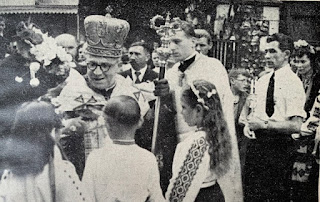
Archbishop Buchko, Coventry 1956
In the 1950s and 1960s, Ukrainian religious leaders visited Coventry: Mitrat Malynovsky assisted with Lenten Confessions in March 1951. Archbishop Buchko made a first brief stop to Coventry on 18 July 1952, and a solemn visitation was organized in July 1956. After the formation of the Apostolic Exarchate, the new Vicar General, Paul Maluga, visited and preached a mission from 13 to 16 March 1958. Bishop Augustine Hornyak visited in 1962, 1965, 1969. Missions for the twentieth and twenty-fifth anniversaries of UGCC in Britain were preached by Basilian Fathers Maksym Markiv, on 22 May 1967, and by Athanasius Pekar, on 25 November 1972. The most important visit to the congregation occurred on 22 May 1970, when Cardinal Slipyi (known as Patriarch Yosyf from 1975) visited and celebrated the Divine Liturgy.

Ukrainian Catholics in Coventry first worshipped at Christ the King RC church in Coundon. In 1948, Canon Raymond Walsh welcomed them to Saint Elizabeth RC church. After his appointment, the lively Father Vivcharuk began looking for a larger building for worship. In January 1956, he acquired a new domivka: a church residence and national home at 482 Foleshill Road. This building was blessed and opened by Archbishop Buchko in July.
Vivcharuk’s ambitious projects were aided by Vicar General Maluga. At a meeting in February 1961, Maluga told the assembled clergy that they needed to increase collections in order to acquire new church buildings in Nottingham, Coventry, and Bolton. In August of the same year, Cardinal William Godfrey, the first apostolic Exarch for Ukrainians, made a token monetary contribution toward the purchase of a temporary church for Coventry.
In July 1961, Father Vivcharuk acquired land at Broad Street and Stony-Stanton Road complete with an old wooden Methodist hall. The first church house was sold while the Methodist hall was repaired and turned it into a “temporary” church, until the congregation could raise funds to build a new structure. The church, rechristened Saint Volodymyr the Great, was blessed by Bishop Hornyak on in March 1962. At the same time, a mosaic icon of Our Lady of Perpetual Succour was installed Saint Elizabeth’s, bearing the inscription: “Gift from Ukrainians of Coventry in thanksgiving for use of Church of St. Elizabeth 1948–1962.” A plan to build a new church in the Hutsul style (Vivcharuk was a Hutsul) was never brought to completion.
            In the 1950s, Coventry became one of most vibrant Ukrainian communities in Britain. The Ukrainian Catholic congregation, numbering 700, began to increase as Ukrainians from Wales and Northern England settled in town. In 1953, the first branch of Brotherhood of Our Lady of Perpetual Succour (OLPS) was established by visiting Redemptorist missionary, Bohdan Kurylas. Members of this confraternity undertook to care for the church and clergy residences, and also took part in church singing and carolling. In the 1950s, other chapters were set up in larger centres, such as Edinburgh and Bradford, due to the efforts of energetic pastors. With the arrival of Father Maluga, the brotherhood became active in organizing church events. Coventry OLPS hosted a reception for the parish praznyk of the Protection of the Mother of God, on Sunday, 18 October 1959. During Maluga’s tenure, Coventry was considered one of the most vibrant branches.
Coventry’s other Ukrainian organizations were also very active. Among these were: a male Choir, Verkhovyna, under the direction of Marian Kostiuk (1926-2000), which performed across the country; drama and dance troops; and a Saturday school, with qualified teachers. Kostiuk’s choir sang the responses at a Divine Liturgy on 24 May 1959, at the Ukrainian church in Saffron Hill, London, in the presence of Exarch Godfrey. They also sang at a commemorate concert in Godfrey’s honour, held at Westminster Cathedral Hall. Verkhovyna sang the Divine Liturgy celebrated at the Lourdes Grotto of Hednesford Shrine, during the annual Ukrainian pilgrimage in July 1961. Over a thousand Ukrainians attended. On 30 June 1968, the choir led one of the Divine Liturgies during the opening ceremonies of the Cathedral of the Holy Family in Exile. Kostiuk emigrated to Australia in 1975, where he continued to establish and work with Ukrainian community choirs.

Cardinal Slipyi, Coventry, 22 May 1970


Monday, 20 December 2021

Exsul Familia – A Family in Exile


Last August, a 68-year-old document was extracted from decades of dust into the light of the present and republished in Italian by the Vatican press. It was Pius XII’s Apostolic Constitution, Exsul Familia Nazarethana, or the Nazarene (Holy) Family in Exile, first issued on 1 August 1952. 

An Apostolic Constitution is the most solemn form of legislation issued by the popes, in the form of a bulla (led-sealed parchment). The background to this was that the Second World War had forced 12.6 million displaced persons (DPs) to seek refuge in various western European countries. Over 3 million of them were Ukrainian. These refugees asked to be ministered to by clergy that spoke their native languages and understood their customs and cultures. Many bishops asked Rome to issue guidelines, the result of which was the first systematic reflection on human migration in the papal magisterium.

Pius XII noted that displaced persons lose much of their security and human dignity, and help up the example of the Holy Family from Nazareth (Jesus, Mary, and Joseph) as an example for migrants of every age. The document also outlined the nature and extent of papal charitable works in favour of millions of DPs, during and after the war (from which Ukrainian religious and cultural entities also benefited). It called for greater, more specified pastoral care of refugees, mandating that ethnic, linguistic, and ritual traditions be supported by local Catholic hierarchs. For its extensive substance and provisions, Exsul Familia became known as the magna carta of migration.

The papal charter was also significant for offering a reflection, not merely on the migration of ethnicities, but also of rites. It provided indications on how the powerful Latin Church should deal with the smaller, more vulnerable Particular Churches. Bishoprics established in the twentieth century for Byzantine-Rite Catholics in Canada, USA, Brazil, and even Italy, were cited as examples of papal solicitude. For the Ukrainian Catholic Church, which had been violently suppressed by the Soviets in countries within their “sphere of influence,” this confirmed the pope’s promise to protect it and restore it in the lands of immigration.

The teaching of Exsul Familia was supposed to serve as a buttress against resourceless Eastern Catholics being forced to assimilate to predominant Latin Rite in their countries of refuge. It was also expected that that Eastern-Catholic missionaries would henceforth be given a freer hand by local Latin hierarchs. Surprisingly, the opposite happened. Exsul Familia laid down principals but its implementation had been entrusted to Roman Curial department known as the Consistorial Congregation. The juridical norms issued by that department replaced existing apostolic visitations to ethnic and linguistic groups with priest-delegates responsible to the Consistorial.


From the moment these norms appeared, diocesan functionaries began to question the authority of Archbishop Ivan Buchko, the Apostolic Visitor for Ukrainian Catholics, who had been granted direct authority over the clergy and faithful throughout western Europe. The wording of the norms made it appear that the papal constitution had also supressed Buchko’s jurisdiction. Chancery functionaries told Buchko’s officials that they would have to apply to become ethnic delegates under Latin diocesan structures. Buchko appealed to the Congregation Pro Ecclesia Orientali to resolve the issue. On 16 November 1953, that Congregation's head, Cardinal Eugène Tisserant, addressed an official letter to Archbishop Buchko, clarifying that Exsul Familia and its accompanying norms did not pertain to the Eastern Rites. 

The Latin Particular Church has long had issues with ritual and spiritual diversity within the Catholic Communion and, historically, has very often mistaken itself to be the unique expression of Catholicism. Having experienced this first-hand, at home and in exile, Buchko acted quickly to have more permanent structures put in place. Following the Exsul debate, he petitioned the Oriental Congregation replace his visitation with apostolic exarchates. These were indeed established: in Britain, in 1957; in Germany, 1959; and in France in 1960. 


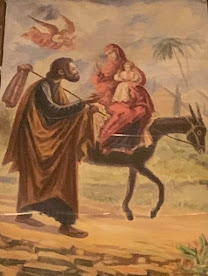
Hieromonk Parteniy Pavlyk's 
the Holy Family's Flight into Egypt
 
In August 1962. on the eve of the Second Vatican Council, a conference was held in Rome to commemorate the tenth anniversary of Exsul Familia. In attendance was Augustine Hornyak, Auxiliary Bishop and soon to be Exarch for Ukrainian Catholics in Britain. The conference and perhaps even more so the papal charter made a  great impression on the freshly-minted bishop, whose flock identified as скитальці or post-war political “exiles.” When seeking financial assistance for a suitable cathedral church, he pleaded with the papal representative in London: “I am asking for a part of the Universal Church of Christ, for an Exsul Familia, which wants to survive here and sustain the ‘Church of Silence’ in our homeland.” After receiving a large subsidy, Hornyak surprised everyone by christening his new cathedral “Holy Family in Exile” after Pius XII’s Apostolic Constitution. The name “Пресвята Родина в Скиталю” was also intended as a reminder to his flock that the Almighty, who had temporarily permitted the Holy Family’s exile, would, one day, allow exiled Ukrainians to return to their own native land.


The year 2022 will mark two important anniversaries: the seventy fifth anniversary of the canonical establishment of the Ukrainian Catholic Church in Britain (3 March 1947), and the seventieth anniversary of Pius XII’s Exsul Familia (1 August 1952). In an introduction contained in its new edition, Professor Andrea Tornielli of Vatican Communications notes that Pope Francis’ teachings on migrants have their roots in Exsul Familia. What many in Rome and elsewhere will be surprised to learn is that a cathedral in London, the spiritual Nazareth of thousands of migrant workers today, stands as a living witness to the first Catholic migrants’ charter.

Friday, 2 July 2021

Ukrainian, Canadian, British Sources in Vatican Archives 1939-1958


In 2020, for the first time time in 22 years, I was unable to access the Vatican Apostolic Archive due to COVID lockdowns and restrictions. I was consoled by the fact that the Archives of the Congregation of the Eastern Churches and the Secretariat of State (Second Section) found a place for me. At the beginning of 2021, I visited ARSI, the Jesuit General Archives, and received bookings for the Vatican Apostolic Archive through to its summer closure, at the end of June. 

            During this period, I have gained great satisfaction in discoveries from several archival fonds for the period of 1939 to 1958. Among these “sub-archives” are: Secretariat of State (Internal Affairs); Nunciature (Apostolic Delegation) in Great Britain; Pontifical Household (Papal audiences); Nunciature (Apostolic Delegation) in Canada.

            What follows is a selection of some of the most interesting finds, some of which have or will be turned into individual articles, or have been included in ongoing projects:


1917: After the disestablishment of the Russian Orthodox Church and its well-funded international missions, several priests petitioned Bishop Nykyta Budka to become Greek-Catholics. Panteleimon Bozyk, author of the famous polemical history, Churches of the Ukrainians in Canada, was received in 1924. Father Stefan Oliynyk’s father, who had been the Orthodox priest in Smoky Lake, Alberta, was received in 1946. Their sons, Vladimir Bozyk and Gregory Oliynyk, became priests of the Archeparchy of Winnipeg. Upon his passing, Monsignor Vladimir Bozyk bequeathed a substantial grant for the use of Ukrainian Catholic education. 


1917 August: Metropolitan Sheptytsky wrote to General Superior, Father Włodzimierz Ledóchowski, proposing that the Jesuits set-up a Byzantine-Rite branch. This was implemented a few years later. During the Second World War, missionaries Jerzy Moskwa, Viktor Novikov, Walter Ciszek, Pietro Leoni and others sent reports to the Jesuit Generalate. By 1957, a conflict arose between veteran missionaries and the younger professors in Rome, over how “native” the Russicum had gone in its attitude towards Russian Orthodoxy. This gave rise to a conflict between dicasteries of the Roman Curia.


1918 July 16: From Hafford, Saskatchewan, Bishop Budka telegraffed the Apostolic Delegation in Ottawa on the day he was released from false arrest. Apostolic Delegate Pietro Di Maria asked Archbishop Alfred Sinnott of Winnipeg to help defend the bishop.


1922 March: Bishop Budka interceded for the Yorkton Redemptorists in a conflict with the Brothers of Christian Schools, who were administering St Joseph’s College in Yorkton, Saskatchewan. The conflict threatened to shut down the entire Eastern-Rite Redemptorist apostolate in Canada, which Budka said would be a disaster for the Ukrainian Greek-Catholic Church. 


1942: Bishop Ivan Buchko brought Father Myroslav Ivan Lubachivsky to Rome from Switzerland, for specialized biblical studies. The published index of the Nunciature in Italy lists him as "of Polish nationality," without further qualification.


1940–1950: In London, England, Vladimir de Korostovets and Danylo Skoropadsky informed the Aposotlic Delegate on Ukrainian issues. The result was that Archbishop William Godfrey was informed and well disposed to Ukrainian DPs and helped establish the UGCC in Britain. Godfrey also intervened vigorously with the Home Office to stop them being deported. A decade later, he was well prepared to accept the mantle of Apostolic Exarch for Greek-Catholics.


1943 December: Apostolic Delegate Antoniutti gave a dispensation to Martin Thomas Demetrius Greschuk to become an eparchial seminarian, since he had been a novice with the Brothers of Christian Schools. Greschuk went on to become auxiliary bishop and later eparch of Edmonton, Canada. 


1945 July 12: Danylo Skoropadsky wrote to his mother on learning of his father Pavlo’s death. The letter was entrusted to Apostolic Delegate Godfrey in London, but does not seem to have been sent.


1945 August 3: Pius XII received Bishop Buchko with Canon Yustyn Hirnyak and journalist Roman Holiyan, who were assisting Ukrainian refugees in Germany, Austria, and Italy. Hirnyak later served in Britain and USA.


1947–1950: Vladimir de Korostovets intervened with the Apostolic Delegate in London, and the Nuncios in Ireland and Vienna, until he was able to secure the repatriation of Gertrud von Habsburg and her children Claudia and Maximillian. They were accompanied by de Korostovets’s wife Alexandra (Ara) to safety in England and Ireland. They had been living in fear after the kidnapping and deportation of Wilhelm von Habsburg (Vasyl Vyshyvany) in August 1947.


1948 January: Rumours that HM Government was considering Catholic bishops to be members of the House of Lords. Cardinal Griffin and Archbishop Godfrey thought it might lay the hierarchy open to political partisanship. Pius XII and the Secretariat of State maintained an open attitude, awaiting a concrete proposal which never materialized.


1948   Retirement of W.L. Mackenzie-King and succession of Louis St Laurent as PM of Canada. Constitutional evolution was taking place with the Canadianization of the monarchy, and projects for a Canadian flag and anthem. Diplomatic relations between Canada and the Holy See were not initiated by the Catholic PM, who feared it would further divide the country, due to ongoing Protestant prejudice.


1949 April: After Newfoundland joined Canada, the Apostolic Delegate suggested reducing the number of Anglophone ecclesiastical provinces, placing the Archdiocese of Winnipeg under the historic Metropolitan See of St. Boniface. The previous year, the single Ukrainian Exarchate had been reorganized and divided in three. It became a metropolitan ecclesiastical province of its own in 1956.


1949: MP Jean Lesage made a speech in Parliament on the proposed UN declaration of Human Rights. He repeated MP Pinard’s statement that all rights and liberties come from God, which is based on the healthy philosophy of Saint Thomas Aquinas. “This remains the Christian foundation of the principles of our democracy.”  


1950: Archbishop Ladyka’s health began to deteriorate and he spent many months at Mundare Hospital in 1942, 1945, 1950. He received auxiliary bishops in 1943 and 1948. In 1950, his Mundare advisors convinced him to petition for Bishop Savaryn to be appointed administrator. Instead, Father Maxim Hermaniuk was named auxiliary bishop, vicar general, and later apostolic administrator and eventually his successor.


1951 June: the episcopal consecration of Maxim Hermaniuk took place during a Congress in Winnipeg which had been posponed the previous year due to the Winnipeg Flood. The packed weekend included the opening of the new Cathedral of Saints Volodymyr and Olha. The event were attended by over 7,000.


1951 November: Princess Elizabeth left Canada for USA as “Princess of Canada.” In Washington D.C., She received the US President not at the British but at the Canadian Embassy. At Her accession the following year, Elizabeth was the first sovereign to be proclaimed “Queen of Canada.” Other former dominions (realms) followed suit.


1953: The OSBM General Chapter agreed to found a minor seminary for the 4 Canadian exarchates in Edmonton for 100 students, grades 7-12. The project was cancelled due to a conflict with Bishop Savaryn. The Ukrainian Redemptorists established the minor seminary in Roblin, Manitoba, and the Basilians opened a high school in Toronto.


1954 October 6: Cardinal Griffin declared that “the Wembley pageant and crowning [Marian Year] was one of the greatest functions held in this country since the reformation.”


1954-1958 Letters and telegrams of homage to Pius XII were sent by Orthodox and Catholic Ukrainians including: Father Mykola Matychak on behalf of Scottish Ukrainians, Professor Ilarion Holubovych on behalf of Ukrainians in the Potteries and the Ukrainian Press Association, General Pavlo Shandruk, the Ukrainian Women’s Exposition Committte of New York, “Obnova” Ukrainian University Students of Canada. John Kozoriz of the Ukrainian Catholic Council and Mary Wawrykow, Nell Kozoriz, Pauline Konofall, Marge Orobko of the Ukrainian Catholic Women’s League of Canada.


1955 March: Cardinal Griffin considered issuing a statement when the UK had decided to manufacture the hydrogen bomb. This was in line with Pius XII's discourse to the Eighth Assembly of the World Medical Association. He also hoped to enlist the Scottish, Irish, and Australian Catholic Hierarchies. During the war, he had attempted to issue a joint statement with the American bishops against indiscriminate bombing, but Cardinal Spellman replied: "For views on bombing, see my book, Action this Day." On Sunday, 13 March, British bishops delivered sermons in their cathedrals on the Basis of Peace, cautioning against nuclear weapons.


1956 May: Ronald Knox had once been proposed as a titular bishop by Cardinal Griffin. In 1952, an enthusiastic layman proposed he be named cardinal. In May 1956, Apostolic Delegate O’Hara suggested Knox again but Griffin said he could not take the responsibilities of an auxiliary bishop, as he preferred a private life of scholarship. Instead, the Cardinal asked for Monsignor Derek Worlock, but the process was never completed due to Griffin’s untimely death, in August of the same year.


1958 September 15: Pius XII consented to have the Ukrainian Bandurist Capella, on tour in western Europe, perform before him at Castel Gandolfo. The majority of its members were Orthodox Christians who had been forced to flee Stalin’s utopia. In the meantime, the Pontiff died.