

Jacques Hnizdovsky is well known among Ukrainian communities on five continents for his delightful engravings and artwork. I have always admired his graphic arts especially his woodcuts of cats and sheep. So, what a delight it was to find him, a few months ago, in the Vatican Archive. I say “find him” because he was not only mentioned in correspondence to the Apostolic See but there is also a sample of his art in the files.
Since December, I have been working on a project centred around DP (Displaced Persons) that emigrated to western Canada at the end of the 1940s. Among these were a group of Ukrainian Greek Catholic priests with their wives and children. Sometimes they were also preceded or followed by parents and siblings. These families were caught up in the great population displacement that occurred due to invading Soviet and Nazi armies that caused the Second World War. The conflict left destroyed and displaced entire communities, families, and individuals, and ended with the re-drawing of the interwar European national borders.
The Soviet Union advanced westward to encompass most ethnographic Ukrainian and Belarusian territories. Minorities on all sides of the Iron Curtain were moved and ethnically cleansed to reflect the agreements concluded at Yalta in Crimea between Stalin and the western Allies. Ukrainians who had fled Russian occupation were threatened by the Allies with forced repatriation to the “Soviet Motherland,” which would result in their execution or, at best, imprisonment in the vast Gulag. Even those who had come from Ukrainian SSR most often sought asylum in the West. Such clemency was contingent upon the willingness of western governments to accept these refugees and in their ability to find gainful employment.
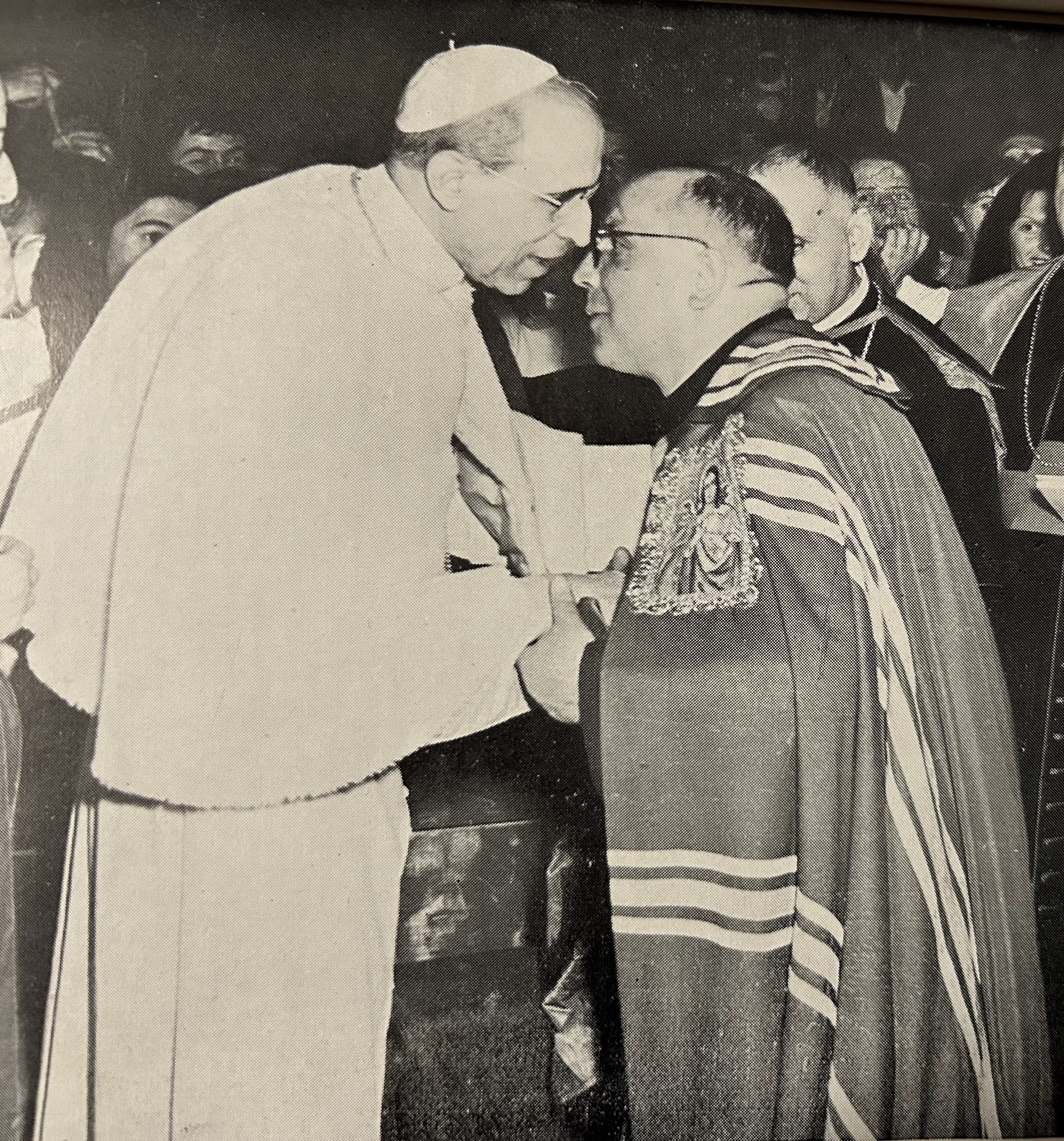
The Auxiliary Bishop of Lviv, Kyr Ivan Buchko, was himself a Displaced Person. He had been stranded in Rome since 1941, when the Nazis refused him permission to return to Lviv from a fact-finding mission in South America. From his residence at the Ukrainian seminary atop the Janiculum Hill, he dedicated himself to the spiritual and material interests of Ukrainian refugees before the Apostolic See (Vatican). At the Vatican’s behest, Buchko founded a Ukrainian Refugee Committee for Italy at the end of the war. A few months later, Pope Pius XII appointed him “Apostolic Visitor” over Ukrainian DPs in Italy and, a year later, to most of the countries of Western Europe.
Buchko’s first task was to visit DP camps and hostels and establish networks of pastoral ministry in at least eight European countries. He advocated for clergy and laity and succeeded in gaining Vatican aid and assistance for individuals, groups, and funding for various cultural and educational ventures (such as the Shevchenko Scientific Society in Munich and Paris, subsidized entirely by the Holy See). Buchko sought to intercede for each person who approach him for help regardless of their religious affiliations, and a number of Orthodox bishops, clergy, and laity became the recipients of his kindness. Most sought to emigrate from refugee camps to the Americas and Australia. After Kyr Ivan’s jurisdiction was extended to include Germany, he spent three months visiting the camps and hostels in Germany and Austria, from May to August 1948. Upon his return to Rome, he submitted a report on the 700,000 Ukrainians still living in refugee camps of those countries.
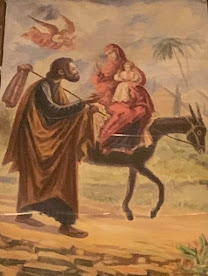
In 1946, in a refugee camp near Munich, 33-year-old Ukrainian artist Yakiv (Jacques) Hnizdovsky attempted to express and remember the life of Ukrainian DPs in a painting which he called Скитальці (Exiles). Lithographs made of the it that same year give the title of the painting in English as "Homeless." This painting came to symbolise the plight of Ukrainian DPs and was eventually reproduced on the cover of CIUS's 1992 The Ukrainian Refugee Experience.
Unable to adequately describe the harrowing life of his fellow countrymen in the camps, Buchko included a coloured lithographic reproduction of Hnizdovsky’s painting. In his letter to the Pope, Buchko also mentioned Hnizdovsky by name. And in a cover letter addressed to Monsignor Giovanni Battista Montini (the future Paul VI), the bishop lambasted the treatment of his people by the I.R.O. and complained that the Holy See was poorly represented at that organization’s headquarters. Both letters, written in Italian, are reproduced here in translation.
 |
| Hnozdovsky painting "Exiles" |
Bishop Ivan Buchko to Pope Pius XII
Rome, 2 August 1948
A new appeal to Christian charity on behalf of refugees.
Most Holy Father,
Following the august command of Your Holiness given to me at the last audience of 27 July, I take the liberty of reproducing in writing my most humble suggestion regarding the fervent desire of the refugees residing in Germany and Austria, together with their plea that Your Holiness deign to once again direct a paternal appeal to Christian charity on their behalf, and to the extent possible, during this coming October, when the Apostolate of Prayer, in accordance with the intention approved by Your Holiness, will pray for the spiritual assistance of the emigrees.
As an expression of the Ukrainian refugees’ feelings of filial love and profound gratitude to Your Holiness, I have only briefly touched on the misery they endure in the camps, and even worse, outside the camps, as I personally witnessed during the last three months of my Apostolic Visit to Germany and Austria. Among the approximately 700,000 Ukrainian refugees who have so far been unable to emigrate to find a new homeland, work, and peace, it would be difficult for me to attempt to describe the living conditions of the refugees in the camps; indeed, it would be entirely impossible to paint in all their colours their state of mind, their fear, and their desperation. I would like to add here a copy of a painting by a Ukrainian painter, Mr. Jacques Hnizdowskyj, illustrating the life of refugees in the camps in the evening. This painting gives an idea of the common living conditions experienced by the majority of refugees, which have been going on for three years now, and for some of them even twice as long, that is, since 1942, when they were transported to Germany for forced labour.
It is true that refugees are not allowed to starve, especially those living in camps administered by the I.R.O., from which they earn the bare minimum of a living, but such a life is becoming increasingly unbearable. Thus, as their desperation grows, especially in light of the rumours of impending war, cases of nervous illnesses and complete exhaustion are multiplying, which sometimes end in suicide in those with little religious foundations.
For two years now, the emigration of refugees from German and Austrian territories to Western European countries and the Americas has been ongoing, and this emigration seems to be accelerating in recent times. However, it is a shame to humanity that this so-called “aid” for refugees is not based on the principles of Christian charity, but rather on the principles of commerce, where human feelings are trampled upon. The adapted system is called labour recruitment, under which the agencies of the various countries, under agreements with the employment authorities, have the right to select from among the so-called displaced persons (D.P.s) the most physically fit individuals for physical labour in the given country. It is true that under this system preference is given to single, unmarried people, but it is also true that a large portion of the married people were recruited and left from Germany and Austria, leaving their families in the camps or outside the camps. As a result, there are often cases where the groom or bride, having arrived at their new destination, forget their obligations to the abandoned families and live a concubinary life. Reports from Western European countries (Belgium, England) are very sad in this regard. Recently, the Australian government has been recruiting men to provide labour in Australia under the express condition that the families must remain in Europe until the housing problem in Australia is resolved. There is no doubt that if this system continues – a large portion of the refugee families will be ruined, and the dependents of the migrant workers will be condemned to certain and rapid death in the poorhouses in Germany or Austria.
Of course, the refugee problem is difficult and complicated. It is certain that every government, beyond the desire to come to the aid of the poor refugees, will also have the interests of its own nation before its eyes and consequently has the right to admit individuals into its country whose presence will contribute to the development of that country. It would be asking too much of governments to open the doors of their countries to all refugees, even individuals.
But on the other hand, it is true that the precarious nature of the problem arises from the international situation, and consequently human society should grant refugees unfit for repatriation some asylum and protection combined with humane treatment and stop treating them as objects of merchandise based on the principles of selfishness. The divine commandment to love one's neighbour applies today as it has always applied to every man, including those in government.
An excellent solution to the problem would be to allow immigration from some of the countries where all refugees of one nationality are present. If, however, this solution is not feasible for any reason, the principle of family consideration should be at least unconditionally observed, allowing the recruited worker to take with him all dependent family members—not only the wife and children, but also the parents and minor siblings, both on his and his wife's side. It is absolutely necessary to permanently break the current system of separating family members; a system brutally practiced in the Soviet Union.
It is equally essential to consider the spiritual needs of the recruited worker, ensuring he receives spiritual assistance during travel and at the workplace. Each group of 100 workers should be joined by a priest, if not several members of the intellectual class, to assist the immigrants in their religious and cultural needs. Christian charity will certainly find a way to help the emigration of intellectuals and professionals who are not suited to physical labour, nor will it leave without help the most unfortunate victims of war: invalids, the elderly, widows, orphans.
The refugees are confident that Your Holiness's paternal appeal will awaken Christian consciences and open the hearts of the wealthy to their unfortunate brothers who have lost everything, including their homeland, in order to save their lives and the Catholic faith.
Your Holiness, during my last trip on the Apostolic Visit of the Ukrainians to Germany and Austria, I heard complaints from the refugees that the Catholics of various wealthy countries—especially those overseas—have shown little interest in the matter, compared to the activities of the various Protestant Churches on behalf of the refugees. To dispel these rumours, I would like to suggest one more thing, which, in addition to Your Holiness's Fatherly Message, would also be very effective in sparking the interest of Catholics around the world in the refugee problem, while also bringing great consolation to the refugees themselves. I most humbly ask Your Holiness to convene an international congress of charitable organizations in Rome, together with the Apostleship of Prayer, on the occasion mentioned above, that is, next October, for the purpose of deliberating and seeking ways to resolve the refugee problem according to the principles of Christian charity.
Prostrate at the feet of Your Holiness, I beg your Paternal Apostolic Blessing for my Ukrainian people, so sorely tried, especially for that portion in exile scattered across almost all the countries of the world, and I profess to be
Your Holiness’ most devoted, most humble, most respected son
+Ivan Bučko, Titular Bishop of Cadi
Apostolic Visitor
Bishop Ivan Buchko to Monsignor Giovanni Battista Montini
Rome, 2 August 1948
Your Excellency,
I humbly beg Your Excellency to present at the feet of His Holiness my attached letter, concerning the refugees’ plea for a new appeal from the Holy Father on their behalf.
On this occasion, I feel it is my duty in conscience to inform Your Excellency more precisely about the refugees’ complaints, as if the assistance provided thus far by Catholic organizations on their behalf was grossly inadequate compared to the charitable work of Protestant organizations, not to mention Jewish organizations.
I have heard the same objection from Catholic members of the British Military Government in Germany (Colonel Anthony Coventry). In particular, these objections are made against the Vatican Migration Office with its headquarters in Geneva, under the direction of the Most Reverend Father Edward Killion, CSSR. His news of the creation of the aforementioned Office by the Holy See was of great comfort to the refugees, but subsequent realities would have demonstrated that too much trust on the part of the refugees was illusory – these are the words of the refugees who turned to the aforementioned Office in their cases.
I do not know exactly what form the Vatican Migration Office would have, but I could guess that the purpose of creating such an Office would have been close contact with the I.R.O. Headquarters in Geneva, the care of the interests of the emigration refugees, especially in cases of appeal made by a given refugee from the unjust decision of the I.R.O. employees. In Germany and Austria, or in other countries, the majority of whose employees are non-Catholic; there are also pro-Communists among them who dare to insult Catholic refugees. Sometimes their decisions are to the material and moral detriment of the refugees.
It was clear that the Office's primary concern would be to ensure the spiritual assistance of individual groups of refugees traveling as workers both in European and overseas countries, and the I.R.O. refused to transport them if the agencies recruiting the labour force did not consider this, so important in the refugees' lives. Generally speaking, the Vatican Migration Office should have served as the Centre for Emigration Affairs, which operates on-site in the individual military occupation zones of Germany and Austria.
On my return from my trip, I found myself in Geneva to consult with the heads of the I.R.O. on matters concerning the fate of the Ukrainian refugees. On that occasion, I paid a respectful visit to the Most Reverend Father Killion, CSSR, Director of the Office in question, at his headquarters, namely the Wilson Palace. To be honest, I found this Office very modest, perhaps too much so compared to other similar offices. It occupies a single small room, in which the Most Reverend Father Director works, employing a typist who, in addition, is in poor health and must be absent frequently. From the friendly conversation I had with the Most Reverend Father Director, I learned that, despite his excellent will, he is not capable of attending to and handling all the business assigned to his Office. The very authority of the Holy See, whose name the Office bears, would require the Office to be somewhat more fully equipped. He feels the lack of some employee who could replace him, at least during office hours, when he himself must travel to the headquarters of the I.R.O. Heads.
I humbly ask Your Most Reverend Excellency to accept on this occasion the expressions of my profound veneration and respect, with which I am grateful to be able to reaffirm myself as always,
Your Excellency’s most devoted Servant
[Note: Father Killion and the Vatican representation at the I.R.O. had interceded successfully for Ukrainian refugees on many occasions since July 1947].