Showing posts with label Augustine Hornyak. Show all posts

Saturday, 30 July 2022

Coventry Ukrainian Catholic Church at 60


Timeline by Bohdan Mandziuk
It has been a very traumatic year for Ukrainians worldwide. A number of celebratory events had to be postponed after Russia’s war in Ukraine intensified, in February. Communities and organizations across the globe focused on aid to Ukraine and welcoming refugees. Some were still able to commemorate significant milestones in their histories. A stained-glass window remembering Ukrainian-Canadian servicemen and women in Britain was hallowed at St. James's, Sussex Gardens, in London, on 8 May 2022. As well, the Ukrainian Orthodox Church in Bradford marked their 70th anniversary. Today, I discovered that St. Volodymyr’s Ukrainian Catholic Church in Coventry is also marking their  60th on Sunday, 31 July. As a tribute to my dear friends from that community, I thought to compose a brief history of this church, taken mainly from my manuscript of the History of UGCC in Britain “This Family in Exile”, which is currently in editing.

Following the Second World War, 30,000 Ukrainian Displaced Persons immigrated to the United Kingdom and were settled in 500 towns, cities, refugee and workers' camps across the country. About two-thirds were Greek-Catholics from Western Ukraine (Galicia). Church authorities dispatched missionary clergy to serve the scattered flock and Bishop Ivan Buchko (Archbishop from 1953) was given jurisdiction over them, as well as all Ukrainian DPs in Europe.

As the refugees were scattered in hundreds of settlements, the clergy had to set up missionary bases, from which they could travel to the surrounding settlements. Six pastoral zones were established at the end of 1947, each served by two priests. They were re-divided into seven zones in May 1949. At first, Coventry was served from Ely because a larger number of refugees were located in camps and hostels in Cambridgeshire. The first priest to serve that area was Father Josaphat Jean. In a letter to Archbishop Godfrey of 22 August 1947, he mentioned Coventry among the places where the faithful were located. Jean was assisted by Father Modeste Gnesko, in the Summer of 1948, and then by Father Petro Diachyshyn, who visited Coventry and 26 camps and hostels, from March to April 1949.

With the arrival of more clergy, the pastoral zones were modified again in August 1949. Father Emanuil Korduba was transferred to Coventry, which was quickly becoming a Ukrainian centre. He was given charge over Essex, Hertfordshire, Bedfordshire, Northamptonshire, Warwickshire, and Worcestershire. Korduba was assisted by Father Yuriy Spolitakevych. When hostels in Cambridgeshire, Norfolk, Suffolk, and Essex were closed, two priests were no longer needed in the area. In September 1950, Korduba was transferred to Manchester. Spolitakevych and Diachyshyn volunteered for a mission in Australia, and newly-ordained Father Mykola Matychak was sent to Coventry in January 1952. Matychak changed his base to Wolverhampton in 1953 and was assisted in Coventry by Father Petro Lisovsky. In November 1954, Father Stefan Vivcharuk, who had been serving in Paris, took over the Coventry pastoral zone but made his base in Birmingham. Four years later, some of his territory was included in a new Bedford pastorate, assigned to Father Ivan Hasiak. For three months in 1959, Father Alexander Baran assisted Vivcharuk while waiting to emigrate to Canada. Father Volodymyr Dzioba replaced Vivcharuk in December 1962, when the former was appointed chancellor.
          
Archbishop Buchko, Coventry 1956
In the 1950s and 1960s, Ukrainian religious leaders visited Coventry: Mitrat Malynovsky assisted with Lenten Confessions in March 1951. Archbishop Buchko made a first brief stop to Coventry on 18 July 1952, and a solemn visitation was organized in July 1956. After the formation of the Apostolic Exarchate, the new Vicar General, Paul Maluga, visited and preached a mission from 13 to 16 March 1958. Bishop Augustine Hornyak visited in 1962, 1965, 1969. Missions for the twentieth and twenty-fifth anniversaries of UGCC in Britain were preached by Basilian Fathers Maksym Markiv, on 22 May 1967, and by Athanasius Pekar, on 25 November 1972. The most important visit to the congregation occurred on 22 May 1970, when Cardinal Slipyi (known as Patriarch Yosyf from 1975) visited and celebrated the Divine Liturgy.

Ukrainian Catholics in Coventry first worshipped at Christ the King RC church in Coundon. In 1948, Canon Raymond Walsh welcomed them to Saint Elizabeth RC church. After his appointment, the lively Father Vivcharuk began looking for a larger building for worship. In January 1956, he acquired a new domivka: a church residence and national home at 482 Foleshill Road. This building was blessed and opened by Archbishop Buchko in July.
Vivcharuk’s ambitious projects were aided by Vicar General Maluga. At a meeting in February 1961, Maluga told the assembled clergy that they needed to increase collections in order to acquire new church buildings in Nottingham, Coventry, and Bolton. In August of the same year, Cardinal William Godfrey, the first apostolic Exarch for Ukrainians, made a token monetary contribution toward the purchase of a temporary church for Coventry.
In July 1961, Father Vivcharuk acquired land at Broad Street and Stony-Stanton Road complete with an old wooden Methodist hall. The first church house was sold while the Methodist hall was repaired and turned it into a “temporary” church, until the congregation could raise funds to build a new structure. The church, rechristened Saint Volodymyr the Great, was blessed by Bishop Hornyak on in March 1962. At the same time, a mosaic icon of Our Lady of Perpetual Succour was installed Saint Elizabeth’s, bearing the inscription: “Gift from Ukrainians of Coventry in thanksgiving for use of Church of St. Elizabeth 1948–1962.” A plan to build a new church in the Hutsul style (Vivcharuk was a Hutsul) was never brought to completion.
            In the 1950s, Coventry became one of most vibrant Ukrainian communities in Britain. The Ukrainian Catholic congregation, numbering 700, began to increase as Ukrainians from Wales and Northern England settled in town. In 1953, the first branch of Brotherhood of Our Lady of Perpetual Succour (OLPS) was established by visiting Redemptorist missionary, Bohdan Kurylas. Members of this confraternity undertook to care for the church and clergy residences, and also took part in church singing and carolling. In the 1950s, other chapters were set up in larger centres, such as Edinburgh and Bradford, due to the efforts of energetic pastors. With the arrival of Father Maluga, the brotherhood became active in organizing church events. Coventry OLPS hosted a reception for the parish praznyk of the Protection of the Mother of God, on Sunday, 18 October 1959. During Maluga’s tenure, Coventry was considered one of the most vibrant branches.
Coventry’s other Ukrainian organizations were also very active. Among these were: a male Choir, Verkhovyna, under the direction of Marian Kostiuk (1926-2000), which performed across the country; drama and dance troops; and a Saturday school, with qualified teachers. Kostiuk’s choir sang the responses at a Divine Liturgy on 24 May 1959, at the Ukrainian church in Saffron Hill, London, in the presence of Exarch Godfrey. They also sang at a commemorate concert in Godfrey’s honour, held at Westminster Cathedral Hall. Verkhovyna sang the Divine Liturgy celebrated at the Lourdes Grotto of Hednesford Shrine, during the annual Ukrainian pilgrimage in July 1961. Over a thousand Ukrainians attended. On 30 June 1968, the choir led one of the Divine Liturgies during the opening ceremonies of the Cathedral of the Holy Family in Exile. Kostiuk emigrated to Australia in 1975, where he continued to establish and work with Ukrainian community choirs.

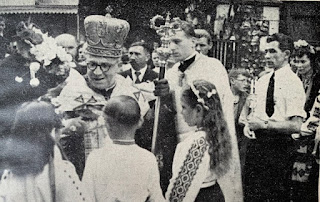
Cardinal Slipyi, Coventry, 22 May 1970


Monday, 20 December 2021

Exsul Familia – A Family in Exile


Last August, a 68-year-old document was extracted from decades of dust into the light of the present and republished in Italian by the Vatican press. It was Pius XII’s Apostolic Constitution, Exsul Familia Nazarethana, or the Nazarene (Holy) Family in Exile, first issued on 1 August 1952. 

An Apostolic Constitution is the most solemn form of legislation issued by the popes, in the form of a bulla (led-sealed parchment). The background to this was that the Second World War had forced 12.6 million displaced persons (DPs) to seek refuge in various western European countries. Over 3 million of them were Ukrainian. These refugees asked to be ministered to by clergy that spoke their native languages and understood their customs and cultures. Many bishops asked Rome to issue guidelines, the result of which was the first systematic reflection on human migration in the papal magisterium.

Pius XII noted that displaced persons lose much of their security and human dignity, and help up the example of the Holy Family from Nazareth (Jesus, Mary, and Joseph) as an example for migrants of every age. The document also outlined the nature and extent of papal charitable works in favour of millions of DPs, during and after the war (from which Ukrainian religious and cultural entities also benefited). It called for greater, more specified pastoral care of refugees, mandating that ethnic, linguistic, and ritual traditions be supported by local Catholic hierarchs. For its extensive substance and provisions, Exsul Familia became known as the magna carta of migration.

The papal charter was also significant for offering a reflection, not merely on the migration of ethnicities, but also of rites. It provided indications on how the powerful Latin Church should deal with the smaller, more vulnerable Particular Churches. Bishoprics established in the twentieth century for Byzantine-Rite Catholics in Canada, USA, Brazil, and even Italy, were cited as examples of papal solicitude. For the Ukrainian Catholic Church, which had been violently suppressed by the Soviets in countries within their “sphere of influence,” this confirmed the pope’s promise to protect it and restore it in the lands of immigration.

The teaching of Exsul Familia was supposed to serve as a buttress against resourceless Eastern Catholics being forced to assimilate to predominant Latin Rite in their countries of refuge. It was also expected that that Eastern-Catholic missionaries would henceforth be given a freer hand by local Latin hierarchs. Surprisingly, the opposite happened. Exsul Familia laid down principals but its implementation had been entrusted to Roman Curial department known as the Consistorial Congregation. The juridical norms issued by that department replaced existing apostolic visitations to ethnic and linguistic groups with priest-delegates responsible to the Consistorial.


From the moment these norms appeared, diocesan functionaries began to question the authority of Archbishop Ivan Buchko, the Apostolic Visitor for Ukrainian Catholics, who had been granted direct authority over the clergy and faithful throughout western Europe. The wording of the norms made it appear that the papal constitution had also supressed Buchko’s jurisdiction. Chancery functionaries told Buchko’s officials that they would have to apply to become ethnic delegates under Latin diocesan structures. Buchko appealed to the Congregation Pro Ecclesia Orientali to resolve the issue. On 16 November 1953, that Congregation's head, Cardinal Eugène Tisserant, addressed an official letter to Archbishop Buchko, clarifying that Exsul Familia and its accompanying norms did not pertain to the Eastern Rites. 

The Latin Particular Church has long had issues with ritual and spiritual diversity within the Catholic Communion and, historically, has very often mistaken itself to be the unique expression of Catholicism. Having experienced this first-hand, at home and in exile, Buchko acted quickly to have more permanent structures put in place. Following the Exsul debate, he petitioned the Oriental Congregation replace his visitation with apostolic exarchates. These were indeed established: in Britain, in 1957; in Germany, 1959; and in France in 1960. 


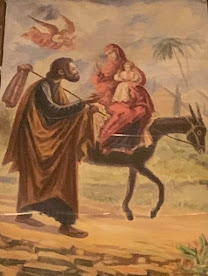
Hieromonk Parteniy Pavlyk's 
the Holy Family's Flight into Egypt
 
In August 1962. on the eve of the Second Vatican Council, a conference was held in Rome to commemorate the tenth anniversary of Exsul Familia. In attendance was Augustine Hornyak, Auxiliary Bishop and soon to be Exarch for Ukrainian Catholics in Britain. The conference and perhaps even more so the papal charter made a  great impression on the freshly-minted bishop, whose flock identified as скитальці or post-war political “exiles.” When seeking financial assistance for a suitable cathedral church, he pleaded with the papal representative in London: “I am asking for a part of the Universal Church of Christ, for an Exsul Familia, which wants to survive here and sustain the ‘Church of Silence’ in our homeland.” After receiving a large subsidy, Hornyak surprised everyone by christening his new cathedral “Holy Family in Exile” after Pius XII’s Apostolic Constitution. The name “Пресвята Родина в Скиталю” was also intended as a reminder to his flock that the Almighty, who had temporarily permitted the Holy Family’s exile, would, one day, allow exiled Ukrainians to return to their own native land.


The year 2022 will mark two important anniversaries: the seventy fifth anniversary of the canonical establishment of the Ukrainian Catholic Church in Britain (3 March 1947), and the seventieth anniversary of Pius XII’s Exsul Familia (1 August 1952). In an introduction contained in its new edition, Professor Andrea Tornielli of Vatican Communications notes that Pope Francis’ teachings on migrants have their roots in Exsul Familia. What many in Rome and elsewhere will be surprised to learn is that a cathedral in London, the spiritual Nazareth of thousands of migrant workers today, stands as a living witness to the first Catholic migrants’ charter.

Friday, 20 March 2020

Unity and Universality upon English Shores

            
On Saturday, 21 March, Bishop Kenneth Nowakowski is enthroned as bishop of the Eparchy of the Holy Family of London. Although he is only the second eparch since the creation of a full eparchy in 2013, he is the seventh bishop to shepherd the Ukrainian Greek-Catholics of the United Kingdom.
Kyr Buchko in Great Britain
            Although Ukrainian Catholics began to settle in Britain around 1900, the Byzantine Catholic Church of the Kievan tradition (UGCC) was canonically established for them only in 1947, when Bishop Ivan Buchko was given jurisdiction over all the Ukrainian Catholic clergy and faithful scattered across western Europe, following the Second World War. He came to London on 4 January 1947 and, the following day, formally notified the local Catholic hierarchy of his charge. Raised to the rank of archbishop in 1953, Buchko held jurisdiction over Great Britain until the creation of an apostolic exarchate for England and Wales, in June 1957 (extended to the rest of the United Kingdom in 1967). And he continued as apostolic visitor over various parts of Europe until 1971.
            Being too poor to build their own churches, Ukrainians relied on generous moral and financial support of the Roman Catholic hierarchs, parish priests, and organizations. Still, the English and Welsh bishops would have preferred to have the Ukrainians under a single Latin ecclesial structure. For this reason, a proposal for a separate Ukrainian bishopric was rejected in October 1954. In the face of resistance from the bishops, the project was salvaged due to the firm leadership of Cardinal Eugène Tisserant at the helm of the Vatican Congregation pro Ecclesia Orientali (renamed “of the Eastern Churches” after the Second Vatican Council).
Tisserant 1950
With the eparchies suppressed in their homeland, Pope Pius XII had promised to restore the Ukrainian hierarchy in the diaspora, and Cardinal Tisserant helped find a way to keep that promise. Buchko was to be relieved of some of his responsibilities by the creation of individual apostolic exarchates for England, Germany, and France. Since the local hierarchs were reluctant to see a ‘foreigner,’ Tisserant asked the Archbishop of Westminster, Cardinal Bernard Griffin, to serve as first exarch. In April 1955, Griffin accepted and the English hierarchy gave their approval. However, Scotland was to be left under Archbishop Buchko, since it was considered inappropriate for an English archbishop to hold jurisdiction in that country. Pius XII approved the apostolic exarchate for England and Wales in June 1955.
Cardinal Tisserant had obtained what was possible for the moment. Once the Latin bishops got used to the structure, a Ukrainian bishop would be appointed. But knowing the strong nationalistic feelings of the Displaced Persons (DPs), Buchko worried that the faithful would not accept an English exarch unless a there was a Ukrainian priest or auxiliary bishop at his side. He suggested proceeding with an exarchate in Germany, but the search for suitable candidates led to the postponement of both projects. In the meantime, Cardinal Griffin died prematurely and his successor, Archbishop William Godfrey, had to be approached. Godfrey accepted on 2 May 1957 and the exarchate was  finally created on 10 June 1957 with the issuing of a papal bull, Quia Christus omnes. 
The formal handover of the mission proved to be somewhat complicated. Buchko came to London, in August, to perform a final visitation and met with Godfrey to discuss the handover and appointment of a Ukrainian vicar-general, to run day-to-day affairs. Godfrey insisted that such a priest be from Canada, as a former British colony and member of the Commonwealth.
Buchko was adamant that Ukrainians witness the Latin and Byzantine hierarchies cooperating at a solemn liturgical ceremony. It had to take place in the tiny Ukrainian church in Saffron Hill, rather than at Westminster Cathedral, and the Byzantine Liturgy needed to be celebrated by a member of the Ukrainian Catholic hierarchy. Metropolitan Maxim Hermaniuk of Winnipeg was in London in September, but did not officiate because the ceremony was delayed: the papal bull did not arrive on time and Godfrey left for Ireland on his annual vacation. 
The problem was resolved when Cardinal Tisserant instructed Archbishop Buchko to return to London to preside. The ceremony took place on 10 November 1957, according to an order of service devised by Buchko and approved by Apostolic Delegate O’Hara. The newly-appointed exarch and the apostolic delegate were received at the entrance of the church by Buchko, who presided over a hierarchical Divine Liturgy concelebrated by Ukrainian priests. As exarch, Godfrey gave the blessings in Church Slavonic and assisted from a throne on the left side, while the apostolic delegate sat in a simpler throne on the right. The papal bull was read in Latin and Ukrainian. Buchko brought greetings from the Ukrainian hierarchy, the clergy made obeisance by kneeling and kissing the ring of the enthroned exarch. The ceremony concluded with the intonation of the liturgical prayer “God grant them many years” (Mnohaya lita) for Exarch Godfrey, Apostolic Delegate O’Hara, the imprisoned Metropolitan Yosyf Slipyi, and the Ukrainian hierarchy worldwide. Godfrey was accompanied by his two priest-secretaries and his courtly gentleman, Anthony Bartlett
Godfrey & Buchko 1957
On 30 December 1957, Buchko replied to Godfrey’s letter of thanks, assuring him that he conserved beautiful memories of that solemnity which will be surely noted in the pages of the history, not only of the Ukrainian Catholic Church but also those of the Universal Church, during which unity and universality were magnificently resplendent upon English shores.
            All of Godfrey’s successors held proper enthronement ceremonies, which involved being ritually lifted into their throne and receiving a Byzantine crozier. Each ceremony was slightly different and, as with the first bishop’s, encountered some difficulties in the planning and execution. 
Enthronement 1963
Bishop Hornyak, the second exarch, was scheduled to be enthroned on 6 June 1963. Pope John XXIII died three days before. Rather than postpone, some adjustments were made. Westminster Diocese was represented by the Capitular Vicar, Bishop Craven, as the see had been vacant since the death of Cardinal Godfrey. Hornyak was lifted into the throne and given the pastoral crozier by Apostolic Delegate O’Hara. However, as a sign of mourning, the clergy wore red and the exarch wore a red omophorion. Following the Divine Liturgy, panakhyda was celebrated for the late pope.
Enthronement 1968 
On 12 May 1968, Bishop Hornyak was enthroned again, this time as apostolic exarch for Great Britain and Northern Ireland. The ceremony took place at the Ukrainian church of the Protection of the Mother of God and Saint Andrew, in Edinburgh. It was performed by Apostolic Delegate Igino Cardinale and attended by the Scottish Catholic hierarchy: Archbishop Gray of Edinburgh, Bishop Scanlon of Glasgow, and Bishop Hart of Dundee. 
Enthronement 1989
On 10 October 1989, the third exarch, Bishop Michael Kuchmiak, was the first to be enthroned at the Ukrainian Cathedral of the Holy Family in London. The rite was performed by the apostolic pro-nuncio, with Cardinal Basil Hume of Westminster assisting from a throne. On 16 June 2002, the fourth exarch, Paul Chomnycky, was enthroned by a Head of the Ukrainian Catholic Church, Cardinal Lubomyr Husar. Although several Ukrainian hierarchs came, neither the nuncio nor any of the Latin bishops were able to attend. 
Enthronement 2011
Upon his appointment as apostolic administrator in 2009, Bishop Hlib Lonchyna held an inaugural Divine Liturgy with Cardinal Husar and two English bishops assisting from the throne. After being confirmed as fifth exarch on 8 November 2011, Kyr Hlib was enthroned by the nuncio, Archbishop Mennini. Husar’s successor, His Beatitude Sviatoslav Shevchuk, presided at the hierarchical Liturgy concelebrated by several British bishops as well as Ukrainian, Belarusian, and Melkite Greek-Catholic and Latin clergy. Ecumenical representatives attended from Ukrainian Orthodox and Presbyterian Churches. 


Cardinal enthrones Eparch 2020
Due to the Coronavirus crisis, the date of Kyr Kenneth’s enthronement was brought forward. The ceremony itself was changed to a semi-private rite performed by the Archbishop of Westminster, Cardinal Vincent Nichols, standing in for His Beatitude Sviatoslav. His Eminence had previously attended significant Ukrainian celebrations, including the 2009 inauguration (when he was yet Bishop of Birmingham). Cardinal Nichols also invited His Beatitude and all the European Eastern Catholic bishops to celebrate an hierarchical Divine Liturgy at Westminster Cathedral, in 2017. This is the first Ukrainian inauguration/enthronement in Britain to be broadcast live, over the internet. A public celebration marking the beginning of the eparch’s ministry is being planned for a later date.

Friday, 26 July 2019

British Pilgrimage to Rome 1969


by Engineer Vasyl Oleskiw (1924–2016)
[Василь Олеськів, “У поклоні Верховнону,” 
in Наша Церква, vol. 18, no. 1 [90] (January–March 1970), p. 7–9.]
           
 On Thursday, 2 October 1969, Ukrainian pilgrims from Great Britain, together with their Bishop Kyr Augustine Hornyak and three parish priests, arrived in Rome for the solemn consecration of the noble Sobor of Saint Sophia. On that day, they experienced perhaps the greatest and most moving moments of their visit to the Eternal City. On that day, at 3:30 in the afternoon, they were received in a private audience by His Beatitude Major-Archbishop Cardinal Yosyf, at the Ukrainian Catholic University of Pope Saint Clement. On that day they had the joy to personally meet with our Chief Hierarch, Confessor of the Faith and of the Ukrainian nation, to touch the same hand which, not long ago, had been tortured, to exchange a brief word, and to receive his blessing.
            Our group greeted the majestic figure of His Beatitude Kyr Yosyf with enthusiastic applause. With visible emotion, Kyr Augustine gave the following address: 
“Most Blessed Hierarch, here before you is the bishop, priests, representatives of Ukrainian organizations, and faithful which, together, constitute the People of God of the Apostolic Exarchate in Great Britain. It is our pleasure to render You filial homage, fidelity and love. We are all children of our Mother-the-Church which was cut down in our native land but whose roots have spread far and wide, even across the English Channel and which sprung up on the other side— a beautiful branch which is the Ukrainian Catholic Church in Great Britain. It remains part of the Universal Church and of the Ukrainian Nation.”
            “We came to take part in the solemn consecration of Saint Sophia and to observe the achievements which are the result of Your intense labours and of God’s grace upon His children. Wherefore it is a pleasure for us to greet you as our Dearest Hierarch and, on this occasion, to bring you the gift of these cloths for the high altar and side altars. The material from these cloths was made by the same firm that furnishes Buckingham Palace, and the embroidery upon it is the work the members of the Organization of Ukrainian Women in Great Britain (OUZ) from Coventry, Leicester, and Waltham Cross, and of our Sisters Servants of Mary Immaculate in London. We also brought a collection toward Saint Sophia, which has already surpassed two-thousand pounds sterling, and which is to continue and which we hope will surpass three-thousand pounds. For our country, this represents a very considerable gift, especially considering that were are still fundraising to pay the debt on our new Cathedral.”
            “On this occasion when we come before Your Beatitude, it is a pleasure for me to render homage and filial love, and to repeat and once again invite Your Beatitude to visit us in Great Britain. We hope that this will take place in the coming year, perhaps around the time of Green Holidays [Pentecost], so that, as with other eparchies around the world, we too might have the joy of welcoming you among us and that You would lift our spirits with Your presence. This [visit] would surely bright forth the choicest fruits for our Church. which grows and flourishes not only to support our life in the lands of emigration but also to support our suffering Church [in Ukraine]. Surely our growth, in a wider sense, represents the fruits of the [spiritual] merits of Your sufferings.” *
            “And here I would like to say that we, the bishop, clergy, and all the faithful, share your dreams and hopes which we have also taken upon ourselves that, God willing, our Particular Church (Pomisna Tserkva), our Ukrainian Catholic Church will soon be crowned with a Ukrainian Catholic Patriarchate.”

            A powerful chorus of Mnohaya lita [God grant him many years] concluded those sincere and heartfelt greetings, to which His Beatitude Kyr Yosyf responded with emotion:
            “Most Reverend Bishop, Dear Pilgrims! I am extraordinarily pleased that, particularly from Great Britain, you came here in such numbers. Our Ukrainian Church in Britain should raise its powerful voice. Never forget that you live in a country that, since the Middle Ages, had ruled the world. I hope that, living among that people, you would benefit from even a small portion of their practical wisdom, courage, and composure, for which the British are famous. Then, like it or not, living among that powerful nation spread across the globe, you will acquire their virtues and characteristics and bring a good portion of those positive qualities to the history of the Ukrainian Nation.”
            “I am especially grateful to you, Dear Bishop, for your donations and for these beautiful altar cloths. God grant that they be a visible testimony of the strength and consciousness of the unity of the Ukrainian nation across the entire globe. And may they serve as a powerful prayer to the Lord God for the many years of your labours. I am especially grateful, especially to You, Bishop, that you are the first in Europe to acquire a Cathedral church as a stronghold and enduring home. Do not fear because, having fled your homeland, you are living as if in a foreign country. Rather the opposite is true: for we should be represented everywhere and have our own homes and strong enclaves. By establishing such homes far and wide, today our emigration can do much more that all those 45 million in Ukraine! Reflect well on this, that your voice, your achievements, your deeds is a voice heard by the world and has tremendous significance. And it is precisely this that our opponents and our enemies fear the most! And if you, Most Reverend Bishop, will lead this people and direct it, you can be confident that the majority of the Ukrainians in Great Britain will be a powerful support, not only for you in Britain, but also for the entire Ukrainian nation throughout the world.”
            “God grant You many years! God grant You success! God grant that you form Your children to become well-educated wise people and leaders, and also that you may succeed and not have to live by begging for bread but from the labour of your own hands. And when you become prosperous and are able to support not only yourselves but also the Church and the whole nation, and raise your children to become honourable people, then you will have fulfilled your calling. May God grant you many years and His blessing.”

            After singing Боже великий, Творче всесильний (O Great God, Almighty Creator, look upon our native land), Kyr Augustine presented to His Beatitude Rev. Ivan Muzychka, Rev. Stefan Orach, Rev. Teodor Tysak, as well as representatives of Ukrainian organizations: Ivan Ravliuk (AUGB), Maria Sydor (OUZ), Bohdan Rohach (SUM), Roman Stryhanyn (Plast), Vasyl Oleksiv (UVC, UIC), Vasyl Bortesky (Obnova), Vasyl Dubil (OBV), V. Parubochy (church men), Onufriy Shtunder (Church elders), Ilya Yavorsky (cantors), I. Shkatuliak (church contacts).
            At the end of this moving encounter, each of the approximately 70 people greeted His Beatitude separately. In the middle of an historic Synod of Ukrainian Catholic Hierarchs, our Major Archbishop sacrificed a lot of time, attention, and love for us. It has made an impression on us which will remain as an enduring testimony not only for those who took part but also the entire Ukrainian community in Great Britain. 

* Slipyi accepted the invitation to visit Britain from 9 to 24 May 1970.  

Friday, 22 June 2018

“In Exile No Longer” : Holy Family Cathedral Celebrates 50 years


Ukrainian version: "Вже не вигнані" Патріярхат, no. 6 [470] (листопад–грудень 2018), ст. 21–24.
          
On Saturday, 23 June 2018, the Ukrainian Catholic Cathedral in Westminster solemnly marked the fiftieth anniversary of its opening. For over forty of those years, it was known as “The Holy Family in Exile.” We might say that this cathedral had its origins in two historical events: the forced emigration of Ukrainians from their homeland, during and after the Second World War; and a promise made to them by the Pope. 
The Ukrainian Greek-Catholic Church had been outlawed by the Soviet Communists in 1945, but Pope Pius XII defended it and made a promise to preserve the Church abroad and to reconstitute its hierarchy. His Apostolic Constitution, Exsul Familia Nazarethana (The exiled Nazarene [Holy] Family), of 1 January 1952, was part of that promise. Known as the magna carta on migration, it mandated that diocesan bishops had the duty to offer special pastoral care for migrants and displaced persons. Placing the Faith above all, the Pontiff supported he migrants' desire to maintain their ethnic traditions, language, and gave particular attention to preserving the Rites of the Eastern Churches.
Saffron Hill
Ukrainian Catholic immigrants began to form a community in London in 1946. Bishop Ivan Buchko, whom the Pope had appointed as their overseer (apostolic visitor) throughout Western Europe, visited London in January 1947, and sent a permanent pastor two months later. This priest chosen for the mission was Father Josaphat Jean of the Basilian Order, a French-Canadian who had adopted the Byzantine Rite to minister to Ukrainian immigrants in Canada. With the assistance of community leaders, organizations, and the Archbishop of Westminster, Father Jean was able to acquire a small church in Saffron Hill, Farringdon, in July 1948. The first Ukrainian Catholic church in Britain, dedicated to Saint Theodore of Canterbury, was solemnly blessed by Bishop Buchko, on 5 December 1948.
Buchko and Jean both considered this first edifice to be temporary, intended to provide a stable place for worship and to gain a foothold in London. From the beginning, however, they foresaw the acquisition of a larger church, once the congregation became stable and better equipped financially. Jean was recalled to Canada in the Summer of 1949. Bishop Buchko replaced him, as his Vicar General for Britain, with Redemptorist Father Volodymyr Malanchuk. The following year, due to ill health, Malanchuk was also transferred to Canada and was succeeded by Monsignor Oleksander Malynovsky. In the early 1960s, the little church in Saffron Hill was rededicated to the Protection of the Mother of God.
In only a few years, the Ukrainian Greek-Catholic Church made significant progress in Great Britain. It acquired churches in several major centres, such as Manchester, Nottingham, and Edinburgh. Through the work of his minister for Eastern Catholic Affairs, Cardinal Eugène Tisserant, Pius XII began to establish missionary dioceses to replace Bishop Buchko’s provisional mission. Apostolic exarchates were established: in England & Wales in 1957, in Germany in 1959, and in France in 1960.
Nevertheless, when asked for their opinion in 1954, the Catholic Bishops of England and Wales were not enthusiastic about a special jurisdiction for Ukrainians. In order to soften the blow, Cardinal Tisserant asked the Archbishop of Westminster, Cardinal Griffin, if he would take on this responsibility himself. Griffin agreed but died soon afterwards. His successor, William Godfrey also accepted and was solemnly enthroned as exarch for Ukrainians at the little Saffron Hill church, on 9 November 1957.
proposed cathedral 1959
The Papal Bull establishing the exarchate, dated 10 June 1957, stated that it needed a cathedral church in London (probably at Bishop Buchko's suggestion). The project for a cathedral fell to a new Vicar General, Canadian Redemptorist Father Paul Maluga. In March 1958, Godfrey made the first contribution to the cathedral fund of 2000 Guineas (slightly more than 2000 pounds). Maluga commissioned sketches for a new church in the Byzantine style, and the fundraising campaign was inaugurated on 2 December 1959. Despite his Canadian pragmatism, energy, and enthusiasm, Paul Maluga’s project encountered opposition from segments of the local Ukrainian community and even some clergy. In the end, he raised just over 17,000 pounds, which was barely enough to buy London property.
Archbishop Godfrey was elevated to the cardinalate at the end of 1958, and was given a Ukrainian-Rite auxiliary bishop in August 1961. Maluga was passed over for a Basilian monastic from the USA, Augustine Hornyak. The bishop’s first solemn Liturgy, on 17 December 1961, had to be held in St Peter’s Clerkenwell (founded for Italian immigrants), since Saffron Hill was woefully inadequate. Godfrey died in January 1963 and, on 18 April, Hornyak was appointed to succeed him. During his enthronement on 6 June, the Apostolic Delegate, Gerald Patrick O’Hara, told Hornyak: “you deserve a better church.” 
Duncan Street church
The new exarch abandoned Maluga’s earlier project, deemed unworkable, and chose to acquire an existing church. In May 1963, the exarchate purchased the former Catholic Apostolic Church in Duncan Street, Islington. Hornyak established an advisory committee with members from all over England, together with an executive committee, to plan the necessary extensive renovations and a fundraising campaign. The executive committee was made up of Fathers Vivcharuk, Havryliuk, Orach, Muzychka, Mykhalsky, Professor Robert Lisovsky, Architect Vasyl Boretsky, Engineer Vasyl Oleskiv, and Engineer Malytsky. Boretsky was asked to prepare plans for the alterations to the exterior and interior of the building. However, by August 1964, estimated renovations of the exterior alone had risen from 30,000 to 45,000. In 1965 the bishop decided to demolish the Islington church and build a new structure. But the committee ran into difficulties with the Islington authorities over a church hall and parking space. While waiting for planning permission, Hornyak asked committee members to keep watch for another property.
King's Weigh House bulletin 1902
In August 1965, Canon Arthur Rivers, the financial secretary of Westminster Archdicoese, drew Hornyak’s attention to a property in Duke Street, which had recently come onto the market. Formerly the Congregationalist King’s Weigh House Chapel, it was being used as a place of worship for the American Navy, and the hall beneath was gallery for hire. On 27 January 1966, the cathedral committee met at the “Weighouse Gallery” to inspect the building. The asking price was 150,000 pounds, an amount far beyond the Ukrainian Exarchate’s resources. Nevertheless, Bishop Augustine petitioned Rome for permission to purchase it. The Oriental Congregation authorized the purchase in December 1966, and promised to help cover the interest on the loan, if donations from the faithful did not suffice.
The Ukrainian Exarchate had deposited its cathedral fund with the Archdiocese of Westminster at a rate of 5% interest, and Canon Rivers had promised that the Archdiocese would grant them a loan, at the same rate. But to Bishop Hornyak’s surprise, when he returned from a trip to United States in November 1966, he discovered that Rivers had left the finance office, and Cardinal Heenan said he was unable to offer the loan directly. Rivers, however, was still able to negotiate a loan from the National Bank Ltd., as Westminster diocesan debt, on behalf of the Exarchate. And the following year, Heenan made a donation of 2,500 pounds, from personal funds.
Finding himself in a very difficult situation, Hornyak appealed to the Apostolic Delegate, Igino Cardinale. The Bishop confessed that the cathedral fund was a mere 20,000 pounds, and the only foreseeable solution was to asked for a large subsidy from the Oriental Congregation, as Hornyak wrote on 5 December 1966: 
“I am asking for a part of the Universal Church of Christ, for an Exsul familia, which wants to survive here and to sustain the 'Church of Silence' in our homeland.” Archbishop Cardinale seconded the cause before the Congregation for the Eastern Church, which granted a subsidy of 100,000 US dollars, allocated by various Catholic charities. 
After difficult negotiations, bids and counter bids from a rival buyer, the cathedral committee petitioned the city for a preservation order, declaring the church to be object of art. This caused the other party, which had intended to demolish the church, to make their offer conditional, and the Charity Commission ruled in favour of the smaller, Ukrainian offer of 155,000 pounds. But this amount still necessitated a third fundraising campaign. In April 1967, the faithful were informed of the impending purchase. And on 18 July, in the presence of the committee executive, Augustine Horynak signed the contract to purchase the King’s Weigh House and its adjacent residences. These became the property of the Ukrainian Catholic Church on 26 October 1967. 
Upon the Apostolic Delegate’s recommendation, in January 1968, Pope Paul VI extended the Exarchate’s jurisdiction to all of Great Britain, including Scotland (in 1957 Godfrey, as the head of the English and Welsh episcopate, could not have jurisdiction in Scotland). Unfortunately, as with first cathedral campaign of 1959, there were those in the British Ukrainian community that sought to limit the authority and prestige of the Ukrainian Catholic Church. At the very same time, rival fundraising campaigns were initiated and, in order to frighten donors, rumours were spread that the new cathedral would not belong to the Ukrainians but to the Vatican. As a result of these intrigues, the community was mediocre in its support and the debt lingered into the mid 1970s.
In February 1968, Bishop Augustine discussed the alterations to the interior of the church with Architect Boretsky and, on 21–22 February, the priests in clergy conference gave their opinions regarding an opening date. On 29 March, Kyr Augustine informed them that the inauguration would be divided in two. In order that the church could be used immediately (as both Saffron Hill and Duncan Street had to be sold to cover part of the debt), only the most basic alterations would be made, so that a simple blessing and opening could take place by June. The full consecration rite would be postponed for a year or two, until after the installation of the iconostasis and the paying off of the cathedral debt. The simple opening was announced to the faithful in April, and Archbishop Cardinale, who had been much responsible for the acquisition of the building, agreed to attend.
The Cathedral committee helped plan the opening ceremonies, which were extended over Saturday and Sunday, so that all the clergy could participate. The London parish had already had two patrons: Saint Theodore of Canterbury and the Protection of the Mother of God. For the new church, Kyr Augustine chose a new name: “The Holy Family in Exile,” based on Pius XII’s charter for displaced persons.
thanksgiving moleben, 29 June 1968
On Saturday, 29 June 1968, at 3:00 PM, Bishop Hornyak greeted Archbishop Cardinale at the cathedral entrance. In the name of the Holy Trinity, the two prelates opened the doors and sprinkled the interior of the cathedral with holy water. The bishop-exarch and twelve priests concelebrated a moleben of thanksgiving to the Mother of God. Apostolic Delegate Cardinale spoke in English and Bishop Hornyak preached in Ukrainian. Undeterred by a partial rail strike, over 1000 faithful travelled to London by coach and automobile. On the following day, Sunday, 30 June, Hornyak celebrated the first hierarchical Divine Liturgy together with Fathers Stefan Vivcharuk, Oleksander Babiy, Yarema Havryliuk, Stefan Orach, and Danylo Humnicki as deacon. The responses were sung by Boyan Choir, under the direction of Mykola Solomka. A second Divine Liturgy was celebrated by the priests in the afternoon, sung by Verkhovyna Choir of Coventry, under the direction of Mariyan Kostiuk.
Heenan, Hornyak, Slipyi 1970
The opening of the cathedral occurred during the tenth anniversary of the Exarchate and the twentieth of the Ukrainian Greek-Catholic Church in Great Britain. The event marked a high point in the history of the Ukrainian community. In the fifty years that have elapsed since that joyous day, the cathedral has witnessed moments of of great joy and of bitter sorrow. An historical turning point occurred with the visit of Cardinal Yosyf Slipyi, Head of the Ukrainian Catholic Church worldwide, on 8 May 1970. Slipyi’s unwavering crusade for a Ukrainian patriarchate was strongly supported by British Ukrainians, clergy and faithful alike. But a conflict between Patriarch Yosyf and Bishop Hornyak led to a bitter division. The majority of the parishioners abandoned the cathedral and, on a Sunday morning in the late 1970s, visitors from abroad found a cold, sad place, attended by a remnant of 30 faithful. Due to lack of income, the planned second phase, including the installation of an icon screen and solemn consecration, had to be postponed indefinitely. 
A decade later, the cathedral slowly came back to life. One of Bishop Augustine's final acts was to begin installing the iconostasis with icons commissioned from Hieromonk Yuvenaliy Mokrytsky. In 1987, Hornyak was replaced by an interim administrator, Bishop Michael Hrynchyshyn, and, in 1989, Bishop Michael Kuchmiak was enthroned as the third exarch. Beginning in the mid 1990s, an influx of economic migrants from independent Ukraine transformed the cathedral, restoring much of its former glory. As a result of this change, the young and energetic Basilian, Paul Chomnycky, succeeded Kuchmiak in 2002. Less than four years later, Chomnycky was transferred to the Stamford Eparchy in USA. 
August 2007
Although thriving numerically, in a sense, the cathedral was orphaned without a bishop-exarch. During this difficult period, on 13 August 2007, a large portion of the ceiling collapsed, and divine services had to be celebrated in the adjacent hall, and at nearby Farm Street Church. In 2009, after waiting three years, the Apostolic See finally appointed Bishop Hlib Lonchyna as administrator and, on 2 August 2011, he was enthroned as the fifth exarch. Kyr Hlib was to be the last apostolic exarch. After fifty-six years, on 8 January 2013, Pope Benedict XVI raised the exarchate to the status of full eparchy (diocese), and Bishop Hlib was named the first Eparch. As there was already a Catholic diocese in Westminster, the new diocese took the name of the cathedral: “Eparchy of the Holy Family of London,” but not “in Exile.” 
In 2017, the Ukrainian Greek-Catholic Church marked seventy years in Britain, and sixty since the founding of the exarchate. To commemorate this anniversary, a hierarchical Divine Liturgy was held at Westminster Cathedral on 28 October, presided over by Patriarch Sviatoslav (Shevchuk) and concelebrated by all the Eastern Catholic Bishops in Europe. In his sermon, the Archbishop of Westminster, Cardinal Vincent Nichols, declared: “How good it is that the Ukrainian Greek-Catholic Eparchy remains under the patronage of the Holy Family, but the Holy Family ‘in Exile’ no longer.” This proclamation, from the head of the Latin Church in England, seemed to hearken back to Bishop Hornyak’s explanation of the cathedral's name, on its first patronal feast of 12 January 1969: “From a foreign land, the Holy Family ended their journey in Nazareth, because it had become their home.” 


Bishop Hlib, Clergy, Faithful, 23 June 2018