Showing posts with label vatican archives. Show all posts

Friday, 13 March 2026

Lettera smarrita della vedova del colonnello Montezemolo


This post was is written in Italian with a view to reproducing the pertinent documentation and out of respect for the late Colonel Montezemolo's family and the Italian Resistance. 

Solo una volta, in 27 anni di ricerche negli archivi vaticani, mi era capitato di trovare un documento sigillato il cui contenuto non era mai stato esaminato. Oggi è successo di nuovo. Attualmente sto esaminando i fascicoli della Prima Sezione della Segreteria di Stato Pontificia relativi al periodo tra il 1936 e il 1958, alla ricerca di materiale riguardante l'Ucraina. Effettuando una ricerca per parole chiave utilizzando l'indice digitalizzato di questi fascicoli dell'Archivio Apostolico Vaticano, mi sono imbattuto in altri nomi interessanti. Uno di questi era: "Marchesa Montezemolo chiede un automezzo Vaticano le trasporti a Roma da Perugia 5 biciclette di sua proprietà". Ho correttamente supposto che si trattasse della vedova dell'eroe di guerra della Resistenza italiana, il colonnello Giuseppe Cordero Lanza di Montezemolo.

Molti associano la Resistenza italiana ai partigiani comunisti, ma Montezemolo era un aristocratico fedele alla monarchia italiana e un cattolico devoto. Dopo l'occupazione tedesca di Roma, si unì alla resistenza e la sua famiglia si nascose. Suo figlio Andrea, futuro cardinale, si nascose per diversi mesi nel seminario ucraino (il Pontificio Collegio di San Giosafat), fino alla liberazione di Roma da parte degli Alleati nel giungo 1944, mentre suo padre viene catturato dai Nazisti in gennaio e giustiziato alle Fosse Ardeatine le 24 marzo 1944.

Il fascicolo che ho esaminato conteneva due documenti dall'inizio di agosto 1944, o almeno così sembrava. Il primo era una lettera dell'Ambasciata italiana alla Santa Sede e il secondo una busta indirizzata dalla vedova di Montezemolo, Amalia, soprannominata "Juccia." Dopo aver trascritto il primo documento, ho notato che la busta indirizzata alla contessa Nina Guiglia Sartorio era sigillata con lo stemma di Montezemolo e non era mai stata aperta e neppure spedita a destinazione, ma rimasta sigillata per 80 anni, fino a stamattina. Ho chiesto il permesso al personale di aprire la busta, che conteneva non una, ma ben tre lettere: le prime due della marchesa Montezemolo alla sua amica contessa Sartorio, e la terza di Lydia, la figlia maggiore dei Montezemolo, alla figlia della sua amica "Esa" Sartorio. La terza lettera è controfirmata anche dalle altre sorelle, Isolda e Amalia.

Di seguito le trascrizioni dei documenti in parola:


R. Ambasciata d’Italia

presso la Santa Sede

                                                                     Roma 8 Agosto 1944


            Eccellenza Reverendissima,


                                                            mi sono permesso di chiedere l’altro giorno il Suo intervento per un opera buona che interessa la famiglia del compianto Colonnello Montezemolo.

            Si tratta cioè di ottenere che uno dei mezzi del Vaticano transitanti per Perugia possa portare a Roma 5 biciclette lasciate colà (presso la Contessa Nina Guiglia Sartorio, Billa “Il Boschetto”– Monterone, Perugia) dalla Marchesa Montezemolo.

            La famiglia di questa povera signora composta di ben 5 figli si trova in ogni difficoltà per la precarietà dei mezzi di comunicazione e sarebbe per essa un grande sollievo il poter ritirare le biciclette.

            Seguendo il Suo consiglio ho fatto scrivere una lettera dalla Marchesa Montezemolo alla sua amica contenente l’autorizzazione a ritirare le biciclette.

            Veda Lei se dalla cortesia del Governatorato sia possibile affidare l’incarico a persona di fiducia. Il Conte Faina del quale parlammo era purtroppo già partito.

            Con vivissimi ringraziamenti Le rinnovo, Eccellenza Reverendissima, l’espressione del mio deferente ossequio.


                    Roma 4 VIII – 44

            Carissima Nina,


la tua cara lettera con le due suave parole mi ha fatto tanto bene …. se sapessi quanto ho sofferto e quanto soffro! Non mi rendo conto di come io possa continuare a vivere … Prego Dio che mi dia la forza di andare avanti giorno per giorno e di pensare solo ai bambini e a Papà e Mamma.

Ho tanto pensato a te quando ho saputo lo strazio che ti ha colpita, soltanto quando uno soffre molto può comprendere il dolore degli altri…. ho pregato con le bambine perché il Signore ti sostenesse e ti consolasse. Sarò tanto contenta di poterti riabbracciare, voglio sperare che ti faccia presto una gita a Roma - Anche le bambine, che ricordano sempre le tue con tanto affetto, desiderano molto di rivederle –

        Mi ha fatto molto piacere di sentire che la battaglia si è passata vicina senza molestarti troppo. Il Boschetto è stato proprio benedetto da Dio …..

Immagino quali saranno le tue ansie per i tuoi cari di Genova, io pure sono in continuo pensiero per Papà e Mamma di cui non ho più avuto notizie dal 25 maggio. Chissà quando potremo rivederli…. Che Dio ci aiuti tutti e salvi la nostra povera Italia ! Ti prego di dire a Don Giuseppe tutto la parte che prendo ai suoi lutti, ho sentito da tuo marito le tragedie dei suoi nipoti, digli anche che preghi un po’ per me, perché ne ho tanto, tanto bisogno….

        Ti abbraccio, cara, con la speranza di rivederti presto, e ti ringrazio di aver pensato di mandarmi la cappelliera, che mi è venuta molto utile.

                                                                                 tua Juccia.


6 - agosto- 1944.

            Carissima Nina,


riapro la lettere che attendevo di consegnare a tuo marito per aggiungervi questo soglio. Il ministro presso il Vaticano mi offre l’occasione di farmi trasportare le biciclette, di cui ho immenso bisogno e mi avverte che spera di poter mandare un camion della Santa Sede (di transito a Perugia) a prenderla direttamente al Boschetto, ti prego perciò di consegnarle senz’altro a chi ti porterà questa lettera. Se per caso ti vedessi che sul camion si fosse ancora posto, e se fossero disposti a caricare, ti pregherei di mandarmi anche altro; di tutto ho bisogno, perciò qualunque cosa mi verrà utile specialmente il forno perché qui si fa una vita impossibile per cucinare e a Roma i forni da campagna costano da 1000 lire in su! (Del letto non ho bisogno).

Pensa la noia e ancora affettuosissimi saluti, baci ai cari piccoli.

                                                                                                       Juccia.


            Cara Esa,


Ti ringrazio molto della Tua lettera che ci hai portato Tuo padre; da molto tempo solevo risponderTi ma aspettavo di sapere quando sarebbe ripartito per Perugia, purtroppo però non l’abbiamo saputo e approfitto perciò di questa occasione per scriverti e ringraziarti tanto tutti della parte che avete preso al nostro grande dolore e delle Vostre preghiere che ci sono di gran conforto. 

    Ci ha fatta molta pena la notizia della perdita della Vostra cara Nonna ala quale eravate tanto affezionate; si siano tanto vicine col cuore in questo momento così doloroso anche per voi.

Tuo padre ci ha detto che forse fra qualche tempo verrete a Roma per continuare gli studi siano proprio contente al pensiero di rivederci presto –

Tutti i venerdì andiamo a Trinità [dei Monti] dove restiamo tutta la mattina, dopo la messa, in giardino a chiacchierare e a lavorare con le madri.

Ieri abbiamo visto Eugenia Sansonetti che è arrivata da Mottola, si fermerà qui qualche giorno col padre e con la madre e poi ripartirà. Parliamo sovente di voi con le compagne e con le madri e tutte rimpiangono molto la vostra mancanza. Ti prego di salutari i Forti e di dare un bacio a Raggi e a Checco da parte nostra.

Devoti saluti alla vostra Mammina, a Te e a Amma un abbraccio affettuoso da Lydia.

                         Tanti saluti da Isolda

                              Adriana

Saturday, 4 November 2023

The Polish Ambassador to the Holy See and the Holocaust


Archival research can be like looking for a needle in a haystack. But, along the way, you find some fascinating and even disturbing things of great significance, which you we not seeking.  My field of research is Ukrainian oriented, but Ukraine's story is part of a larger narrative and is interconnected with Polish, Austrian, Russian, and German history. A better understanding of the former can only be had by grasping its context upon the backdrop of the others.

 I used to wonder what the fuss was about in Poland about Auschwitz and why it was considered a memorial for Poles as well as for Jews. Although these reports have an indirect connection to Ukrainian history (there were several Ukrainians at Auschwitz), and perhaps are already published elsewhere, I felt compelled, as a witness before history, to post them. Tragically, the cycle of racial hatred and violence introduced and maintained by the Germans continued, later in the war, between Ukrainians and Poles.


Kazimierz or Casimir Papée (1889–1979), served as Ambassador of Poland to the Holy See from 1939 to 1958. He was born in Lemberg or Lwów, which is Lviv in modern day Ukraine. The majority of the city's population were Poles and in 1919 it became part of the Second Polish Republic. Lwów also had a large Jewish population which exceeded Ukrainians in number. Papée was appointed Ambassador in June 1939, only a few months before the onset of the Second World War. It was a time of high tension between the authoritarian "Regime of the Colonels" in Poland and the Holy See, and the post had remained vacant for two years after the death of long-time ambassador Władyslaw Skrzyński. 

Papée bombarded the Vatican with reports throughout the war. He was one of the strongest voices pressuring the Holy See to speak out against the Holocaust and became a thorn in the side of the papal Secretariat of State (Section for political affairs). He continued to maintain the embassy for the Polish Government in Exile after 1939. Even though his ambassadorial rank was revoked by John XXIII in 1958, he headed the Legation of the Government-in-Exile until his death, in 1979.

Below are English translations of two of Papée's French-language reports to the Vatican Secretariat of State concerning Auschwitz and the Shoah:

Vatican, November 21, 1941 

The situation in occupied Poland


[…] III Prison camp in Oświęcim


It is reported from reliable sources that Gestapo agents recently carried out a terrible massacre among those they had locked up in the Oświęcim Camp. It is said that 3,000 inmates were killed there during a single day in October. We still don't know their names.


The Oświęcim Camp – (the Germans gave this locality the name “Auschwitz”) – has existed since the spring of 1940. It was installed in the former barracks of the 73rd Polish Infantry Regiment. The number of prisoners – which can be determined by comparing the numbers that each of them wears sewn into their clothes – comes to 17,000; there would be among them more than 12,000 Poles and more than 4,000 Germans. – It must be emphasized that the vast majority of detainees in this Camp are subject to simple administrative provisions, without any court, in which they could have defended themselves, having ruled against them, and without any accusation made against them: the Gestapo arbitrarily sends there all those who seem dangerous or simply undesirable.


The Camp is surrounded by recently constructed walls, barbed wire and high voltage electrical wires. Surveillance is entrusted to a detachment of the Gestapo, which at its command – a strong military troop of SS men and numerous police dogs. The Camp depends on a higher office of the Gestapo, based in Katowice.


In order to isolate the Camp as far as possible from any contact with the population, last march, the Gestapo deported the inhabitants of the entire two kilometre zone around the barracks. For this purpose, the entire population of 3 neighbouring villages, as well as 80 % of the inhabitants of the town of Oświęcim, were deported. After these expulsions, approximately 5,000 prisoners from the Camp were often employed in work outside the barracks, always under the very strict supervision of the agents. The others never come out.


Recently, 19 prisoners were released. Those who have seen them say that they are almost mad, that several of them have broken limbs and that they are terrible to see. Those who have seen them note, with the deepest emotion, that the very appearance of the prisoners is terrible proof of a cruelty which cries to heaven for vengeance.


Stefan Petekycky from Auschwitz
There are children from 16 months old, and old people over 60 years old. The cold, the hunger, the bodily and moral tortures, to which they are subjected night and day, exterminate them. A crematorium, set up in the middle of the Camp, consumed no less than 10 corpses per day in summer, and up to 60 corpses in winter. Almost none of those who were locked up in the Camp in March 1940 have survived to date. The dead are replaced by new victims who are arrested throughout the country. They are, for the most part, intellectuals, and there are many priests and religious people. Recently, His Excellency Monsignor Wetmański, Auxiliary Bishop of Płock, also joined them.


The women from around Oświęcim, despite the terrible danger to which they were exposed, managed to come to the aid of the prisoners by smuggling them food. The poverty which reigns everywhere restricts these women’s Christian heroic activity to a minimum. No more than 300 prisoners are able to obtain additional food through these clandestine channels, which allows them to survive for some time to come.


Recently, in Warsaw, on the square in front of the central station, a film was shown entitled: “Europe on the front lines against the Bolsheviks”. After speaking about this “crusade”, the loudspeaker asked the question: “Where are you, Poles?” Voices immediately rang out from the entire crowd in response: “In Oświęcim!” - The show had to be suspended and various people were arrested. The word “Oświęcim” is written, like the “V” [Victory] on the walls and palisades, despite the Germans.


One of the Germans, a collaborator of the head of the Gestapo, publicly announced that “the Oświęcim Camp is one of Himmler’s glories”. They call this Camp “Todeslager” [Death camp].


Vatican, November 23, 1942


We are informed from Warsaw...  “[…] Mass executions of Jews continued. In Warsaw, Lwów, Wilno, Lublin, Przemyśl, Przeworsk, Tarnów – the number of Jews killed is calculated by many tens of thousands for each of these cities, not to mention all the others. They are killed by means of asphyxiating gas in rooms specially prepared for this purpose (and often in wagons), and by means of machine-gunning, after which the dead and the half-dead are covered with earth together. There are frequent cases of collective suicides of Jewish families; Jewish mothers throw themselves out of high-story windows with their children. In Lublin, the Germans themselves threw Jewish children onto the streets. In Przeworsk, a crowd of desperate Jews gathered around a cross, invoking the pity of Christ. We see everywhere convoys of Jews being led to death. Rumours circulated about the Germans using their corpses in chemical factories (soap factories).


It is already foreseen that the extermination of the Jews in Poland will soon end and that the special detachments, trained for this work, unable to stop shedding blood every day, will have a pressing need for other victims. Already in Eastern Little Poland [Eastern Galicia], men and women beggars have been hunted down and killed. It is feared that a general suppression of the elderly will soon be ordered. All these measures are taken because the aim is to reduce the number of mouths to feed. The sight of these deeds has immense repercussions on the mentality of the Poles: feelings of hatred continue to grow. [...]


Wednesday, 1 June 2022

A "Canadian Queen" - the Apostolic Delegation in Ottawa reports on Elizabeth II


Translations of reports from Vatican Apostolic Archive, Archive of the Nunciature of Canada fonds.


Idelbrando Antoniutti to Domenico Tardini 

25 February 1952


The British Royal Family and Canada


The death of His Majesty George VI of Great Britain and the accession to the throne of Queen Elizabeth also had the greatest resonance in this country. It seems superfluous to dwell on the editorials and chronicles that, for a few days, filled the local press, recalling everything that could be of interest to the public, with particular references to the official trips made to Canada by the late King, in 1939, and last October of the new Queen.


Catholic newspapers were not inferior to others in expressing national condolences, while the [Canadian] Episcopate interpreted the sentiments of the faithful in widely circulated public messages. In all Catholic churches, memorial ceremonies were celebrated with a sizable participation of authorities and the people, during which specific speeches were made. The Administrator of Canada [in place of the late Governor General], Hon. T. Rinfret and Prime Minister Hon. St. Laurent, together with various members of the Federal Government, attended the solemn ceremony which took place in the Catholic Cathedral of Ottawa. I [also] attended, accompanied by the staff of this [Apostolic] Delegation.


Alongside these manifestations, a new fact has caught the attention of the public. While in the official documents of the death of George VI, he is called “King of Great Britain, of Ireland, and of the British Dominions beyond the seas, defender of the faith etc." in the act of proclamation of the new Queen, she is called: “by the grace of God, Queen of this realm and of other realms and territories; head of the Commonwealth [...]" Dominions” have become “kingdoms” and “colonies “territories.”


At the receptions held for the Hon. Winston Churchill, during his recent visit to Canada [...] the Prime Minister, Hon. St-Laurent, always avoided any allusion to “Dominion” and “Empire” in his statements and speeches, always calling Canada by the name of  “Realm,” while the British Prime Minister, Hon. Winston Churchill, recalled significant episodes of the glories of the "Great Dominion" and the historical function of the Empire. All this solemn vocabulary came to an end in the official document of accession to the throne of Elizabeth II. It seems to be the starting point of a new constitutional evolution in the countries of the British Commonwealth, of which Canada is a part, and the decisive influence that this country has had in the modification of the aforementioned terminology is now recognized.


The British, as practical people, understood the need for the new title, in order to continue to maintain the unity of the countries of the Commonweatlh. It is now a question of how the rich and, at the same time, imprecise vocabulary of the British monarchical system will be interpreted. In this regard, it has already been stated that an innovation in speech is acceptable if the appellative “realms” is used to demonstrate the equality that must exist between all the countries of the British Commonwealth. But the same innovation would not be accepted if Britain wanted to use this title to strengthen imperial ties, contrary to the progress already made in the path of national independence of the various countries concerned.


Elizabeth II was here proclaimed Queen of Canada, and Canada, which of all the nations of the British Commonwealth was the first to recognize her as Queen, does not intend to return to its ancient imperial affiliation. This is the main aspect and meaning of the new situation. [...]


Idelbrando Antoniutti to Domenico Tardini 

6 June 1953


Elizabeth II Queen of Canada


I think it opportune to give your Most Reverend Excellency some thoughts on the participation of Canada, and particularly of Canadian Catholics, in the recent events that took place in London, on the occasion of the solemn coronation of Queen Elizabeth.


Elizabeth II is the first “Queen of Canada.” This title, already approved by the Federal Parliament of Ottawa [in February], had the august royal sanction in a document signed in London and personally remitted by the new Sovereign to the Prime Minister of Canada, Rt. Hon. Louis St-Laurent, who took part in the coronation on behalf of the Canadian government and people. [...]


It can be said that this visit consolidated the relations between the British Royal Family and Canada, and also facilitated the choice, for the first time, of a viceroy [Governor General] of Canaadian origin who, in 1952, became the official representative of the Crown in this nation. [Vincent Massey] [...]


The celebrations of this week therefore took on a historical-legal significance in Canada, since not only was the coronation of the new Queen celebrated, but the title given to the young monarch of “Queen of Canada” was publicly proclaimed. Perhaps the people did not follow the meaning of this juridical element, but the press and, even before the press, the authorities could not fail to take the utmost account of it.


It should be recognized that the respectful sympathy of the public towards Elizabeth II and her Family, and the specific title that has now been attributed to her, have everywhere given rise to a series of solemn and enthusiastic demonstrations.


The civil ceremonies had their most solemn expression in Ottawa. On the day of the coronation, impressive military parades were held in this capital, which ended in a public ceremony in Parliament Square, where the Governor General gave an appropriate address, followed by the Queen's Speech broadcast from London.


The ecclesiastical authorities took direct part in all civil ceremonies and also celebrated special religious functions. This [Canadian] Episcopate had indeed enjoined that, in all the churches, a special ceremony would take place to ask for Heaven’s assistance upon the new Sovereign and her subjects. Thus, alongside the commemorative functions held in the cathedrals and in all the parishes, the people felt that they were appropriately called to consider the Christian principles of the authority of the rulers and the dependence of the governed. [...]

Saturday, 17 April 2021

The Jesuit Refoundation of Saint Paul’s in Winnipeg


Saint Paul's at Ellice & Vaughan
An Alma Mater nourishes both the intellectual and the spiritual sides of man. Two of the educational institutions I attended were run by the Society of Jesus, known as the Jesuits. One of the archives which I had always intended to consult was their central archive in Rome, Archivium Romanum Societatis Iesu (ARSI), and last month I had the privilege of doing so. ARSI is well organized and administered and each researcher is assigned an assistant. The organization of the files reveal the top-down military structure of the Jesuit chain-of-command. For instance, the files of the “Vice-Province of Upper Canada” contain scheduled annual reports by superiors, advisory counsellors, rectors, pastors. All of these were sent directly to the General Superior, who made all of the final decisions. 

The building which houses ARSI is also home to a number of outdoor cats, which I photographed through the glass corridors leading from the entrance on Borgo Santo Spirito, about 250 stairs up a hill overlooking the Vatican. Cats and historians are curious creatures. I had gone there to look for documents pertaining to Jesuit missions in eastern Europe. Nevertheless, I also found a letter from the first Archbishop of Winnipeg regarding Saint Paul’s College-High School. My curiosity led me to trace the correspondence to its source. What I discovered was a compelling story of how the Jesuits transformed Saint Paul’s from a failure into a success.

Saint Paul’s College

The Archdiocese of Saint Boniface already had its own institution of higher learning run by the French-speaking Jesuits. Discussions for establishing a college for English speakers began in 1911. In 1915, Saint Boniface was divided in two, with the western portion becoming the Archdiocese of Winnipeg.  In 1926, the first Archbishop, Alfred Arthur Sinnott, founded Saint Paul’s College for his own archdiocese. 

To assume the direction of the College, Sinnott turned to the Oblates of Mary Immaculate (OMI) only after the English-speaking Jesuits declined to take up his offer. As a result of their refusal, he became cold toward the Jesuits, and there was even talk of their leaving Winnipeg altogether. Father Erle G. Bartlett, stationed at Saint Ignatius Parish, helped to heal that rift. Bartlett befriended the Archbishop and encouraged him in his plans to improve the College. 

After five years, the Oblates left and Sinnott entrusted the direction of Saint Paul’s to his diocesan clergy. He also moved it from a modest Selkirk Avenue building to the corner of Ellice Avenue and Vaughan Street, a centrally located campus with large playing fields. The magnificent Manitoba College building had been built by wealthy Presbyterians as a training centre for their ministers. When Presbyterians and Methodists joined to form the United Church of Canada, they pooled their resources at the nearby Wesley College, making Manitoba College redundant. 


William Hingston, SJ
After two years of administration by the secular clergy, the college was on the verge of collapse. The Society of Jesus was famous for its pedagogical skills and organizational methods, which had produced many of the finest universities and schools across the globe. With this in mind, Sinnott wrote to the Provincial Superior of the English-speaking Jesuits (Province of Upper Canada), Father William Hingston (son of the famous physician, senator, and Montreal mayor, Sir William Hales Hingston.) In his letter of April 1933, Sinnott asked Hingston for the Jesuits to assume the direction of Saint Paul’s. He did not hide the fact that the institution was burdened with a large debt ($178,000) but promised that the diocese would help. 

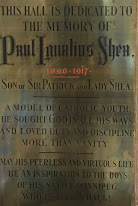
Wealthy hotelier and brewer Patrick Shea had already contributed toward an modern annex to the building, named in memory of his son Paul Ignatius, who had been a student at the Jesuit-run Fordham University in New York. Shea was terminally ill and further benefactions were expected in his will. Sinnott kept pressuring Father Hingston who, looking toward his order’s future, was adverse to refuse a second time and possibly lose their Winnipeg base, “the key to the west and capital of prairie provinces.”
 

from SPHS Archive
Father General advised the Provincial to proceed with caution but the Archbishop, anxious to have the Jesuits assume the administration for the 1933–1934 school year, gave Hingston to understand that they could expect $10,000 annually from the Shea estate. In response to an urgent telegram asking for permission to accept the Archbishop’s offer, on 14 August 1933, Ledóchowski cabled Hingston from Zurich: “affirmative, consultoribus consentientibus (affirmative, with the consent of your council of consulters.” On 26 August, Hingston signed a contract to transfer the administration and property of the College from the Archdiocese to the Jesuit Province of Upper Canada.


Father Holland’s Team


Archbishop Sinnott had wanted Father Bartlett to lead the College but the Jesuit superiors made a careful selection of four priests, each intended to compliment the others. More intellectually gifted, Bartlett was named Dean of Studies. John Samuel Holland, rector of Campion College in Regina, was chosen to be rector of Saint Paul’s. This office also included the responsibility of acting as superior over his four confreres. Joseph McDonald became Prefect of Discipline, and Christopher Keating professor of Philosophy and spiritual director.


While Bartlett and others wrote to the Father General in Latin, Holland addressed his superior in his native English. Holland’s letters to Ledóchowski were atypical among the Jesuits’ reports to Rome. Rather than focusing on the internal aspects of their mission, Holland focused foremostly on people, making them the subject rather than the object. His reports from Regina began by describing the material condition of his flock, expressing concern for farmers’ failed crops and that 75% of the people were living on relief. Yet, even in such dire straits, Holland, a consummate optimist, saw “much to be thankful for.” 

On 12 January 1934, four months after assuming the rectorship of Saint Paul’s, Father Holland penned his first letter to the General Superior:

from SPHS Archive
“I dreaded coming here as rector knowing the conditions that prevailed here during the past two years. The finances were in bad shape as little attention was paid to economy; the studies were greatly neglected though lack of firmness of the part of those in charge and lack of interest on the part of the teachers; and discipline was an unknown quantity. Besides there existed little or no union among the members of the faculty.  Thank God conditions have improved and we are getting along much better than I had anticipated. We have been able to meet our current expenses so far… There is a marked improvement also in the studies but it will take time before the results will be satisfactory…”

At the end of February 1934, the Provincial Superior made his first canonical visitation (inspection) of the College to observe the progress of his confrères first-hand. He had the occasion, in his letter to the Father General of 12 March, not to regret his choice of Holland, whom he described (in Latin) as 

“extremely patient and supremely kind to Ours [Jesuits], to the students and their parents and to the other priest and lay teachers. Because of him, they submitted to the new regime and freely accepted greater burdens than previously. He is sufficiently firm but never excessively nor does he anger easily. The qualities which perhaps he lacks are found in the other Fathers. The Archbishop, who wanted Father Bartlett, now sees the wisdom of the Society in appointing Father Holland as rector.”


The other members of the Jesuit team were also playing essential roles. McDonald “successfully introduced discipline which hitherto had never existed.” A new spirit had begun: “everyone is teaching better, the students are working harder, and this was accomplished by only four Fathers who have already given the College a Jesuit aspect.” This “aspect” included the setting up of a Marian Sodality, the Apostleship of Prayer, and the practice of frequent Communion.

College Debt

In their first year, Jesuits were successful in improving the morale at Saint Paul’s, but financial problems were more difficult to resolve. And Father Hingston would live to regret his words of two years previously:  “Financially the prospect is not exorbitantly rosy… perhaps I should have driven a harder bargain with the Archbishop.” Although the Jesuits managed to reduce expenses and cover expenditures, by frugality and efficiency, the college debt continued to grow. 


Now that the Jesuits had a second mission in Winnipeg, Hingston wanted to give up Saint Ignatius Parish. Holland and his locals confrères opposed this. They warned the Father General that it would be a grave error, since the College needed local friends and benefactors and could not exist as a stands-alone affair. Holland believed that, if the parishioners of Saint Ignatius would take up the cause of the College, their attitude would spread to the other parishes of the Winnipeg Archdiocese.


In the spring of 1935, a loophole was discovered which served as a bargaining tool: Although Sinnott had transferred to college according to civil law, he had failed to secure the necessary approval from Rome, required by Canon Law. Sinnott had sent the request to the Papal Embassy (Apostolic Delegation) in Ottawa which forgot to send it on to Rome. On 4 April, the Father General wrote Cardinal Bilsetti (in charge of the Vatican education department) explaining that Hingston had been remiss about this and other matters, so he sent a priest directly from England to replace him.


In May 1935, the new Provincial Superior, Father Henry Keane, confessed to the Archbishop that the Jesuits would have to withdraw, as they were unable to continue at the College under the current circumstances. Sinnott responded furiously, on 10 June, that he wanted them to fulfil their contractual obligations:


 “I shall be very sorry to see the Jesuit Fathers leave St. Paul’s College, for they have done excellent work and I am much pleased with them. But with regard to the financial situation I have been grievously disappointed.” 


The College’s creditors had forced the Archbishop to pay the interest on one of the loans, and Sinnott demanded a decision from the Jesuits within three weeks.


Keane advised Ledóchowski to obtain Vatican permission to leave the College unless Sinnott helped with the debt. The Provincial did not think the Archbishop would let them go because, as he wrote to the General, “under our direction the College has flourished, the number of students has increased, it recovered its fame, it has achieved successful exam results once more.” 


On 4 July, the General responded to the Provincial that one could manage such a debt under the conditions of the Great Depression and told him to remind Sinnott of his promises of $10,000 annual support. The Jesuits were prepared to remain but not to shoulder the whole debt. Ledóchowski even expressed doubts about civil legalities because, under English Common Law, a contract was invalid if one of the conditions (i.e. annual support) was not met. When questioned, however, Father Hingston was vague about exactly what Sinnott had “guaranteed” in the way of financial support. 


Keane increased the number of priests at Saint Paul's from 4 to 7.   In the meantime, the conflict over the College soured relations between the Archdiocese and the Winnipeg Jesuits. After a year of studies in Montreal, Winnipeg seminarian John Hanley had entered the Society of Jesus. Sinnott subsequently dispatched the bill for Hanley’s studies to Keane, which he was advised to pay without protest by Ledóchowski, so as not to make relations even worse.

On 26 September 1935, the College Rector sent his annual report to the General in which he touched the misunderstanding between the Provincial and the Archbishop. John Holland explained that Sinnott was poor and his cathedral was in heavy debt. The Archbishop was under a false assumption that the Upper Canada Jesuits were wealthy and would take care of the debt. And Father Hingston had been led to believe that the Patrick Shea had made a large bequest to the College. 


Holland identified the root of the problem in the expectations placed upon the Sheas' on-going generosity. He felt that the Archbishop had been too forceful with the Sheas before the Jesuits assumed the college mantle. It was Margaret Byrne Shea, rather than her late husband, who given to charitable works and who had taken an interest in Saint Paul’s. Although she had cooled toward Sinnott, she continued to be close to the Jesuits and promised $25,000 for the College, provided that none of it went to the Archbishop.

A Mistake to Give it up

With the debt looming, the Jesuits had to carefully consider their permanence at the College. In the autumn of 1935, several Canadian Jesuits sent their views to the General Superior. On 26 September, John Holland wrote: 


“The Fathers who are here are all convinced that there is a splendid future for St. Paul’s College and that it would be a mistake to give it up. They are willing to make every sacrifice, as they have been doing, to retain it. … The enrolment has increased considerably this year…The College is becoming increasingly known and especially its reputation for order and discipline being spread. … The Archbishop is very anxious that the Jesuits keep the College. He has been quite pleased with the progress that has been made and  has shown himself ready to help us all he can.”


On 17 November, Father James Carlin, Prefect of Studies, told of Holland’s extraordinary skills: 


“The Reverend Rector shows great wisdom and discretion in all his dealing and due to his untiring efforts, the College is being spoken of most highly by the people of Winnipeg and especially by His Grace [Sinnott].” 


Carlin had a great vision for the College’s future, which included a training centre for Jesuit recruits: 


“To my mind this is the very best opening we have in Canada. We are making every possible effort and sacrifice to finance and we can do so, if given time. … Our affiliation with the University permits a theological faculty with degrees of Divinity. If we established this course we would become the Innsbruck of Western Canada. A Canisianum would prove most popular to the western bishops who are trying hard to conduct small seminaries of their own. The West is our field, if we establish immediately.”


Father Adélard Dugré, the “Assistant” (regional delegate) advised that the Jesuits accept the College but ask for a new contract, freeing them of some of the debt. And, finally, the Apostolic Delegate (papal representative), Archbishop Andrea Cassulo, said that the only way to guarantee a prosperous future for the College would be for the Jesuits to stay with it.


Refinancing and Reconciliation


At the beginning of 1936, the clouds that had been hovering over Saint Paul’s began to clear. In January, the Provincial wrote to the General that Margaret Shea had donated $6,000 to pay off one of the banks. And the Jesuits had succeeded in refinancing a loan, at a lower rate of interest.

In May, Father Keane came from Toronto to make an official visitation. In his report to Rome, he noted that, in spite of many difficulties, the College had increased enrolment and had been successful with exam results and with human formation. In addition, “religious formation and solid teaching of Christian doctrine were constantly required “neque negligatur ad veram et christianam urbanitatem institutio (so that formation of true Christian manners be not neglected) –Letters of Saint Ignatius Loyola, 386.” He believed that “the experiment [of running Saint Paul’s] promises to be a solid success in every way.”

In his 22 May letter to Father Ledóchowski, Father Keane recounted an event incident that had occurred a few days previously. The Jesuits had invited Archbishop Sinnott to lunch and, the following day, Sinnott returned the compliment, after which he had a long conversation with the Jesuit Provincial. The Archbishop behaved very amicably, never waning in his praise for the College and the Jesuits. “Above all, he praised Fathers Holland, Kelly, and McDonald, who had “transformed the students for the better,” which had result in an increase of financial support from their families. These positive results bode well for the College’s future.

Keane was given the opportunity to explain the financial situation, which greatly surprised Sinnott. While the Jesuits were not in a position to pay the debts, the Provincial Superior argued that, given time and with a new loan, they would be able to do so. The Archbishop “begged and pleaded” for the Jesuits not to leave the College, which he characterized as “the greatest misfortune.” As to Vatican permission for the canonical transfer of the institution, Sinnott laughed and said that the matter had been bungled by the Apostolic Delegate. The Jesuits did not need to be concerned because “they cannot refuse to grant it.”

In September 1936, Father Holland sent his annual report to the Father Ledóchowski. Father Carlin’s death had dealt “a great blow to the College,” Holland described his late confrère as “a splendid religious, a capable Prefect of Studies and a tremendous worker.” From his deathbed, Carlin expressed but one regret: that he would not be able to help the College by carrying out his beloved duties. On a positive note, friendly relations with Archbishop Sinnott had been completely restored, as the Rector noted: 


“He has done a great deal for us and he is certainly interested in the welfare of the college. I think that the interview that Reverend Father Provincial had with him during the visitation helped to clear away certain misunderstandings which had existed up to that time.”

Material and Spiritual

Charles Kelly, SJ
The Jesuits had completed their fourth year at Saint Paul’s in 1937. The College had weathered the storm and had begun to really flourish. During the summer vacation, the Rector, the Provincial Superior, Fathers Charles J. Kelly and James.G. McGarry, submitted their reports to Father General Ledóchowski. These touched on three topics: finances, the Archbishop, and the religious community. 


According to these reports, the financial standing was improving and, for the first time, the interest on the loans was paid in full. Over half of the 271 students were receiving discounts, bursaries, or scholarships. Relations with Archbishop Sinnott were very good, according to McGarry, largely “due to the prudence of Father Rector.” Sinnott took an interest in the College and helped in various ways, including a Diocesan collection on Pentecost Sunday, to pay the College taxes. Father Kelly wrote that Sinnott “is more of a help to us than any other Archbishop or Bishop is to any of the other Jesuit Colleges in Canada.” But he was very conscious of his position and dignity: “he wishes all and sundry to realize that he is the Archbishop of Winnipeg.” Sinnott could be impatient but also magnanimous and expected others to show him gratitude.


The internal spirit of the Jesuit community was of primary importance to the order. Indeed, engendering a positive, united, and religious attitude was Holland’s recipe for a successful endeavour. Both he and Keane wrote that the “spirit of observance of the rule, laboriousness, charity, and cooperation abide.” Kelly could not “commend too highly the spirit of charity and piety that marks the life of the Community. … The spirit and mutual trust among the Community at St. Paul’s is noted in this Vice-Province and we wish to keep it that way.” And finally, in his 31 December report, McGarry noted: “Gubernatio hujus domus suavis est, sed non ut in laxitatem labatur. (This community is governed lightly but not in a way that falls into laxity.) Indeed, Holland monitored religious discipline daily so that that Jesuit community life remained a concrete reality. 

Sinnott blesses Shea Hall cornerstone, 1932

Sinnott’s Vision

As its founder, Alfred Sinnott considered Saint Paul’s as his own and the Jesuits his administrative agents. By the end of the decade, the buildings at Ellice and Vaughan had become too small for the needs of a college and high school with resident staff and student borders. In the spring of 1939, Sinnott commissioned an architectural plan for a major expansion which would add additional classrooms and a new dormitory to Paul Shea Hall. Without consulting the Jesuit superiors, he began a fundraising campaign and published a drawing in the Winnipeg Free Press

Father Keane’s successor as Provincial Superior, Father Thomas Mullaly, informed the General Superior that he and his counsellors were opposed to the expansion unless $100,000 could be found to cover the costs. Meanwhile, the Archbishop went to Rome to perform his ad limina visit and to present his plans to the new Pope, Pius XII, and the Roman Curia. First, he met with Monsignor Ruffini of the Vatican education department, then with the Jesuit General, who approved the matter in principle. On 11 June 1939, Sinnott addressed two letters letter to the Pope. In the first letter, he sought the Pontiff’s blessing for the expansion of the College upon which he lavished high praise:


“This College is my joy and my pride. It is now under the care and direction of the Jesuit Fathers and I am thoroughly satisfied with their work. I am wholeheartedly behind them and I will not be content until every Catholic boy under my jurisdiction receives his higher education in this institution.”


The Archbishop asked for the Jesuits be allowed to borrow $100,000 to finance the venture, and the Pope entrusted the matter to his Secretariat of State. On 8 July, Monsignor Giovanni Battista Montini (the future Pope Paul VI) asked the Jesuit General to accede to Sinnott’s desire, provided that he thought it “wise and opportune.”


Meanwhile, the Winnipeg Jesuits came up with a counter-offer. Instead of a large and costly extension, they proposed adding six classrooms which would require only $45,000. Sinnott agreed to the more modest extension and gave his solemn assurance that he would help with fundraising. On 6 June 1939, Father Ledóchowski approved the revised plan after obtaining permission from the Vatican department for religious orders. On 15 July, he informed the Secretariat of State that the matter was arranged, and Montini gave Sinnott the good news on 21 July.


Alfred Sinnott’s second letter to the Pope, presented on 11 June 1939, was also connected with his plans for Saint Paul’s. He was looking for a mark of success and a visible sign that the institution (and its founder) enjoyed papal approval. The Archbishop wrote:


“I crave a mark of benevolence and paternal encouragement that will never be forgotten in the years to come. I ask that Your Holiness will make a gift to the College of an oil painting of the great apostle St. Paul. I do not desire an original, but rather a copy of an existing picture which will be inspiring to the young men who frequent the institution.”


Della Porta's original
A few days after receiving this letter, Monsignor Montini contacted the Director of the Vatican Museums, Professor Bartolomeo Nogara. The latter commissioned a copy by an artist named De Simone, of a painting by Renaissance master, Fra Bartolommeo della Porta. On 1 August, Montini wrote to inform Sinnott that Pius XII had acceded to his request:


“It was with particular pleasure that the August Pontiff learned of the growth of the College and it is His confident hope that this gift which He deigns to bestow at this time,  […] may, indeed, be a source of real inspiration to the students of the College.”


The additional classrooms were completed by the end of 1939. In December, Sinnott sent effusive thanks to the Pope “for the magnificent painting,” together with a notably large “Peter’s Pence” offering for that year. He also agreed to a new contract with Jesuits, which came into effect in April of 1940, in time for his episcopal silver jubilee. 


Even with the additional classrooms, with almost 400 students, Saint Paul’s was outgrowing its downtown campus on more than one level. Father Francis Smith’s report, from the summer of 1938, noted that Holland, who had been marvelous in dealing with the problems of the early years, was lacking a vision for the future. Holland, Kelly, and McDonald were not intellectuals and placed a great deal of emphasis on sporting activities. Also, the students of the High School were excelling at greater rate than those of the College, perhaps because the Rector himself taught the former and subconsciously gave them preference. It was time for a change if the College was to progress. Accordingly, in 1941, Holland was replaced as rector, though he continued to teach in the high school. 

St. Paul's with extended Paul Shea Hall

Abiding Spirit

John Holland had proven to be a second founder of Saint Paul’s. Despite several changes in leadership and personnel, the good spirit which he painstakingly cultivated continued to characterize the College and High School. The reports of visitations from the late 1950s testify to this fact. In 1955, Provincial Superior George E. Nunan, wrote to General Superior Jean-Baptiste Janssens, that: 


“The fidelity of the members of the Community to spiritual duties and their generosity in doing the work assigned them is gratifying. For these divine blessings and that of mutual union, the Community should be thankful to God.” 


And in 1957 Nunan said: “the charity and zeal of the members of this community is remarkable.”


Father St. Clair Monaghan, the principal of the High School, observed that “the spirit of union and religious charity existing in the community is worthy of praise and commendation.” Clemens J. Crusoe noted that “ the community’s spirit of good will and basic contentment is reflected in their work.” In 1958, future librarian Father Harold J. Drake said, “Our community here is considered to be one of the luckiest and happiest ones in the Province.”


In their reports from 1956 to 1958, Fathers Nunan, Crusoe, and Sheridan praised the High School Principal, Father Monaghan, and his assistant, Father Barry Connelly, for their “firmness in direction of studies and discipline.” Father Clarence Lynch, assisted by Jesuit Scholastic (seminarian) John English, had obtained good results with religious sodalities. And Crusoe defined Father Hanley’s course in speech as “outstanding.” Sheridan observed that the boys, who were observing a stricter dress code of jackets and ties, manifested “a more serious approach to studies and a wider interest in things spiritual.” 

Old Wine in New Wineskins

Archbishop Sinnott did not live to see his vision for Saint Paul’s become a reality. In 1954, the year of his death, the University of Manitoba extended an invitation to relocate to its Fort Garry campus, offering cost free land on a renewable 99 year lease. The College would have to find the money to construct a building. After much discussion, in the spring of 1956, the Jesuits accepted the offer.


In order to ensure the future of the College, on 18 May 1956, several Jesuits, led by College Rector Cecil C. Ryan, asked the General Superior for permission to establish a lay advisory board. This was to bring prestige to the institution by the association of prominent citizens, Catholic and non-Catholic alike, from Winnipeg business and professional sectors.  In addition to funds received from private donors, the Province of Manitoba provided $100,000 toward the construction of the new Saint Paul’s.


Cecil Ryan, SJ
In December of 1957, Nunan quoted Sinnott’s successor, Archbishop Philip Pocock, as saying that “the transfer of the College to the university campus is the greatest thing that has happened to the Archdiocese since his arrival.” Construction was on schedule, thanks to the efficient handling of the project by Father Ryan. Father Drake quoted the Archbishop’s words of praise at a clergy dinner, held in January 1958 at the old buildings: “Father Ryan has done a magnificent job of public relations for the College during his term of office, and he wished there was some loophole that would allow an even further extension of that term.” 
In fact, Ryan’s term had already been extended a year to oversee the completion of the new College. The new Provincial Superior, Father George F. Gordon, obtained further permission to delay the announcement of the new rector until after the opening ceremony, because Pocock wanted Ryan remain in office until that event took place. In a report to the General, Gordon described the October 1958 inauguration as “a very notable event in the history of Catholic education in Canada.”


In 1964, the High School relocated to its a new building of its own, taking with it the painting which Pius XII gave Archbishop Sinnott for Saint Paul’s. Originally displayed in the main foyer, it has since been moved to the entrance of the new chapel. Bartolommeo della Porta’s renaissance original has been located in the papal antechamber, the Sala del Tronetto, where it hangs on the oppose wall of the artist's painting of his fellow apostle of Rome, Saint Peter. Documents pertaining to the Winnipeg copy were discovered in the Vatican Apostolic (formerly know as the “Secret”) Archive, only weeks after the papers on Saint Paul’s were unearthed in ARSI.

Father Holland’s Corner

Father Drake wrote that “the story of Saint Paul’s is a good one, and has to be told.” The same goes for the story of its refounder and his Jesuit team. The decision to appoint Holland to lead Saint Paul’s was fortuitous. He began his mission by accompanying young men in a search for wisdom to its Source. And in retirement, he continued to accompany alumni and friends and share news, making use of his prodigious memory. His care for the Saint Paul’s family, past and present, was epitomized in his column, “Father Holland’s Corner.” 

John Samuel Holland ended his earthly mission in November 1987, at his beloved Saint Paul’s. Both High School and College communities prayed over his bones, invoking the Divine Mercy in thanksgiving for his care. Now it is time for us alumni to care for his memory and that of the schools he helped transfigure.


To presume to eulogise one man is to pipe up for a whole generation.
– The Poet Laureate, The Patriarchs, 17 April 2021

A·M·D·G