Showing posts with label oriental congregation. Show all posts

Monday, 20 December 2021

Exsul Familia – A Family in Exile


Last August, a 68-year-old document was extracted from decades of dust into the light of the present and republished in Italian by the Vatican press. It was Pius XII’s Apostolic Constitution, Exsul Familia Nazarethana, or the Nazarene (Holy) Family in Exile, first issued on 1 August 1952. 

An Apostolic Constitution is the most solemn form of legislation issued by the popes, in the form of a bulla (led-sealed parchment). The background to this was that the Second World War had forced 12.6 million displaced persons (DPs) to seek refuge in various western European countries. Over 3 million of them were Ukrainian. These refugees asked to be ministered to by clergy that spoke their native languages and understood their customs and cultures. Many bishops asked Rome to issue guidelines, the result of which was the first systematic reflection on human migration in the papal magisterium.

Pius XII noted that displaced persons lose much of their security and human dignity, and help up the example of the Holy Family from Nazareth (Jesus, Mary, and Joseph) as an example for migrants of every age. The document also outlined the nature and extent of papal charitable works in favour of millions of DPs, during and after the war (from which Ukrainian religious and cultural entities also benefited). It called for greater, more specified pastoral care of refugees, mandating that ethnic, linguistic, and ritual traditions be supported by local Catholic hierarchs. For its extensive substance and provisions, Exsul Familia became known as the magna carta of migration.

The papal charter was also significant for offering a reflection, not merely on the migration of ethnicities, but also of rites. It provided indications on how the powerful Latin Church should deal with the smaller, more vulnerable Particular Churches. Bishoprics established in the twentieth century for Byzantine-Rite Catholics in Canada, USA, Brazil, and even Italy, were cited as examples of papal solicitude. For the Ukrainian Catholic Church, which had been violently suppressed by the Soviets in countries within their “sphere of influence,” this confirmed the pope’s promise to protect it and restore it in the lands of immigration.

The teaching of Exsul Familia was supposed to serve as a buttress against resourceless Eastern Catholics being forced to assimilate to predominant Latin Rite in their countries of refuge. It was also expected that that Eastern-Catholic missionaries would henceforth be given a freer hand by local Latin hierarchs. Surprisingly, the opposite happened. Exsul Familia laid down principals but its implementation had been entrusted to Roman Curial department known as the Consistorial Congregation. The juridical norms issued by that department replaced existing apostolic visitations to ethnic and linguistic groups with priest-delegates responsible to the Consistorial.


From the moment these norms appeared, diocesan functionaries began to question the authority of Archbishop Ivan Buchko, the Apostolic Visitor for Ukrainian Catholics, who had been granted direct authority over the clergy and faithful throughout western Europe. The wording of the norms made it appear that the papal constitution had also supressed Buchko’s jurisdiction. Chancery functionaries told Buchko’s officials that they would have to apply to become ethnic delegates under Latin diocesan structures. Buchko appealed to the Congregation Pro Ecclesia Orientali to resolve the issue. On 16 November 1953, that Congregation's head, Cardinal Eugène Tisserant, addressed an official letter to Archbishop Buchko, clarifying that Exsul Familia and its accompanying norms did not pertain to the Eastern Rites. 

The Latin Particular Church has long had issues with ritual and spiritual diversity within the Catholic Communion and, historically, has very often mistaken itself to be the unique expression of Catholicism. Having experienced this first-hand, at home and in exile, Buchko acted quickly to have more permanent structures put in place. Following the Exsul debate, he petitioned the Oriental Congregation replace his visitation with apostolic exarchates. These were indeed established: in Britain, in 1957; in Germany, 1959; and in France in 1960. 


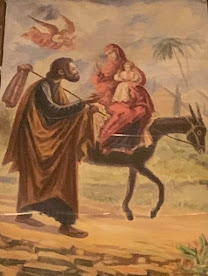
Hieromonk Parteniy Pavlyk's 
the Holy Family's Flight into Egypt
 
In August 1962. on the eve of the Second Vatican Council, a conference was held in Rome to commemorate the tenth anniversary of Exsul Familia. In attendance was Augustine Hornyak, Auxiliary Bishop and soon to be Exarch for Ukrainian Catholics in Britain. The conference and perhaps even more so the papal charter made a  great impression on the freshly-minted bishop, whose flock identified as скитальці or post-war political “exiles.” When seeking financial assistance for a suitable cathedral church, he pleaded with the papal representative in London: “I am asking for a part of the Universal Church of Christ, for an Exsul Familia, which wants to survive here and sustain the ‘Church of Silence’ in our homeland.” After receiving a large subsidy, Hornyak surprised everyone by christening his new cathedral “Holy Family in Exile” after Pius XII’s Apostolic Constitution. The name “Пресвята Родина в Скиталю” was also intended as a reminder to his flock that the Almighty, who had temporarily permitted the Holy Family’s exile, would, one day, allow exiled Ukrainians to return to their own native land.


The year 2022 will mark two important anniversaries: the seventy fifth anniversary of the canonical establishment of the Ukrainian Catholic Church in Britain (3 March 1947), and the seventieth anniversary of Pius XII’s Exsul Familia (1 August 1952). In an introduction contained in its new edition, Professor Andrea Tornielli of Vatican Communications notes that Pope Francis’ teachings on migrants have their roots in Exsul Familia. What many in Rome and elsewhere will be surprised to learn is that a cathedral in London, the spiritual Nazareth of thousands of migrant workers today, stands as a living witness to the first Catholic migrants’ charter.

Monday, 19 July 2021

The Union of Brest at 425


The UNION of Brest (1595–1596) aimed to heal the lack of canonical unity between the Churches. In the spirit of the 1439 Florentine Union, the Orthodox Church of Kievan Metropolia (today's Ukraine and Belarus) sought to rekindle ecclesial union with the Roman Apostolic See. Prominent Roman theologians and curialists made theological, canonical, disciplinary, and liturgical arguments why they should be forced to conform to the prevailing Roman Rite. Instead, Clement VIII achieved an authentic, enduring unity by confirming their ancient customs and particularities. 


Even after the Union, the bishops-delegates were interrogated by curial cardinals as to why they were not wearing the 'proper' vestments. Unity was achieved in diversity, although not all accepted union and "Uniates" were often treated a second-class Catholics.

When Eastern Catholic migrants came to the Americas and western Europe, similar arguments were made, that multiple Rites an Disciplines within the same territory would harm the unity of the Church. Local Roman bishops cited the newcomers' aversion to the majority Rite as proof of the inauthenticity of their Catholicism. They were accused of disobedience, divisiveness, and having schismatic proclivities. One curial cardinal even cited the Fourth Lateran Council.

On closer examination, those fears were more to do with controversies within the local Churches (such as conflicts with Protestants) than going to the peripheries and casting their nets into the deep waters.

Pope Leo XIII (in the 1890s) and Pope Pius XII (after the Second World War) intervened for the marginalised, when the local Churches were too beholden to their own interests to foster unity in diversity. Thus, their names are written in golden letters in the history of the Eastern Catholic Churches.

After 130 years, the Congregation for the Eastern Churches issued a document admitting that earlier curial policies had not properly provided for the early émigré minorities. Significantly, it also admitted that, as a result of those mistakes, 100,000 faithful abandoned the Catholic Communion.

The means used to achieve unity at Brest were far from perfect. Nevertheless, despite every hindrance from tyrants, churchmen, fastidious theologians, and positivist canonists alike, today the Ukrainian Greek-Catholic Church is a Church in its own right (ecclesia sui iuris), with an international hierarchy and more than 6 million faithful on 5 continents. 

Ut unum sint!

Saturday, 8 May 2021

General Pavlo Shandruk to Pope Pius XII

Shandruk in Polish uniform


 Your Holiness! 

            On the solemn day, for the whole world of 80th Birthday Jubilee of Your Holiness,

On behalf of 20,000 soldiers of the 1st Ukrainian Division of the Ukrainian National Army and tens of thousands of their relations, I bend my knee in reverence with deepest gratitude before Your Holiness for having saved those soldiers from certain death.

Those soldiers, and thousands of others of that Division who perished at [the Battle of] Brody were the finest sons of the Ukrainian Nation.

They joined the 1st Ukrainian Division to arm themselves in the hope that, at the opportune moment, they would drive out the old enemy of our beautiful yet somehow unfortunate Ukrainian homeland. And 90% were the flower of the Ukrainian intelligentsia.

 Red Moscow [The Communist Kremlin] demanded their repatriation and the Western Allies, ignorant of the Ukrainian people’s struggle for freedom and independence, were on the verge of handing them over.

At that moment, the one and only hope for us all was the profound faith that only the intervention of Your Holiness could rescue all of those brave patriots. It was with this hope that I, along with delegations from those very soldiers, approached our beloved Prince of the Church, Archbishop Ivan [Buchko], to plead with Your Holiness for help and deliverance.

Your Holiness,

as the Great Patron and Protector of all who are sorrowful and oppressed, You did not refuse His Excellency Archbishop Ivan. We were all saved by the Apostolic See of Your Holiness. And I, their commander, prostrate in filial humility before the Greatest, Worthiest, and Holiest Figure of Your Holiness, we have the greatest honour and good fortune on the day of the 80th jubilee of Your Holiness, to beg the Merciful Saviour and His Most Holy Mother, to bestow endless gifts upon Your Holiness, long life and excellent health for the good of all humanity. All of us without exception will always offer our humble prayers for Your Holiness. We beseech Your Holiness for Your Apostolic Care and intercession before the Throne of the Most High on behalf of our poor humiliated Nation. 

            Prostrate in profoundest respect and endless gratitude          

                        Pavlo Shandruk

Lieutenant-General

Ex-commander of the Ukrainian National Army

May 1956 Anno Domini


Documentation from the reign of Pius XII (1939–1958) was opened to scholars in March 2020. Shortly after this, I discovered an Italian translation of the above letter, made by Archbishop Ivan Buchko, in the Archive of the Congregation for the Eastern Churches. The original letter, written in Ukrainian, was only discovered last month in the Vatican Apostolic Archive.

            Finally, scholars will be able to clarify the role played by the Apostolic/Holy See, through its various officials and representatives, in rescuing the Ukrainian Division from being repatriated to the Soviet Union, as demanded by Joseph Stalin. Several books and many articles have been written on the Division but the role of the Pope and his Curia have hitherto been shadowed in mystery and innuendo, since the relative source documents were not accessible. My friend, Professor Myroslav Shkandrij, will touch on this question in his upcoming book on this controversial topic. 

Buhcko visits the Division 1946

          Bishop Buchko brought the desiderata of Ukrainians refugees to the Pope directly and via his Roman Curia, especially through the Congregation which was then called Pro Ecclesia Orientali (today it is Congregation of the Eastern Churches), headed by the indomitable Cardinal Eugène Tisserant. The refugees included both Catholic and Orthodox Christians, and the Apostolic See assisted all of them without discrimination. Among these was the future Metropolitan Ilarion Ohienko, who requested help with research in Switzerland. Buchko asked Tisserant to intervene and the latter obtained access for Ohienko to the University of Fribourg. In arranging this, Tisserant wrote to the Nuncio in Switzerland, in June 1946: “It is the wish of Holy Father that the Oriental Congregation also takes an interest in the material and moral wellbeing of the Orthodox Bishops, in seeking to help them and to assist them with all their just requests.”

In the Spring of 1945, Bishop Buchko wrote to the Pope, to Cardinal Tisserant, and to Monsignors Montini and Tardini of the Papal Secretariat of State. As a Frenchman in Italy who had made his sympathies clear during the War, Tisserant was highly respected by the victors. He lobbied his Allied political and military contacts and the Papal Secretariat of State, which in turn lobbied Allied authorities all over Europe not to forcibly repatriate Ukrainians to the Soviet Union. The Division was only one among several groups in danger of repatriation. Tisserant also brought the Ukrainians’ appeals to the Pope in an audience of 14 and 28 July 1945 and on subsequent occasions.

On 30 September 1955, a general letter of homage was sent to the Pope by the Association of ex-members of the Division. On 15 June 1956, Buchko entrusted Shandruk’s private letter to Cardinal Tisserant, who sent it to the Pope via the Secretariat of State. At the time, the ex-general was residing in Trenton, Ohio, as indicated on Buchko’s Italian translation of the letter (where he substituted “Trenton” for  “травень” (May) 1956. Buchko also airbrushed himself out and substituted the passages referring to himself with thanks to the Oriental Congregation. Although Shandruk had not made that reference in his original letter, Buchko was aware that, without Cardinal Tisserant’s dogged perseverance (as evidenced by internal notes between Tisserant and his own officials), the papal Secretariat of State would not have intervened so vigorously for the Ukrainian prisoners and refugees. In response, the Pope ordered his underlings to thank the old General and to assure him of the Pope’s enduring concern for the “severely tried” Ukrainian people.

Shandruk in UNR uniform
            
General Shandruk was an Orthodox Christian from Volyn. In the First World War he served as a officer in the Russian Army and later in the army of the Ukrainian National Republic. After the war he continued his association with the UNR in Exile. In 1936, he joined the Polish Army and fought to defend the Second Republic against the German Invasion of September 1939 (for which he was posthumously decorated by the Polish Government-in-Exile, in 1965.) In February 1945, he was appointed commander of  a Ukrainian National Army and was dispatched to Austria to organize the former Galicia Division, for that purpose. On 8 May 1945, he surrendered the Ukrainian Army to the British and American Allies. There has been talk of the intervention of Polish General Anders, but it is clear that Shandruk attributed the salvation of his men, at the most critical moment, to the intervention of the Pope.
 
Shandruk mentioned the papal intervention on p. 291 of his 1959 book Arms of Valor.

Tuesday, 25 August 2020

The Vatican and Events in Soviet Ukraine


Next month, I will be presenting an overview on post 1939 Vatican sources pertaining the Ukrainian Greek-Catholic Church, in a conference organized by the Ukrainian Catholic University in Lviv. Much of this information comes from a book I am publishing about Metropolitan Sheptytsky and from recently opened archives.

During the Second World War, the Holy See (the Vatican) struggled to obtain reliable information about the situation of the local Churches in war-torn Europe. This was particularly difficult in areas under the control of Soviet forces, which did not permit communication with the rest of the world.

  Soon after the Nazis and Soviets partitioned Poland, in September 1939, rumours began circulating in the west that Metropolitan Andrey Sheptytsky, Greek-Catholic primate and Archbishop of Lviv-Halych, had been arrested, deported, or killed by the Soviet invaders. Indeed, Sheptytsky himself had been expecting such a scenario, since the Imperial Russian authorities had deported and imprisoned him in 1914. But no such orders were issued, neither in September 1939 nor when the Soviets returned to Lviv in the summer of 1944, following a German interregnum. Kyr Andrey’s moral authority had become too great and Stalin preferred to wait for his imminent demise before setting in motion his plans to suppress and merge the Greek-Catholic Church with his own state-controlled entity, staffed (especially in Ukraine) by clerics working for the Soviet secret services.

            Having endured most of the Second World War, following a long and painful illness, Metropolitan Andrey finally succumbed on 1 November 1944. His brother, Hieromonk Klymentiy, wrote a note to their other brother, General Stanisław, which read: “This very day, at a quarter-to-two in the afternoon, our dear Metropolitan fell asleep in the Lord.” Four days later, news of the venerable prelate’s death was already appearing in the European press, and the Polish Ambassador to the Holy See informed the Papal Secretariat of State of the fact on 12 November. A brief notice was published on the front page of the Vatican newspaper Osservatore Romano on 14 November followed, the next day, by a longer panegyric containing laudatory declarations from the Cabinet of Ministers of the Polish Government in London. The Government-in-Exile also ordered a solemn requiem Mass to be said by the Polish Military Ordinary on 2 December, at the Church of Saint Stanislaw in Rome.

Confirmation of Sheptytsky’s death from Lviv was not forthcoming for three months. On 6 March 1945, a letter arrived from Sheptytsky’s successor, Metropolitan Yosyf Slipyi, addressed to Pope Pius XII and dated 19 November 1944. Cardinal Eugène Tisserant, head of the Congregation for the Eastern Church (Oriental Congregation), presented the letter to the Pope when he was next received in audience, on 10 March.

News of Slipyi’s succession presented a problem for the Vatican. According to the Concordat between the Holy See and the Second Polish Republic, episcopal appointments required a nihil obstat from the Polish President. But Slipyi had been appointed secretly as coadjutor-successor to Sheptytsky in November 1939, shortly after the Soviet takeover. The Vatican foreign ministry (a section of the Secretariat of State) chose to keep the appointment secret until the end of the war, in order to avoid an inevitable clash with the exiled government. After news arrived that Slipyi succeeded to the post, this became unavoidable.

Monsignor Domenico Tardini, head of the Vatican foreign office, informed Polish Ambassador Casimir Papée that Yosyf Slipyi had succeeded Andrey Sheptytsky in the primatial Lviv-Halych See. Papée had no choice but to issue a diplomatic protest, but his government was in a precarious position. In July 1945, the United States followed by the Allied Governments gave in to Stalin and transferred diplomatic recognition from London to Lublin, where the Soviet occupiers had set up a supposed coalition which was really a Communist regime. Although Papée tried everything to countermand the appointment, in the end diplomatic notes were exchanged stating that it was an exception to the rule, made under wartime conditions. Rather than the exception, it became the new norm: No further placets would be solicited from London, and the Polish People's Republic declared the concordat to be void.

Unbeknown to either party, three days before the Holy See and the Government-in-exile resolved the theoretical conundrum, the entire Greek-Catholic hierarchy, including Slipyi, was arrested and deported by the Soviet secret police. The first news of their arrest reached the Vatican three months later from a Greek-Catholic priest of Polish origins, Count Piotr Rzewuski (later known as Bronsisław Kreuza). He had been a eyewitness to Sheptytsky’s death and the events that followed. As a Pole, he was permitted to leave Soviet Ukraine on 15 June and immediately made his way to Rome. 

After checking his story with the exiled auxiliary-bishop of Lviv, Ivan Buchko, Cardinal Tisserant informed Pius XII on 11 August 1945. At the audience’s conclusion, the Pope kept the typed agenda (foglio di udienza), containing the details, among his own papers. Tisserant’s second in command, Bishop Antonio Arata, sent official notification to the Secretariat of State on 17 September. A week later, further details arrived, via Bishop Buchko, from five sources that had contact with Ukraine via underground agents. The sources specified the exact date of the hierarchs arrest, 11 April 1945, and confirmed their deportation to Kiev, the capital of the Ukrainian Soviet Socialist Republic. In October, Rzewuski would be allowed to present to the pontiff the homage of the loyal Ukrainian clergy, who had been “deprived of their shepherd.” In December, the Pope issued an encyclical letter, Orientales omnes, decrying their imprisonment only days after the Russian Patriarch issued a call to Greek-Catholics to join his fold (a call which would be implemented by force by the NKVD at a fake synod, the following year).

No concrete news of the Ukrainian Catholic bishops’ condition would be be forthcoming for a decade. False reports were published announcing Slipyi’s demise, the first of these appearing in January 1945 in the British Catholic paper, The Tablet. Following the hierarchs’ condemnation by a Soviet military tribunal, on 3 June 1946, the Holy See assumed that Slipyi had died, and Tardini said as much to the peeved Polish ambassador. It was only after Stalin’s death, and the release of some of the bishops and clergy from the gulag, that news to the contrary reached Vatican City. In January 1954, Buchko (now Archbishop), reported that Slipyi was still alive and in prison. The news prompted an elderly and ailing Pius XII to include Slipyi’s name at the top of hierarchs to which he addrressed his encyclical Novimus nos in May 1956. The following December, he sent a formal apostolic letter to Slipyi on the occasion of the latter’s seventieth birthday, congratulating him on his fidelity. We know that a copy of the papal message reached the imprisoned metropolitan. Pius XII did not live to greet Slipyi upon his arrival in Rome seven years later, in January 1963. Negotiations for the longsuffering prelate’s release were carried out by curial officials of Pius’ successor, Pope John XXIII.

Saturday, 2 March 2019

On the 80th Anniversary of the Election of Pius XII


In 2006, Pope Benedict XVI opened the files of the Pontificate of Pius XI (1922–1939). Documents of the archives of the Apostolic See can be consulted up to 11 February 1939, with some exceptions. One such exception are the fascicles concerning the death of Pius XI and the election of Pius XII in the Archive of the Nunciature of Warsaw, in the Vatican Secret Archives. They contain updates from the Roman Curia to the Warsaw Nunciature and official messages of congratulation. Local church archives are invariably open beyond February 1939, and I have translated a message from the Oriental Congregation addressed to Bishop Ladyka, which was sent to all Eastern Catholic superiors. Historians eagerly await the opening of at least a portion of the Apostolic See's archives from of Pius XII's pontificate. Perhaps this eightieth anniversary will be the harbinger of that happy event. 

Update: On 4 March 2019, Pope Francis announced that he has consented to the opening of the fonds of the pontificate of Pius XII (1939–1958), on 2 March 2020.

From the Archive of the Nunciature of Warsaw:

Monsignor Giovanni Battista Montini to Archbishop Filippo Cortesi, Nuncio

2/III 1939
Vatican City
[I have the] pleasure to announce [that] Cardinal Eugenio Pacelli [has been] elected Supreme Pontiff Pius XII [,] alleluja. Deign [to] make [the] announcement [to the Polish] Government.

Cardinal Eugène Tisserant to Archbishop Filippo Cortesi

Vatican City, 2 March 1939

Your Excellency will not have failed to notice the delicate allusion that the new Pontiff addressed, in His first message, not only to the Bishops, the Clergy and to all the children of the Catholic Church spread everywhere across the world, – especially those who are suffering in poverty and pain – but “also to those who dwell outside the bounds of the Catholic Church.” And undoubtedly among the first of these, the heart of the Supreme Pontiff included the separated brethren to which, moreover, the August hope that Pius XII made a point of expressing is addressedthat “they would willingly accept divine assistance from Us, at this most solemn hour which We have implored in prayer from Almighty God.”

From the Archive of the Archeparchy of Winnipeg:

Cardinal Eugène Tisserant to each Eastern Catholic hierarch

Vatican City, 2 March 1939

            Eastern Christianity has very particular reasons to share the joy of the Catholic world at the election of the Most Eminent Lord Cardinal Eugenio Pacelli as Supreme Pontiff with the name of Pius XII.
            He is not new to eastern religious questions as, in His multiple offices, He often dealt with them with vigilant attention and always with desirous hope of a priest and apostle. Now Pius XII assumes the Prefecture of the Sacred Congregation for the Eastern Church after already having offered, for many years, the wisdom of his counsel for its better administration, while fervidly and prudently collaborating with the codification of Eastern canon law.
            And if His office of Supreme Pontiff – which He seems to indicate in the very choice of name – will be inspired by the magnanimous paths traced by the genius and piety of Pius XI, then the East is certain to have, in Pius XII, a Shepherd like the Former, lovingly solicitous of its every need and hope. And if, from the motto borne on his coat of arms “Opus iustitiae pax,” it is reasonable to envision a program, then it can be said that, by Pius XII, the East will continue to be governed with that goodness and justice which are the only sources of peace.
            And wherefore, Most Reverend Excellency, may Your joy be great and that of all the clergy and people which constitutes your crown, and may their feelings of filial devotion and generous confidence reach the Most High, Who again has given the Church its Visible Head. A new era of greatness and glory is announced for Catholicism, and the Christian East shall have the richest part in this general rejoicing.
            United to Your Excellency and to His entire diocese in rendering praise and thanksgiving to the Lord, I again unite myself to Your prayer and to those of Your faithful, that the sweetest Mother of God will protect, comfort, and enlighten, the Holy Father Pius XII in the Pontificate which begins today. 

From the Archive of the Nunciature of Warsaw:

Metropolitan Andrey Sheptytsky to Archbishop Filippo Cortesi

In Pace.                       Léopol, 9 March 1939.

            I beg Your Excellency to deign to receive, in the name of His Holiness the Pope, the homage of obedience, of fidelity and of piety, which I present to Him on the day of His Holiness’s coronation in the name of my clergy, my faithful, and my own mediocrity.
            The magnificent conclave of 2 March was such a striking manifestation of the unity of the Church, that we felt a very great joy. Permit, Excellency, that I congratulate you – who takes the place of the Holy Father. This conclave, no less than the August Person of Pius XII, increases our supernatural hope that, under the reign of this pontiff, the poor eastern nations separated from the Church by the Eastern schism, will return, little by little, to the unity of the Catholic Church, or move toward this unity by evermore understanding that it is the word of the Almighty. 

Friday, 22 June 2018

“In Exile No Longer” : Holy Family Cathedral Celebrates 50 years


Ukrainian version: "Вже не вигнані" Патріярхат, no. 6 [470] (листопад–грудень 2018), ст. 21–24.
          
On Saturday, 23 June 2018, the Ukrainian Catholic Cathedral in Westminster solemnly marked the fiftieth anniversary of its opening. For over forty of those years, it was known as “The Holy Family in Exile.” We might say that this cathedral had its origins in two historical events: the forced emigration of Ukrainians from their homeland, during and after the Second World War; and a promise made to them by the Pope. 
The Ukrainian Greek-Catholic Church had been outlawed by the Soviet Communists in 1945, but Pope Pius XII defended it and made a promise to preserve the Church abroad and to reconstitute its hierarchy. His Apostolic Constitution, Exsul Familia Nazarethana (The exiled Nazarene [Holy] Family), of 1 January 1952, was part of that promise. Known as the magna carta on migration, it mandated that diocesan bishops had the duty to offer special pastoral care for migrants and displaced persons. Placing the Faith above all, the Pontiff supported he migrants' desire to maintain their ethnic traditions, language, and gave particular attention to preserving the Rites of the Eastern Churches.
Saffron Hill
Ukrainian Catholic immigrants began to form a community in London in 1946. Bishop Ivan Buchko, whom the Pope had appointed as their overseer (apostolic visitor) throughout Western Europe, visited London in January 1947, and sent a permanent pastor two months later. This priest chosen for the mission was Father Josaphat Jean of the Basilian Order, a French-Canadian who had adopted the Byzantine Rite to minister to Ukrainian immigrants in Canada. With the assistance of community leaders, organizations, and the Archbishop of Westminster, Father Jean was able to acquire a small church in Saffron Hill, Farringdon, in July 1948. The first Ukrainian Catholic church in Britain, dedicated to Saint Theodore of Canterbury, was solemnly blessed by Bishop Buchko, on 5 December 1948.
Buchko and Jean both considered this first edifice to be temporary, intended to provide a stable place for worship and to gain a foothold in London. From the beginning, however, they foresaw the acquisition of a larger church, once the congregation became stable and better equipped financially. Jean was recalled to Canada in the Summer of 1949. Bishop Buchko replaced him, as his Vicar General for Britain, with Redemptorist Father Volodymyr Malanchuk. The following year, due to ill health, Malanchuk was also transferred to Canada and was succeeded by Monsignor Oleksander Malynovsky. In the early 1960s, the little church in Saffron Hill was rededicated to the Protection of the Mother of God.
In only a few years, the Ukrainian Greek-Catholic Church made significant progress in Great Britain. It acquired churches in several major centres, such as Manchester, Nottingham, and Edinburgh. Through the work of his minister for Eastern Catholic Affairs, Cardinal Eugène Tisserant, Pius XII began to establish missionary dioceses to replace Bishop Buchko’s provisional mission. Apostolic exarchates were established: in England & Wales in 1957, in Germany in 1959, and in France in 1960.
Nevertheless, when asked for their opinion in 1954, the Catholic Bishops of England and Wales were not enthusiastic about a special jurisdiction for Ukrainians. In order to soften the blow, Cardinal Tisserant asked the Archbishop of Westminster, Cardinal Griffin, if he would take on this responsibility himself. Griffin agreed but died soon afterwards. His successor, William Godfrey also accepted and was solemnly enthroned as exarch for Ukrainians at the little Saffron Hill church, on 9 November 1957.
proposed cathedral 1959
The Papal Bull establishing the exarchate, dated 10 June 1957, stated that it needed a cathedral church in London (probably at Bishop Buchko's suggestion). The project for a cathedral fell to a new Vicar General, Canadian Redemptorist Father Paul Maluga. In March 1958, Godfrey made the first contribution to the cathedral fund of 2000 Guineas (slightly more than 2000 pounds). Maluga commissioned sketches for a new church in the Byzantine style, and the fundraising campaign was inaugurated on 2 December 1959. Despite his Canadian pragmatism, energy, and enthusiasm, Paul Maluga’s project encountered opposition from segments of the local Ukrainian community and even some clergy. In the end, he raised just over 17,000 pounds, which was barely enough to buy London property.
Archbishop Godfrey was elevated to the cardinalate at the end of 1958, and was given a Ukrainian-Rite auxiliary bishop in August 1961. Maluga was passed over for a Basilian monastic from the USA, Augustine Hornyak. The bishop’s first solemn Liturgy, on 17 December 1961, had to be held in St Peter’s Clerkenwell (founded for Italian immigrants), since Saffron Hill was woefully inadequate. Godfrey died in January 1963 and, on 18 April, Hornyak was appointed to succeed him. During his enthronement on 6 June, the Apostolic Delegate, Gerald Patrick O’Hara, told Hornyak: “you deserve a better church.” 
Duncan Street church
The new exarch abandoned Maluga’s earlier project, deemed unworkable, and chose to acquire an existing church. In May 1963, the exarchate purchased the former Catholic Apostolic Church in Duncan Street, Islington. Hornyak established an advisory committee with members from all over England, together with an executive committee, to plan the necessary extensive renovations and a fundraising campaign. The executive committee was made up of Fathers Vivcharuk, Havryliuk, Orach, Muzychka, Mykhalsky, Professor Robert Lisovsky, Architect Vasyl Boretsky, Engineer Vasyl Oleskiv, and Engineer Malytsky. Boretsky was asked to prepare plans for the alterations to the exterior and interior of the building. However, by August 1964, estimated renovations of the exterior alone had risen from 30,000 to 45,000. In 1965 the bishop decided to demolish the Islington church and build a new structure. But the committee ran into difficulties with the Islington authorities over a church hall and parking space. While waiting for planning permission, Hornyak asked committee members to keep watch for another property.
King's Weigh House bulletin 1902
In August 1965, Canon Arthur Rivers, the financial secretary of Westminster Archdicoese, drew Hornyak’s attention to a property in Duke Street, which had recently come onto the market. Formerly the Congregationalist King’s Weigh House Chapel, it was being used as a place of worship for the American Navy, and the hall beneath was gallery for hire. On 27 January 1966, the cathedral committee met at the “Weighouse Gallery” to inspect the building. The asking price was 150,000 pounds, an amount far beyond the Ukrainian Exarchate’s resources. Nevertheless, Bishop Augustine petitioned Rome for permission to purchase it. The Oriental Congregation authorized the purchase in December 1966, and promised to help cover the interest on the loan, if donations from the faithful did not suffice.
The Ukrainian Exarchate had deposited its cathedral fund with the Archdiocese of Westminster at a rate of 5% interest, and Canon Rivers had promised that the Archdiocese would grant them a loan, at the same rate. But to Bishop Hornyak’s surprise, when he returned from a trip to United States in November 1966, he discovered that Rivers had left the finance office, and Cardinal Heenan said he was unable to offer the loan directly. Rivers, however, was still able to negotiate a loan from the National Bank Ltd., as Westminster diocesan debt, on behalf of the Exarchate. And the following year, Heenan made a donation of 2,500 pounds, from personal funds.
Finding himself in a very difficult situation, Hornyak appealed to the Apostolic Delegate, Igino Cardinale. The Bishop confessed that the cathedral fund was a mere 20,000 pounds, and the only foreseeable solution was to asked for a large subsidy from the Oriental Congregation, as Hornyak wrote on 5 December 1966: 
“I am asking for a part of the Universal Church of Christ, for an Exsul familia, which wants to survive here and to sustain the 'Church of Silence' in our homeland.” Archbishop Cardinale seconded the cause before the Congregation for the Eastern Church, which granted a subsidy of 100,000 US dollars, allocated by various Catholic charities. 
After difficult negotiations, bids and counter bids from a rival buyer, the cathedral committee petitioned the city for a preservation order, declaring the church to be object of art. This caused the other party, which had intended to demolish the church, to make their offer conditional, and the Charity Commission ruled in favour of the smaller, Ukrainian offer of 155,000 pounds. But this amount still necessitated a third fundraising campaign. In April 1967, the faithful were informed of the impending purchase. And on 18 July, in the presence of the committee executive, Augustine Horynak signed the contract to purchase the King’s Weigh House and its adjacent residences. These became the property of the Ukrainian Catholic Church on 26 October 1967. 
Upon the Apostolic Delegate’s recommendation, in January 1968, Pope Paul VI extended the Exarchate’s jurisdiction to all of Great Britain, including Scotland (in 1957 Godfrey, as the head of the English and Welsh episcopate, could not have jurisdiction in Scotland). Unfortunately, as with first cathedral campaign of 1959, there were those in the British Ukrainian community that sought to limit the authority and prestige of the Ukrainian Catholic Church. At the very same time, rival fundraising campaigns were initiated and, in order to frighten donors, rumours were spread that the new cathedral would not belong to the Ukrainians but to the Vatican. As a result of these intrigues, the community was mediocre in its support and the debt lingered into the mid 1970s.
In February 1968, Bishop Augustine discussed the alterations to the interior of the church with Architect Boretsky and, on 21–22 February, the priests in clergy conference gave their opinions regarding an opening date. On 29 March, Kyr Augustine informed them that the inauguration would be divided in two. In order that the church could be used immediately (as both Saffron Hill and Duncan Street had to be sold to cover part of the debt), only the most basic alterations would be made, so that a simple blessing and opening could take place by June. The full consecration rite would be postponed for a year or two, until after the installation of the iconostasis and the paying off of the cathedral debt. The simple opening was announced to the faithful in April, and Archbishop Cardinale, who had been much responsible for the acquisition of the building, agreed to attend.
The Cathedral committee helped plan the opening ceremonies, which were extended over Saturday and Sunday, so that all the clergy could participate. The London parish had already had two patrons: Saint Theodore of Canterbury and the Protection of the Mother of God. For the new church, Kyr Augustine chose a new name: “The Holy Family in Exile,” based on Pius XII’s charter for displaced persons.
thanksgiving moleben, 29 June 1968
On Saturday, 29 June 1968, at 3:00 PM, Bishop Hornyak greeted Archbishop Cardinale at the cathedral entrance. In the name of the Holy Trinity, the two prelates opened the doors and sprinkled the interior of the cathedral with holy water. The bishop-exarch and twelve priests concelebrated a moleben of thanksgiving to the Mother of God. Apostolic Delegate Cardinale spoke in English and Bishop Hornyak preached in Ukrainian. Undeterred by a partial rail strike, over 1000 faithful travelled to London by coach and automobile. On the following day, Sunday, 30 June, Hornyak celebrated the first hierarchical Divine Liturgy together with Fathers Stefan Vivcharuk, Oleksander Babiy, Yarema Havryliuk, Stefan Orach, and Danylo Humnicki as deacon. The responses were sung by Boyan Choir, under the direction of Mykola Solomka. A second Divine Liturgy was celebrated by the priests in the afternoon, sung by Verkhovyna Choir of Coventry, under the direction of Mariyan Kostiuk.
Heenan, Hornyak, Slipyi 1970
The opening of the cathedral occurred during the tenth anniversary of the Exarchate and the twentieth of the Ukrainian Greek-Catholic Church in Great Britain. The event marked a high point in the history of the Ukrainian community. In the fifty years that have elapsed since that joyous day, the cathedral has witnessed moments of of great joy and of bitter sorrow. An historical turning point occurred with the visit of Cardinal Yosyf Slipyi, Head of the Ukrainian Catholic Church worldwide, on 8 May 1970. Slipyi’s unwavering crusade for a Ukrainian patriarchate was strongly supported by British Ukrainians, clergy and faithful alike. But a conflict between Patriarch Yosyf and Bishop Hornyak led to a bitter division. The majority of the parishioners abandoned the cathedral and, on a Sunday morning in the late 1970s, visitors from abroad found a cold, sad place, attended by a remnant of 30 faithful. Due to lack of income, the planned second phase, including the installation of an icon screen and solemn consecration, had to be postponed indefinitely. 
A decade later, the cathedral slowly came back to life. One of Bishop Augustine's final acts was to begin installing the iconostasis with icons commissioned from Hieromonk Yuvenaliy Mokrytsky. In 1987, Hornyak was replaced by an interim administrator, Bishop Michael Hrynchyshyn, and, in 1989, Bishop Michael Kuchmiak was enthroned as the third exarch. Beginning in the mid 1990s, an influx of economic migrants from independent Ukraine transformed the cathedral, restoring much of its former glory. As a result of this change, the young and energetic Basilian, Paul Chomnycky, succeeded Kuchmiak in 2002. Less than four years later, Chomnycky was transferred to the Stamford Eparchy in USA. 
August 2007
Although thriving numerically, in a sense, the cathedral was orphaned without a bishop-exarch. During this difficult period, on 13 August 2007, a large portion of the ceiling collapsed, and divine services had to be celebrated in the adjacent hall, and at nearby Farm Street Church. In 2009, after waiting three years, the Apostolic See finally appointed Bishop Hlib Lonchyna as administrator and, on 2 August 2011, he was enthroned as the fifth exarch. Kyr Hlib was to be the last apostolic exarch. After fifty-six years, on 8 January 2013, Pope Benedict XVI raised the exarchate to the status of full eparchy (diocese), and Bishop Hlib was named the first Eparch. As there was already a Catholic diocese in Westminster, the new diocese took the name of the cathedral: “Eparchy of the Holy Family of London,” but not “in Exile.” 
In 2017, the Ukrainian Greek-Catholic Church marked seventy years in Britain, and sixty since the founding of the exarchate. To commemorate this anniversary, a hierarchical Divine Liturgy was held at Westminster Cathedral on 28 October, presided over by Patriarch Sviatoslav (Shevchuk) and concelebrated by all the Eastern Catholic Bishops in Europe. In his sermon, the Archbishop of Westminster, Cardinal Vincent Nichols, declared: “How good it is that the Ukrainian Greek-Catholic Eparchy remains under the patronage of the Holy Family, but the Holy Family ‘in Exile’ no longer.” This proclamation, from the head of the Latin Church in England, seemed to hearken back to Bishop Hornyak’s explanation of the cathedral's name, on its first patronal feast of 12 January 1969: “From a foreign land, the Holy Family ended their journey in Nazareth, because it had become their home.” 


Bishop Hlib, Clergy, Faithful, 23 June 2018

Thursday, 16 February 2017

Yosyf Slipyi: Metropolitan Sheptytsky's Successor


Among other significant historical commemorations, the year 2017 marks the 125th anniversary of the birth of Yosyf Slipyi: priest, scholar, rector, bishop, metropolitan, cardinal-in-pectore and, following 18-years in the Soviet Gulag, major-archbishop, cardinal, and finally acclaimed patriarch of a Church that had spread across five continents of the globe. It also marks the centenary of his priestly ordination at the hands of his mentor, Metropolitan Andrey Count Sheptytsky.

As this year began, I happened to be working on an article about Slipyi but not out of an interest for him, per se. My interest in him, and for the purpose of which I was given access to still-classified files, is as a member of  Sheptytsky’s inner circle; his closest collaborators that shared his vision and strove to make it reality. My purpose it to examine Slipyi’s early career and describe the qualities, achievements, and circumstances which led to him to become Sheptytsky's successor as head of the Ukrainian Greek-Catholic Church.

(to be continued...)