Showing posts with label Ukrainians in Britain. Show all posts

Monday, 19 January 2026

Kushnir and the Association of Ukrainians in Great Britain 80th

Rev. Voyakovsky, Kushnir, Jean, Malynovsky, Germany 1946
Today marks the 80th anniversary of the inaugural meeting of the Association of Ukrainians in Great Britain (AUGB). To mark this occasion, I searched  through my research from archives in the Vatican, London, and Canada, and came upon a report by Reverend Vasyl Kushnir of Winnipeg (1893–1979) which mentioned his work among the Ukrainian refugees (Displaced Persons or DPs) in Britain and  Western Europe. The report was addressed to Cardinal Eugène Tisserant of the Vatican Congregation pro Ecclesia Orientali (today known as the Dicastery for the Eastern Churches).  Kushnir had received and affidavit from his own Bishop, Vasily Ladyka. After arriving in London he received another testimonial letter from the papal representative, Archbishop William Godfrey. This document provided an entré to the offices of Catholic officials and charitable organisations on the European Continent. Kushnir's meeting with Godfrey, which took place on 15 January 1946, was arranged through Vladimir de Korostovetz and Danylo Skoropadsky. They were Orthodox Christians who held the Holy See in high regard and had become Godfrey's principal source on Ukrainian affairs. They were also founding members and founding leaders of AUGB. 

After completing his inspection of the DP camps and settlements in Europe, Kushnir presented a report to Cardinal Tisserant, the excerpts of which concerning Great Britain I reproduce here:

Rome, April 1st 1946            

MEMORANDUM

Re: Mission of Mercy to the displaced Ukrainians in Western Europe by Rev Dr Basil Kushnir, diocesan priest of Ukrainian catholic Diocese in Canada.


Your Eminence,


         As delegate of “Ukrainian Canadian Relief Fund” on a special mission of mercy to the displaced Ukrainians in Western Europe, I consider it as my duty to make to Your Eminence a report on conditions of those people living in different countries I visited.

         The Ukrainian Canadians were deeply and justly concerned, for obvious reasons, with the welfare of a large number of Ukrainians displaced and stranded in Western Europe as a result of the war.

         In consequence “The Ukrainian Canadian Relief Fund” of which I am the president, moved by such concern and Christian charity has made preparations and actions taken to render these unfortunates all the material assistance and moral and spiritual guidance withing their power; for that purpose I have been delegated as a messenger of charity in such a mission to Europe.

         My mission has been sponsored by Canadian Government, British Foreign and War Offices, Canadian and International Red Cross Associations and commended by my highest Ecclesiastical Authorities, His Eminence Cardinal Villeneuve of Quebec, my own Bishop Ladyka of Winnipeg and His Excellency Archibishop William Godfrey, Apostolic Delegate in London.

         During my mission from December 23rd 1945 until March 31st 1946, I visited the following countries: Great Britain, Belgium, France, Germany (British and American Zones), and Italy. I have still to visit Switzerland and Austria. [...]

         In Great Britain I started my mission on the 7th day of January 1946. I visited the camps in the neighbourhood of London, the Ukrainian Catholic community in Manchester and the Ukrainians in Polish forces in Edinburgh. The conditions of those people are in moral and physical aspect satisfactory. During the war, it was the Ukrainian Catholic chaplain [Mykhaylo Horoshko] carried out his pastoral duties for Canadian Ukrainians soldiers and for civilians, especially in Manchester. Now, after the demobilisation of the chaplain, the religious care for these people in Great Britain is a problem. While staying in London, I approached the people in authority in British Foreign Office, War Office, and the House of Lords. The purpose of the contact was to create a favourable opinion in regards the DPs, moreso as, at that time, the United Nations Conference was deliberating in London.

As a result of this contact on behalf of the Ukrainians Central Relief Bureau in London, sponsored by Ukrainian Canadian Relief Fund, I presented a memorandum to the Conference asking for DPs the right of asylum and urging [the UN] to denounce forced repatriation as incompatible with the concept of human liberty. This memorandum has been presented also to all the delegations at the conference and to the press. The London press and especially the Catholic press made, in this respect, very favourable comments.


A Report on the inaugural meeting of the AUGB was published in Nash klych, on 9 February 1946, of which an English translation may be found here.

Its is like that the vaguely identified locati0ns spoken of in the report are the following:

The Orthodox was celebrated at "Saint Mary's Cathedral" likely  the Episcopal Church of Scotland. The Greek Catholics celebrated at "the Roman Catholic Church of the Armed Forces" likely Saint Mary's RC Cathedral. Besides Father Kushnir, Rev. Major Hodys, Greek Catholic Chaplain in the Polish Armed Forces, is identified.

The meeting ws held at "the church hall of St. Mary’s Cathedral." There is still some debate as to which St. Mary's because the only existing photograph of the participants appears to have been taken at another location.  Having been elected honorary chair of the meeting, Kushnir's speech on the Canadian involvement and support in founding the AUGB is significant.

Saturday, 21 January 2023

William Godfrey: Remembering a Forgotten Shepherd


This lecture was given at the tomb of Cardinal Godfrey in the crypt of Westminster Cathedral on 21 January 2023.

It is not true that William Godfrey has been forgotten, for we are remembering him today. Christians are an historical people, in that our faith is firmly rooted in the memory of God’s salvation wrought in human history. The Communion of Saints is the celebration of those who have reposed yet remain with us by Grace and through their enduring inheritance. 

     But it is true that professional historians have relegated Godfrey to oblivion. Comparing him to other Westminster Archbishops, Michael Walsh noted: “No one has ever written a biography of Cardinal William Godfrey, and it is highly unlikely that anyone ever will.” The public is dazzled by clamorous deeds, but Godfrey’s life and service was, for the greeter part, lived out of the public eye. He gave none of his time to writing memoires and much of his service to others remained unknown, obscured by a veil of discretion.

     William Godfrey was beloved by the good and the needy, but he did not cut an attractive figure to fashionable, progressively minded sophisticates. He was a cautious comforter who spoke in the wartime cadence of sacrifice for the greater good, which the emerging Cool Britannia found inconvenient and even incomprehensible.

The impact of a person on history is judged by their whole life and not by particular episodes or periods. William Godfrey’s generous service spanned four decades, and with the opening of Vatican archival sources up to 1958, a greater portion of his robust activity can now be rescued from oblivion. Thus, this kind shepherd shall be restored to a proper place in history.  

For this occasion, it is necessary to select aspects of Godfrey’s ministry that have remained obscured, and to pass over many of his better-known achievements. While we will omit the first half of his life, it is important to mark certain qualities, already evident as a young man, which led to success in later endeavours. 

From his seminary days, we learn that William was a brilliant student but also one who was very human. He was musical, a wonderful mimic and storyteller but also a patient listener. He was popular among his peers yet reserved. As a professor, he was strict on principles but showed understanding to the many seminarians who sought his spiritual counsel. He was true, and thus deeply trusted by peers and students alike. 

Serving as a mentor to future shepherds, his personal qualities also recommended him to diplomatic missions, the most important of which was Apostolic Delegate in Great Britain, the first papal representative in the realm since the Reformation. In 1938, rising tensions in Europe necessitated a direct channel of communication between the Holy See and His Britannic Majesty’s Government, a role for which, by his personality and Roman experience, Godfrey was aptly suited. 

London sent Osborne to Rome not because he was a powerful man but because he was a delightful man.” This was a description of Francis D’Arcy Osborne, British Minister to the Holy See, but it is equally apt to describe Willian Godfrey and hints at why he was chosen to be Apostolic Delegate in London. His delightful character enabled him to establish lasting contacts among people of all classes, with diplomats who called upon him frequently, and with the most notable in British political and ecclesiastical life. 

As Derek Worlock later wrote, he possessed “great noblesse of spirit in counting among his friends from all walks of life, from dukes to sacristans and college servants, and even his critics remained his friends.” He was sensitive but had deep spiritual life and exuded serenity, even when everyone around him was in turmoil. He communicated warm and charitable ‘humanity’ and gentle fatherliness. Gerald Patrick O’Hara, who succeeded him as papal delegate, wrote: “It can be said that he, with his exemplary piety and correctness, placed the Pontifical Representation at the centre of Catholic life.” 

Godfrey fulfilled the instructions received from Cardinal Eugenio Pacelli in the autumn of 1938: “Make sure to be encompassed by such a degree of consideration that those sentiments will always endure.” Although apostolic delegates are not accredited diplomats, HM Government trusted this discreet Englishman in confidential matters. The guest list of a private reception, given for him in 1942, read like a who’s who of British political and ecclesiastical life. As a result, his successor was welcomed like an ambassador by the Foreign Office, with a luncheon in the Commons and a private reception in the speaker’s chambers, the Prime Minister being in attendance. 

            The Government’s openness was not mirrored, at first, by the insular Catholic hierarchy, which had not been consulted on the appointment. In the early years, Godfrey had many occasions to experience the Johannine words, which he prayed each day at the end of Mass: In proprio venit, et sui eum non receperunt. But his kindness and diplomacy melted all reserve, and Godfrey quickly developed cordial, even close relationships with the bishops, especially his two immediate predecessors at Westminster, Arthur Hinsley and Bernard Griffin. At the height of London’s wartime suffering, Cardinal Hinsley wrote: 

Your coming to us as Apostolic Delegate was a great consolation to me and a source of strength. I knew that in you I have a friend always ready to give me sympathy and help in all difficulties and trials. Let me thank you very heartily for your support and ready assistance.

The future Pius XII had instructed Archbishop Godfrey to maintain the least possible publicity as Apostolic Delegate. John Heenan accorded Godfrey faint praise in suggesting that he had “little impact in his robust years because as a diplomat he knew to keep silence.” On the contrary, now that Vatican files have been opened, we must correct Cardinal Heenan by affirming that: in his robust years, he had a great impact because he knew to keep silence.

Surprisingly, Godfrey made significant inroads in inter-church relations, which were, then, still proto-ecumenical in the Catholic Church. Godfrey’s ecumenism took the form of irenic social relations with Anglicans and Orthodox. He corresponded warmly with prelates such as Cosmo Lang, William Temple, George Bell, and at their request interceded for Orthodox prelates and Anglican chaplains interned in Axis-held territories. He met with them, informally, mainly at the Athenaeum, of which he became a member with the strong support of the Anglican primates. 

On Good Friday 1944, during the German occupation of Rome, Archbishop Temple wrote a letter of solidarity to Pius XII which the besieged pontiff appreciated and acknowledged, through Godfrey, who wrote the following to the Anglican Primate: 

I wish to tell you how deeply I appreciate the words which you were moved to write to me on the day which is so sacred and held in such grateful remembrance by all who love and follow Our Lord.

At the behest of the Dean of Westminster, Godfrey asked Cardinal Mercati, head of the Vatican Library, to initiate a search for the lost crucifix of Saint Edward the Confessor, which had been discovered during preparations for the coronation of James II, and subsequently given to the Pope by the Old Pretender. Although the quest proved fruitless, the Dean was very much indebted to Godfrey for having intervened.

The Apostolic Delegate also succeeded in helping several Anglo-Papalists to fulfil their spiritual quest. Sadly, the conviviality of the previous two decades cooled in the early the 1950s, when a shrill Archbishop Geoffrey Fisher became defensive, perhaps because the Catholic population was increasing while Anglican churchgoing was decreasing. Relations began to thaw after Fisher’s visit to Pope John XXIII, and they blossomed under his successor, spiritual giant Michael Ramsey.

As a result of William Godfrey’s noble diplomacy, the British Sovereign and the Roman Pontiff began addressing each other, for the first time in four centuries, through regular diplomatic channels. In 1956, the Queen sent an official delegation and formal letters to Pius XII on his 80th birthday and, the same year, started receiving the Apostolic Delegate at her reception for diplomats. In May 1959, Godfrey became the first English cardinal since Reginald Pole to be invited to dine with the Sovereign and was the first Archbishop of Westminster to have an official representative of the Monarch at his funeral. Nevertheless, his efforts to raise the apostolic delegation to the rank of inter-nunciature floundered on the reluctance of Catholic notables to press the issue, fearing a negative reaction from Canterbury.

William Godfrey also engaged with Orthodox Christians. After the First World War, Representatives of various Ukrainian factions established bases in London, one of which was Pavlo Skoropadsky’s Hetman Movement. Skoropadsky had been installed as Ukrainian head of state in 1918, by the occupying Austro-Germans. After the war, he set up in Berlin, but by the end of the 1930s he perceived that his strongest support came from Ukrainians in democratic Canada and the USA. As a result, the Hetman sent Danylo, his son and heir, to study in England.

Danylo’s avuncular advisor, Vladimir de Korostovetz, began a cordial correspondence with the Apostolic Delegate, thoroughly informing him about Ukrainians and their ongoing quest for self-determination. By January 1947, when Bishop Ivan Buchko came as Apostolic Visitor to establish the Ukrainian Greek-Catholic Church canonically, Godfrey surprized him with his knowledge of Ukrainian affairs.

Archbishop Godfrey furnished letters of commendation to representatives from Canada en route to the Continent to repatriate hundreds of thousands of displaced Ukrainians, 30,000 of which arrived in Britain by 1949. The good Archbishop cared for and followed the progress of the fledgeling Ukrainian Catholic mission. He informed local ordinaries of the presence and spiritual needs of the new arrivals. He wrote to civil and military authorities to facilitate pastoral visitations to POW and refugee camps, and helped overcome bureaucratic obstacles so that Ukrainians could receive the ministration of their own clergy. He advocated for and acted as mediator between the missionaries and the local Latin Rite hierarchy. He petitioned the Holy See for spiritual and material assistance, and liaised with other nuncios to find lodgings and scholarships for Ukrainian university students. 

At the end of 1948, Godfrey made use of Government contacts to block the deportation of 300 Ukrainians, who were too infirm to accept regular employment. In reply to hearty thanks from the president of Association of Ukrainians in Great Britain, he replied: “It was not only a satisfaction but an honour to me to be of any service whatever to your good and sorely tried fellow-countrymen.”

Others have written on William Godfrey’s short term as Archbishop of Westminster. I shall confine my remarks to his role as Apostolic Exarch for Byzantine-Rite Ukrainians (and Belarusians to 1960), which he accepted a few months after coming here to Archbishop’s House.

Commenting on Godfrey’s enthronement as Exarch at the little church in Saffron Hill, named for Saint Theodore of Tarsus, onetime Archbishop of Canterbury, Apostolic Visitor Buchko commented: 


That solemnity will be surely be noted in the pages of history, not only of the Ukrainian Catholic Church but also those of the Universal Church, during which unity and universality were magnificently resplendent upon English shores.

         Unity and Universality, essential marks of Christ’s Church, is the reason why William Godfrey accepted this responsibility. The presence of Eastern Churches is not a luxury. It is an essential witness that the Universal Catholic Church is, by its very nature, a communion of particular Churches with their own law, spirituality, and distinct ritual traditions. Due to historical circumstances, the Latin Church became predominant around the world. Migrants did not have access to their own clergy and were forced to adhere to the Rite of their new land. Seeking to preserve and foster unity and faced with mass migration, the Universal Church discerned the necessity to preserve the Eastern Catholic Churches outside of their home territories.

But the Universal teaching was often perceived as burdensome or superfluous by local churches, as Cardinal Griffin wrote to Archbishop Godfrey in 1946: “An attempt was made during the time of my predecessors to send a priest of the Byzantine Rite to this country to set up a centre, and they strongly resisted.” Griffin also resisted, at first, but the Apostolic See was determined to protect Ukrainians and help them form a strong community in exile which, one day, would aid in the restoration of the Mother Church, after the defeat of the totalitarian regime imposed by Moscow. 

National and cultural assimilation is an inevitable process, but religious and ritual assimilation are not and, as Griffin himself declared in The Catholic Herald, in 1948: Any attempt to integrate Ukrainians “would be one of defiance to the policy of the Holy See, which has ever demanded the fullest respect of all Catholics for the venerable Eastern rites.”

By the 1950s, Ukrainian Catholics demonstrated, not only that they had not been assimilated, but that they were preparing a new generation of British-born faithful and priests. This necessitated a permanent structure, and the universal ministry of the Roman Pontiff established Apostolic Exarchates in western Europe. 

The first was to be in Britain, where the Ukrainian community had achieved a greater stability. Accordingly, the British hierarchy were consulted but felt that the structure was best managed within their Latin dioceses. They did not realize that they lacked the necessary knowledge and experience to properly govern an Ecclesia sui iuris that, although in full communion, was entirely distinct from their own. The Congregation for the Eastern Churches resolved the impasse by offering the position of Exarch to Cardinal Griffin, who accepted but died before the plan could be put into practice. The post was next offered to his successor. And this was providential for, among Roman Catholic churchmen in Britain, Archbishop Godfrey knew best and sympathized most with Ukrainians.

In accepting, William Godfrey understood that he was to provide the Exarchate with a good start and to prepare for a native successor. Until such time, he administered the Exarchate through a vicar general, he met with his Ukrainian clergy and community lay leaders and advocated to Rome for more priests. The Exarch visited Ukrainian churches in Wolverhampton, Bedford, Nottingham, blessed the campaign to build or acquire a cathedral, and donated generously toward this project and for a church in Coventry. During a visit to Saffron Hill, he remarked:

This building which is your church is small, but your hearts are great. You cleave so tenaciously to your national traditions, yet above all you remain so loyal to the Holy Catholic Church. It is a privilege to be associated as Exarch with people who have borne the heavy trial of exile and persecution.

Exarch Godfrey took steps to clarify discrepancies between his Latin and Byzantine clergy. The Exarchate was given its own listing in the Catholic Directory, distinct from ethnic chaplaincies of the Latin Rite. In June 1959, he issued a pamphlet entitled “Regulations of Canon Law Regarding Different Rites.” This practical guide explained that Eastern faithful could not change rites by attending a Latin Church. Catholic schools were reminded that Eastern children had received the Sacrament of Confirmation at Baptism. When our Society of St. John Chrysostom was brought back to life in 1959, the Cardinal and Exarch agreed, for himself and his successors, to be our patron. 

Three months before his death, Godfrey wrote a dedication in a prayerbook for a priest freshly ordained at his hands, that concluded with the following words: Senex puerum portabat: puer autem senem regebat. The old man carried the child, but it was the child that led the old man. From the Office of the Purification, the verse recalls Simeon bearing the infant in his arms. Yet it was the Christ-Child who was leading the old man to fulfilment.

In this inscription, William Godfrey was identifying who he was: Despite later honours, he was first and foremost a priest, a humble servant of those in need. That verse also summarizes his role as Exarch. He accepted the burden to bring the fledgeling Ukrainian diocese into being and to protect its first steps. And within a short time, he handed it on to the next generation, just as he passed the torch, symbolically, to the young levite he had consecrated.

       Cardinal Godfrey's final act of discretion was to keep secret his last illness, so as not to distract from the vital work of the Second Vatican Council. As he lay dying, Archbishop Michael Ramsey set out to bid him farewell but, arriving too late, was the first person to offer condolences.

       Five-thousand faithful came to honour and remember William Godfrey at the Cathedral where he spent many hours in prayer and present among his flock. There too, his Ukrainian auxiliary and soon-to-be the new Exarch, Bishop Augustine Hornyak, led the panakhyda office for the dead. This prompted an article in The Times entitled, “Two Dirges for Cardinal.” We have prayed that requiem again today, sixty years on, concluding with the very same prayer: O Saviour, make his memory endure forever.

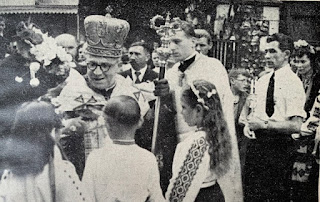
Bishop Hornyak, Cardinal Exarch Godfrey, Archbishop Buchko, December 1961

Saturday, 30 July 2022

Coventry Ukrainian Catholic Church at 60


Timeline by Bohdan Mandziuk
It has been a very traumatic year for Ukrainians worldwide. A number of celebratory events had to be postponed after Russia’s war in Ukraine intensified, in February. Communities and organizations across the globe focused on aid to Ukraine and welcoming refugees. Some were still able to commemorate significant milestones in their histories. A stained-glass window remembering Ukrainian-Canadian servicemen and women in Britain was hallowed at St. James's, Sussex Gardens, in London, on 8 May 2022. As well, the Ukrainian Orthodox Church in Bradford marked their 70th anniversary. Today, I discovered that St. Volodymyr’s Ukrainian Catholic Church in Coventry is also marking their  60th on Sunday, 31 July. As a tribute to my dear friends from that community, I thought to compose a brief history of this church, taken mainly from my manuscript of the History of UGCC in Britain “This Family in Exile”, which is currently in editing.

Following the Second World War, 30,000 Ukrainian Displaced Persons immigrated to the United Kingdom and were settled in 500 towns, cities, refugee and workers' camps across the country. About two-thirds were Greek-Catholics from Western Ukraine (Galicia). Church authorities dispatched missionary clergy to serve the scattered flock and Bishop Ivan Buchko (Archbishop from 1953) was given jurisdiction over them, as well as all Ukrainian DPs in Europe.

As the refugees were scattered in hundreds of settlements, the clergy had to set up missionary bases, from which they could travel to the surrounding settlements. Six pastoral zones were established at the end of 1947, each served by two priests. They were re-divided into seven zones in May 1949. At first, Coventry was served from Ely because a larger number of refugees were located in camps and hostels in Cambridgeshire. The first priest to serve that area was Father Josaphat Jean. In a letter to Archbishop Godfrey of 22 August 1947, he mentioned Coventry among the places where the faithful were located. Jean was assisted by Father Modeste Gnesko, in the Summer of 1948, and then by Father Petro Diachyshyn, who visited Coventry and 26 camps and hostels, from March to April 1949.

With the arrival of more clergy, the pastoral zones were modified again in August 1949. Father Emanuil Korduba was transferred to Coventry, which was quickly becoming a Ukrainian centre. He was given charge over Essex, Hertfordshire, Bedfordshire, Northamptonshire, Warwickshire, and Worcestershire. Korduba was assisted by Father Yuriy Spolitakevych. When hostels in Cambridgeshire, Norfolk, Suffolk, and Essex were closed, two priests were no longer needed in the area. In September 1950, Korduba was transferred to Manchester. Spolitakevych and Diachyshyn volunteered for a mission in Australia, and newly-ordained Father Mykola Matychak was sent to Coventry in January 1952. Matychak changed his base to Wolverhampton in 1953 and was assisted in Coventry by Father Petro Lisovsky. In November 1954, Father Stefan Vivcharuk, who had been serving in Paris, took over the Coventry pastoral zone but made his base in Birmingham. Four years later, some of his territory was included in a new Bedford pastorate, assigned to Father Ivan Hasiak. For three months in 1959, Father Alexander Baran assisted Vivcharuk while waiting to emigrate to Canada. Father Volodymyr Dzioba replaced Vivcharuk in December 1962, when the former was appointed chancellor.
          
Archbishop Buchko, Coventry 1956
In the 1950s and 1960s, Ukrainian religious leaders visited Coventry: Mitrat Malynovsky assisted with Lenten Confessions in March 1951. Archbishop Buchko made a first brief stop to Coventry on 18 July 1952, and a solemn visitation was organized in July 1956. After the formation of the Apostolic Exarchate, the new Vicar General, Paul Maluga, visited and preached a mission from 13 to 16 March 1958. Bishop Augustine Hornyak visited in 1962, 1965, 1969. Missions for the twentieth and twenty-fifth anniversaries of UGCC in Britain were preached by Basilian Fathers Maksym Markiv, on 22 May 1967, and by Athanasius Pekar, on 25 November 1972. The most important visit to the congregation occurred on 22 May 1970, when Cardinal Slipyi (known as Patriarch Yosyf from 1975) visited and celebrated the Divine Liturgy.

Ukrainian Catholics in Coventry first worshipped at Christ the King RC church in Coundon. In 1948, Canon Raymond Walsh welcomed them to Saint Elizabeth RC church. After his appointment, the lively Father Vivcharuk began looking for a larger building for worship. In January 1956, he acquired a new domivka: a church residence and national home at 482 Foleshill Road. This building was blessed and opened by Archbishop Buchko in July.
Vivcharuk’s ambitious projects were aided by Vicar General Maluga. At a meeting in February 1961, Maluga told the assembled clergy that they needed to increase collections in order to acquire new church buildings in Nottingham, Coventry, and Bolton. In August of the same year, Cardinal William Godfrey, the first apostolic Exarch for Ukrainians, made a token monetary contribution toward the purchase of a temporary church for Coventry.
In July 1961, Father Vivcharuk acquired land at Broad Street and Stony-Stanton Road complete with an old wooden Methodist hall. The first church house was sold while the Methodist hall was repaired and turned it into a “temporary” church, until the congregation could raise funds to build a new structure. The church, rechristened Saint Volodymyr the Great, was blessed by Bishop Hornyak on in March 1962. At the same time, a mosaic icon of Our Lady of Perpetual Succour was installed Saint Elizabeth’s, bearing the inscription: “Gift from Ukrainians of Coventry in thanksgiving for use of Church of St. Elizabeth 1948–1962.” A plan to build a new church in the Hutsul style (Vivcharuk was a Hutsul) was never brought to completion.
            In the 1950s, Coventry became one of most vibrant Ukrainian communities in Britain. The Ukrainian Catholic congregation, numbering 700, began to increase as Ukrainians from Wales and Northern England settled in town. In 1953, the first branch of Brotherhood of Our Lady of Perpetual Succour (OLPS) was established by visiting Redemptorist missionary, Bohdan Kurylas. Members of this confraternity undertook to care for the church and clergy residences, and also took part in church singing and carolling. In the 1950s, other chapters were set up in larger centres, such as Edinburgh and Bradford, due to the efforts of energetic pastors. With the arrival of Father Maluga, the brotherhood became active in organizing church events. Coventry OLPS hosted a reception for the parish praznyk of the Protection of the Mother of God, on Sunday, 18 October 1959. During Maluga’s tenure, Coventry was considered one of the most vibrant branches.
Coventry’s other Ukrainian organizations were also very active. Among these were: a male Choir, Verkhovyna, under the direction of Marian Kostiuk (1926-2000), which performed across the country; drama and dance troops; and a Saturday school, with qualified teachers. Kostiuk’s choir sang the responses at a Divine Liturgy on 24 May 1959, at the Ukrainian church in Saffron Hill, London, in the presence of Exarch Godfrey. They also sang at a commemorate concert in Godfrey’s honour, held at Westminster Cathedral Hall. Verkhovyna sang the Divine Liturgy celebrated at the Lourdes Grotto of Hednesford Shrine, during the annual Ukrainian pilgrimage in July 1961. Over a thousand Ukrainians attended. On 30 June 1968, the choir led one of the Divine Liturgies during the opening ceremonies of the Cathedral of the Holy Family in Exile. Kostiuk emigrated to Australia in 1975, where he continued to establish and work with Ukrainian community choirs.

Cardinal Slipyi, Coventry, 22 May 1970


Monday, 20 December 2021

Exsul Familia – A Family in Exile


Last August, a 68-year-old document was extracted from decades of dust into the light of the present and republished in Italian by the Vatican press. It was Pius XII’s Apostolic Constitution, Exsul Familia Nazarethana, or the Nazarene (Holy) Family in Exile, first issued on 1 August 1952. 

An Apostolic Constitution is the most solemn form of legislation issued by the popes, in the form of a bulla (led-sealed parchment). The background to this was that the Second World War had forced 12.6 million displaced persons (DPs) to seek refuge in various western European countries. Over 3 million of them were Ukrainian. These refugees asked to be ministered to by clergy that spoke their native languages and understood their customs and cultures. Many bishops asked Rome to issue guidelines, the result of which was the first systematic reflection on human migration in the papal magisterium.

Pius XII noted that displaced persons lose much of their security and human dignity, and help up the example of the Holy Family from Nazareth (Jesus, Mary, and Joseph) as an example for migrants of every age. The document also outlined the nature and extent of papal charitable works in favour of millions of DPs, during and after the war (from which Ukrainian religious and cultural entities also benefited). It called for greater, more specified pastoral care of refugees, mandating that ethnic, linguistic, and ritual traditions be supported by local Catholic hierarchs. For its extensive substance and provisions, Exsul Familia became known as the magna carta of migration.

The papal charter was also significant for offering a reflection, not merely on the migration of ethnicities, but also of rites. It provided indications on how the powerful Latin Church should deal with the smaller, more vulnerable Particular Churches. Bishoprics established in the twentieth century for Byzantine-Rite Catholics in Canada, USA, Brazil, and even Italy, were cited as examples of papal solicitude. For the Ukrainian Catholic Church, which had been violently suppressed by the Soviets in countries within their “sphere of influence,” this confirmed the pope’s promise to protect it and restore it in the lands of immigration.

The teaching of Exsul Familia was supposed to serve as a buttress against resourceless Eastern Catholics being forced to assimilate to predominant Latin Rite in their countries of refuge. It was also expected that that Eastern-Catholic missionaries would henceforth be given a freer hand by local Latin hierarchs. Surprisingly, the opposite happened. Exsul Familia laid down principals but its implementation had been entrusted to Roman Curial department known as the Consistorial Congregation. The juridical norms issued by that department replaced existing apostolic visitations to ethnic and linguistic groups with priest-delegates responsible to the Consistorial.


From the moment these norms appeared, diocesan functionaries began to question the authority of Archbishop Ivan Buchko, the Apostolic Visitor for Ukrainian Catholics, who had been granted direct authority over the clergy and faithful throughout western Europe. The wording of the norms made it appear that the papal constitution had also supressed Buchko’s jurisdiction. Chancery functionaries told Buchko’s officials that they would have to apply to become ethnic delegates under Latin diocesan structures. Buchko appealed to the Congregation Pro Ecclesia Orientali to resolve the issue. On 16 November 1953, that Congregation's head, Cardinal Eugène Tisserant, addressed an official letter to Archbishop Buchko, clarifying that Exsul Familia and its accompanying norms did not pertain to the Eastern Rites. 

The Latin Particular Church has long had issues with ritual and spiritual diversity within the Catholic Communion and, historically, has very often mistaken itself to be the unique expression of Catholicism. Having experienced this first-hand, at home and in exile, Buchko acted quickly to have more permanent structures put in place. Following the Exsul debate, he petitioned the Oriental Congregation replace his visitation with apostolic exarchates. These were indeed established: in Britain, in 1957; in Germany, 1959; and in France in 1960. 


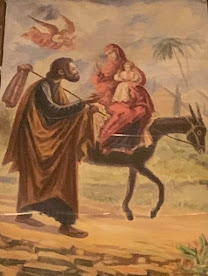
Hieromonk Parteniy Pavlyk's 
the Holy Family's Flight into Egypt
 
In August 1962. on the eve of the Second Vatican Council, a conference was held in Rome to commemorate the tenth anniversary of Exsul Familia. In attendance was Augustine Hornyak, Auxiliary Bishop and soon to be Exarch for Ukrainian Catholics in Britain. The conference and perhaps even more so the papal charter made a  great impression on the freshly-minted bishop, whose flock identified as скитальці or post-war political “exiles.” When seeking financial assistance for a suitable cathedral church, he pleaded with the papal representative in London: “I am asking for a part of the Universal Church of Christ, for an Exsul Familia, which wants to survive here and sustain the ‘Church of Silence’ in our homeland.” After receiving a large subsidy, Hornyak surprised everyone by christening his new cathedral “Holy Family in Exile” after Pius XII’s Apostolic Constitution. The name “Пресвята Родина в Скиталю” was also intended as a reminder to his flock that the Almighty, who had temporarily permitted the Holy Family’s exile, would, one day, allow exiled Ukrainians to return to their own native land.


The year 2022 will mark two important anniversaries: the seventy fifth anniversary of the canonical establishment of the Ukrainian Catholic Church in Britain (3 March 1947), and the seventieth anniversary of Pius XII’s Exsul Familia (1 August 1952). In an introduction contained in its new edition, Professor Andrea Tornielli of Vatican Communications notes that Pope Francis’ teachings on migrants have their roots in Exsul Familia. What many in Rome and elsewhere will be surprised to learn is that a cathedral in London, the spiritual Nazareth of thousands of migrant workers today, stands as a living witness to the first Catholic migrants’ charter.

Monday, 12 July 2021

Danylo Skoropadsky on His Father’s Death


 I first learned of Danylo Skoropadsky on a visit to the old Basilian Fathers Museum in Mundare, Alberta; a building which had been erected in 1938 to house the Basilian Press. When the Press moved to a larger premises in Toronto, and Fathers Orest Kupranets Josaphat Jean moved the Basilian Museum in to it. On 28 July 1957, the new Basilian Fathers Museum (which at an earlier state had been christened, by Jean, as the Archbishop Ladyka Museum) was solemnly inaugurated in its new premises. For the occasion, a telegram, which I recently discovered in the Vatican Apostolic Archive, was solicited and received from the Apostolic See.

            On the second floor of the old museum, there was a photograph of Danylo Skoropadsky visiting the Mundare Monastery, in 1938. It was part of his tour across Canada and the United States to promote the Hetmanite movement. The conservative political movement was headed by his father, Pavlo Skoropadsky, who had ruled as Hetman of Ukraine for a few months, in 1918. Pavlo had taken the old Cossack title Hetman and, as the movement promoted an hereditary monarchy, Danylo was accorded the filial title of Hetmanych. For a time, the Sich-Hetmanite Movement gained a certain popularity among diaspora Ukrainians, notably among Greek-Catholics. 

            Hetman Pavlo remained in Berlin while Danylo was given a cosmopolitan education of university as well as learning a trade. Such preparation would help him, as future leader of the international Hetmanite movement, to identify with him supporters and they with him. As a result, Danylo became a very popular among Ukrainians of various political and religious views. With the Second World War about the break out, in August 1939, Danylo was dispatched to London to gain British support, where he teamed up with his father’s emissary, Vladimir de Korostovets.

            The Vatican Archive holds the Archive of the Apostolic Delegation in Great Britain. One of its fascicles is entitled “Ukrainians” and contains correspondence with various Ukrainian clerical and lay representatives, including Skoropadsky and especially Korostovets. Beginning in 1940, they established friendly contacts with the papal representative (apostolic delegate), Archbishop William Godfrey, to whom they gave a “crash-course” on Ukrainians. Although both Orthodox Christians, Skoropadsky and Korostovets admired Catholicism, given its support for their movement and the Church’s anti-communist stance. Having gained his sympathy, Godfrey interceded for them and other Ukrainians before British church and state authorities. 

             De Korostovets introduced Skoropadsky to Godfrey in May 1940, and made repeated visits subsequently. By the end of the war, the Hetmanych had established confidential relations with the papal envoy. On 7 July 1945, he went to see the Apostolic Delegate with Father Mykhailo Horoshko, a Greek-Catholic chaplain with the Canadian Forces, who was stationed in London at the time. Danylo had received tragic news from Germany and was seeking advice and assistance from the papal diplomat. Godfrey, responded with “sympathy and understanding” and advised Skoropadsky to write to head of the Papal Secretariat of State’s Diplomatic Section, Monsignor Domenico Tardini. Five days later, on 12 July, Danylo had composed 2 letters, transcriptions of which I reproduce here:


 Your Excellency,

            I hope you will forgive me for troubling you with this letter. Only the deepest anxiety about the fate of my family, or, to be more exact -of its remaining members- is my excuse. His Grace Archbishop W. Godfrey advised me to write to you and I am venturing to do so.

            Several days ago news reached me that my father, Paul Skoropadsky, former Hetman of the Ukraine in 1918, has died in Metten, Deggendorf (near Prattling), Bavaria as a result of wounds. I do not know how he was wounded, I have, however, reason to believe from other sources that it happened during a air-raid on Prattling on or about the 14th of April.

            With him was my second sister, Elisabeth, as well as our old nurse. The latter two, according to the above short message, were also wounded and are still in the hospital in Metten. My sister was apparently so weak that she could not write the letter herself which was therefore written by an unknown Ukrainian to me and forwarded through Belgium probably by a Belgian prisoner of war returning home.

            There is no possibility of getting an exact picture of what has actually happened and in what circumstances my sister Elisabeth is at this moment. I very much fear that she and our old nurse (both of them wounded) are absolutely alone, with no moral support, and probably without any means.

            I only know that my father with Elisabeth and the nurse were on the way from Berlin, through Weimar, to join the rest of my family in Oberstdorf, Bavaria. The latter, comprising my mother, the eldest sister Mary and my brother Peter, an invalid from birth, were staying with Russian friends, the Mordvinoff’s, at “Het-Haus”, 40 Loretto-Strasse, Oberstdorf-Allgäu, Ober-Bayern, Germany. However about them too I have no exact news and I fear that they also are facing great difficulties. I only know that until the end of June when I received indirect news that the members of my family in Oberstdorf were alive, my mother knew nothing of the whereabouts of my father, my sister Elisabeth and our old nurse.

            I would be immeasurably grateful, Your Excellency, if you find it possible that something  should be done for them all through the channels of the Catholic Church to help them in their present position, in the first case my wounded sister and our nurse. I am certain that Elisabeth is anxious to join the rest of the family in Oberstdorf. For both of the  realisation that someone is trying to help them would be of great oral support. The same applies to my mother (she is 66 years old), who has now to face, after having lost my father, all the present hardships alone and without my being able, from this country, to be helpful to her. The moment there is any possibility of establishing direct contact from here by mail and also the possibility of sending money, I will do so, however, for the time being, this is impossible.

            I enclose herewith: A) A letter to my mother and I would be very grateful if it could be conveyed to her. She is without any direct news from me since the beginning of the war. B) A letter to M-me A. de Korostovetz, who is presumably staying also in Oberstdorf, if not, her whereabouts should be known by my mother. […]

            I am very much worried about the present discussion on the status of people like my family who are stateless. Their future seems very doubtful. Any transfer to the East would mean for them death or deportation. I would be immeasurably grateful for anything Your Excellency would find it possible to do to allay their anxieties.


Dated the same day, 12 July 1945, Danylo enclosed the following letter, written in English, to his mother Alexandra:


            Darling Mother,

            I am writing you these lines still under the impression of the first shock on receiving the news about father a couple of days ago. How terrible all this is, especially as it was only a few days before the cessation of hostilities! I don’t know whether you have managed to establish contact with Lily and Anna, who both were, according to the message from Dmytro Hryschtchynskyj, on the 12.6.45 in hospital in Metten, near Deggendorf, Bavaria. I hope that our Catholic friends who are forwarding this letter to you will be able to help her and Anna and all of you and to bring you all together in Oberstdorf.

            Personally I have no doubts that the message from Hryschtchynskyj (it was forwarded to me through Belgium) is true. However, I must admit I have never heard his name before. On the other hand his news (that Father died on the 26thof April in Metten as results of wounds) is corroborated by similar rumours, which reached Ara [Aleksandra de Korostovets] from Switzerland and then Vladimir here. News about Father appeared first in the “Swoboda” 38 Jersey City, N.J., USA. However, there was only a short note saying that Father has died on the 26 of March which was hardly possible. In the meantime I received, as I said, the message from Hryschtchynskyj, which was written on the instruction of Lily. He did not give any further details except that Lily and Anna were still in the hospital in Metten (on June 12th), furthermore he gave me your address in Obserstdorf, which I knew.

            I have at once initiated steps through Capt. Mattlaw with the British and American Authorities to have, if possible, an official confirmation and also to help Lily and Anna to join you all in Oberstdorf. But this, as always, takes long time.

            To you all I want to say this: we must face it and take it, as so many other people have done in this war. I should have been at my Father’s side to hear his last words and to tell him that I will always continue his work. However God has decided otherwise ad we are helpless to change it.

            Now we must look ahead and make, if possible, plans for the future. I don’t know at all in what circumstances you are. Have you managed to save something or are you without any means? What is the position of Aunt Olga and her family in general? At the first opportunity I could forward you a little money and I know that our people in Canada and U.S.A., with whom I am in contact will not let us down.

            I think the right thing is first that Elisabeth and Anna should join you in Oberstdorf, then to establish contact with me and let me exactly know what is your position as far as money and other means are concerned, and then to decide, whether you should stay for the time being in Oberstdorf (where life is probably cheaper) or should try to go to Iritirzor[?] (I have made all the necessary applications for obtaining of visas along time ago. There were difficulties, but I hope it will be possible to overcome them. In any case P. Kovaliv in Geneva, wrote me You could stay for several months with him, until things in general settle down.

            I hope it will be possible for you to send me a message using the sae channels as I have sending you this letter.

            I have also notified Pavlo Rodzienko about your position. He is with the Forces in Italy. In particular I wrote him about the urgence [sic] of help for Lily. It is not possible to write about everything in this letter as space is short and it must be forwarded in the morning. Only a couple of words about Vladimir and myself. We both are alright and are working hard to help you all. Also we don’t forget our friends, fellow countrymen elsewhere.

            I am working in my factory and am preparing quite well. Michael Hethman is as helpful as always. Everybody in the New World is very anxious about all of you.

            Personally I am not married yet, but am in love with the same woman of whom I wrote to you and Father a long time ago. She has helped me to go through many difficult times during the last years. The question of marriage is still open, and will depend, dear Mother, on your word an advice and also on what were the ideas of Father on this matter. I will write you about all this at some later date, as now the question of having you all together, in safety and warmth, is more urgent.

            God bless you all! Kisses to all of you! My love to Aunt Olga and all her family and do not get downhearted, as we all think of you and are working for you.

            Yours Danylo

            P.S. Vladimir is sending his love to Ara and to all of you. D.

            P.S. I have received a letter yesterday from Olenka’s father in law and we are going to try to find him in Würzburg or elsewhere. Also her husband until last night I did not know his name. D.


 The handwritten letters to Tardini and his mother remain in the Archive of the Apostolic Delegation. Further research is required to determine the reason they were never forwarded to Rome. Likely, Godfrey sent a summary to his superior, who perhaps indicated that the communications could not be forwarded. Godfrey was extremely zealous in another matter: the rescue of Gertrud of Habsburg-Lothringen and her children Maximillian and Claudia. They arrived safely in Paris, Dublin, and London, accompanied by Vladimir de Korostovets’s wife Aleksandra (Ara).


Ara de Korostovetz
            Danylo Skoropadsky continued to have close relations with Ukrainian Greek-Catholics in Britain until his untimely death, eleven years later. Below are a list of some events which I have come upon in my research:

            On 15 January 1946, Skoropadsky introduced Father Vasyl Kushnir to the Apostolic Delegation. As President of the Canadian Ukrainian Committee, he had “come to Europe to study the position of the Ukrainian Displaced Persons on the Continent.” Kushnir was instrumental in repatriating Ukrainian refugees from DP camps in Germany to Canada and USA.

            On 27 April 1947, together with Ara and Vladimir de Korostovetz, he attended a Divine Liturgy at the 218 Sussex Gardens celebrated by Canadian Greek-Catholic missionary, Father Josaphat Jean. After the Liturgy, Jean held the inaugural meeting of Saint Theodore of Canterbury Greek-Catholic Parish. These Orthodox notables took part and pledged their support to help acquire a building for the fledgling congregation.  

On 17 January 1948, Father Jean sent Skoropadsky and de Korostovets to lobby the Archbishop of Westminster, Cardinal Griffin, for a church building in London. Following that meeting, Griffin became more energetic in helping to look for a suitable structure. The Orthodox leaders continued to actively liaise until a church was found.

            Skoropadsky became one of the founders of the Association of Ukrainians in Great Britain (AUGB) in January 1946.  After a rift occurred in the organization, in 1949, he accepted the titular headship of AUGB and sought to bridge all divisions in the Ukrainian community. Rather than acting as a partisan politician, Skoropadsky was content to be a figure of unity among various parties, in imitation of the role of the British Monarchy.

            Vladimir and Ara Korostovets participated in a pilgrimage to Rome for the papal Holy Year of 1950. Ara was an iconographer and donated an icon of the Madonna of Hoshiv (a western Ukrainian shrine) to Pope Pius XII, for which she received a telegram from the papal Secretariat of State. In 1953, Ara completed the iconostasis of the Belarusian Catholic Mission begun by another iconographer.

In August 1953, Hetmanych Danylo thanked Archbishop Ivan Buchko for his work on behalf of all Ukrainians, during an AUGB reception for the Archbishop, at 49 Linden Gardens. In February 1954, Skoropadsky made sure to have the head of the Greek-Catholic Church in Britain, Monsignor Aleksander Malynovsky, next to him at the head table, during a banquet held for Danylo’s fiftieth birthday.


In 1956, Skoropadsky organized an 11,000 strong Polish-Ukrainian protest to Soviet dictator Nikita Khrushchev’s visit to Britain. Some have speculated that, in revenge, Khrushchev ordered his assassination the following year; the first of a series of poisonings of Ukrainian émigré leaders which, in 1961, were shown to have been ordered by the dictator. Monsignor Malynovsky had the unenviable task of representing the UGCC at Skoropadsky funeral, at the end of February 1957.

Only three months later, in May 1957, Archbishop Godfrey accepted the nomination as the first Apostolic Exarch for Greek-Catholics in Britain. He had been offered the post because he had succeeded Cardinal Griffin, who had already accepted the appointment in 1955, but died before the exarchate could be established. The succession was fortuitous for Ukrainians, since Griffin had been rather lukewarm to their cause whereas, thanks in large measure to his friendship with Skoropadsky and Korostovets, Godfrey was extremely well prepared to assume spiritual leadership over Ukrainian Catholics, whose national and religious causes he sympathized with. 

As yet in a pre-ecumenical period, Skoropadsky and the de Korostovets’s forged solidarity among Ukrainians of different denominations and factions, working to breakdown down prejudices and establish close cooperation, for the prosperity of the local hromada and the benefit of the Ukrainian nation spread across five continents.