

The 3rd of March marks the seventy-fifth anniversary of the foundation of the Edmonton and Toronto Eparchies (formerly designated exarchates). On 3 March 1948, the Apostolic See of Rome divided the Ukrainian Greek-Catholic bishopric for Canada into three, creating Apostolic Exarchates of Western Canada (Edmonton), Central Canada (Winnipeg), and Eastern Canada (Toronto).
From the outset, when the Ukrainian (Greek-) Catholic Church in Canada (UGCC) was canonically established in July 1912, it was understood that the task of shepherding a flock spread in settlements across the country, from the Atlantic to the Pacific, would be too onerous for a single bishop. Bishop Nykyta Budka was based in Winnipeg, which then had the largest Ukrainian population. He requested an auxiliary bishop in 1914, 1916, 1923, and 1927, but was repeatedly refused. When his health finally broke down, the Apostolic Delegate, Archbishop Andrea Cassulo, recommended that at least one more bishop be named and the territory divided between 2 or three jurisdictions with additional bases in the west and east of the country. In 1928, Rome decided to replace the exhausted and bankrupt Budka with two younger men, an ordinary and an auxiliary, but only one could be prevailed upon to accept. After three years of constant travels across the vast dominion, in December 1933, Bishop Vasyliy Ladyka requested that his ordinariate be divided, with additional bishops in Edmonton and Toronto. Cassulo seconded this request but, in the meantime, Pope Pius XI decided that Ladyka was to appoint a Vicar General for Eastern Canada. The impoverished UGCC in Canada was unable to support itself and a second bishopric would be too costly. Meanwhile, the Archbishop of Quebec, Cardinal Villeneuve, has offered to support a Ladyka’s Vicar General in his diocese.
By the onset of the Second World War, the Ukrainian Catholic population in Canada had almost doubled reaching 300,000. Ladyka’s health was also deteriorating and an auxiliary bishop had become necessary. But the candidates presented were found wanting and Pope Pius XII asked for additional names to be added. The new Apostolic Delegate, Idelbrando Antoniutti, began collecting testimonials on various candidates but the War disbarred those residing in Europe. Antoniutti turned to the Basilians and the Redemptorists, asking their general councils to provide a list. The Basilians submitted 3 names, while the Redemptorists declined for lack of a suitable candidate.
After submitting a terna of two Basilians and one secular priest, on 29 March 1943, the cardinals of the Oriental Congregation settled upon the candidacy of Basilian hieromonk Nil Savaryn. Born in Austrian Galicia (Western Ukraine) in 1905, Savaryn was reared in a a pious family of farmers. He had entered the Basilian Order in 1922 and was ordained a priest in 1931. The following year, he volunteered for service in Canada, where the Order was asked to expand its mission under a newly appointed Bishop Ladyka, himself a Basilian.
In 1932, Basilian mission in Canada was raised the status of an autonomous province of the Order with its own provincial superior. Henceforth, Canadian monks would no longer be sent to Europe but train inhouse at the Mundare Monastery. For this purpose, additional priests were recruited from Galicia to serve as teachers of philosophy and theology. As Nil Savaryn had excelled in his studies, he enlisted as one of those recruits, boarding the Cunard ship Ausonia bound for Canada in September 1932.
During his decade service at the Mundare Monastery, Savaryn became renowned for his piety and was well liked as a professor by the fledgeling monks. In addition to teaching, he served a number of churches in the surrounding area. On the negative side he was sometimes given to melencholy, timid and reluctant to take counsel with others, preferring to write and be alone. As a result, his English conversational skills were poor. In 1938, he was appointed superior of the monastery by the Provincial Superior and pioneer missionary Navkratiy (Naucratius) Kryzhanovsky.
Bishop Ladyka considered Savaryn worthy but gave preference to another Basilian, Father Mykola Kohut, but the latter was deemed to be too young. The Basilian General Curia in Rome as well as Apostolic Delegate Antoniutti indicated Savaryn as the principal candidate. After a lively discussion of all the options, the Cardinals who were members of the Eastern Congregation unanimously proposed Savaryn to the Pope.

The Pope accepted the cardinal’s choice and appointed Father Nil Savaryn as auxiliary bishop of Ladyka on 3 April 1943. He was informed by the Apostolic Delegate of his appointment on 23 April and telegraphed his acceptance to Ottawa. The new bishop also wrote a personal letter thanking the Pope on 11 August but, as Rome was under Nazi occupation, the letter did not reach the Vatican until 7 months later. Bishop Nil’s consecration took place in Toronto on 1 July 1943 but, since the local Saint Josaphat’s Church was too small, the ceremony was held at Saint Michael’s Roman Catholic Cathedral, so that a large number of faithful could attend.
The number of churches and missions had increased in the 1940s along with a new generation of homegrown religious vocations. The UGCC enjoyed greater financial stability due to aid from the Roman Catholic Church and its charitable organizations, and with its own faithful becoming more established. Sisters Servants of Mary Immaculate, Redemptorist Fathers and Brothers of Christian Schools established schools, academies, and hospitals. And the children of the first immigrants began to take their place in the Ukrainian community and in Canadian society. They were instrumental in the foundation of organizations such as the Ukrainian Catholic Women’s League, Ukrainian Catholic Brotherhood, Ukrainian Catholic Youth, and other organizations and institutions. From a missionary entity, the Ukrainian Catholic had matured into an established national community.
Bishop Savaryn had had to move to Winnipeg in 1943 and the problem of the lack of command centres in the west and east of the country remained unresolved. Bishop Ladyka became ill again in 1945 and, following the war, a large influx of Ukrainian refugees swelled the ranks of the UGCC faithful. Rome began to ask Bishop Ladyka in Canada and Bishop Bohachevsky in USA to accept large numbers of refugee clergy. The increased number priests, faithful, and organizations, coupled with the great distances that the two bishops were required to travel, warranted a new arrangement.
To inspect the terrain, the head of the Oriental Congregation, Cardinal Eugène Tisserant, made a trip to USA and Canada in the spring of 1947. Based on his first-hand observations, together with the views of Canadian Catholic bishops (who told him that Ukrainians formed almost half of the Catholic population), on 19 July Tisserant asked Archbishop Antoniutti to lay out a detailed plan for the division of the Ordinariate into three apostolic exarchates. Ladyka was to remain in Winnipeg and continue to serve the Provinces of Saskatchewan and Manitoba. But two candidates were required to become bishops in Edmonton (serving Alberta and British Columbia) and Toronto (serving Ontario, Quebec, and the Maritimes).
Ladyka’s auxiliary, Bishop Savaryn, war earmarked for the west, where 33 out of 34 priests belonged to his own Basilian Order. Having served in the Mundare district, before becoming a bishop, he was very familiar with the Ukrainian community in Alberta. For five years, he had faithfully carried out his duties as auxiliary bishop, was beloved of the faithful and respected by the clergy and hierarchy. Gerald Murray, Coadjutor-Archbishop of Winnipeg, considered him to be one of most edifying churchmen that he had he ever met.
The parish priest of Saint Josaphat’s Church in Toronto, Father Isidore Boretsky, was chosen for Eastern Canada. And as a new auxiliary to Ladyka, who was too frail to manage alone, Father Andrew Roborecky, also from Toronto, was listed. Apostolic Delegate Antoniutti submitted a map with the proposed division and Pius XII approved the creation of the exarchates on 19 January 1948. Savaryn and Boretsky were asked whether they would accept their appointments. However, Roborecky had not been universally recommended and the Pope ordered a further investigation into his suitability. Antoniutti asked that the announcement of all the appointments be made at the same time, so the canonical creation of the new exarchates had to be delayed until the appointment of Ladyka’s auxiliary was finalized. After all three candidates had indicated their acceptance, the Oriental Congregation issued a decree, on 3 March 1948, creating three apostolic exarchates for Western, Central, and Eastern Canada, naming Savaryn, Ladyka, and Boretsky as Apostolic Exarchs, and Roboretsky as auxiliary to Ladyka.

Cardinal James McGuigan (the de-facto primate of English-speaking Catholics in Canada) was deputized to install Bishop Savaryn as Exarch of Western Canada. The ceremony The ceremony took place on 13 April 1948 at Saint Josaphat’s in Edmonton, which was designated as the Western Exarchate’s new cathedral church. In attendance were 27 eparchial priests, 6 archbishops, 19 bishops (one from Africa, one from China and from Japan), 1 Abbot-nullius, 140 priests, and Sisters from various orders. McGuigan performed the act of enthronement, Bishop Ladyka preached Ukrainian, Archbishop MacDonald of Edmonton preached in English. 120 clergymen attended a luncheon at the MacDonald Hotel, and a reception for 400 parish and organizations representatives was held at the same venue, in the evening. Basilian Provincial Superior, Father Benjamin Baranyk, read the papal bull in Latin, Father Nestor Drohomyretsky read a Ukrainian translation of it, and Father Hryhoriychuk an English version. Ukrainian Catholic clergy attended from Saskatchewan, Manitoba, and even Ontario.

Fathers Boretsky and Roboretsky were consecrated bishops on 27 May 1948 at Saint Michael’s Cathedral in Toronto. Cardinal McGuigan also issued a pastoral letter Canadian Catholics about the division, dated 6 May. In this letter, he affirmed that the migration of Ukrainians to North America had had a profound significance on the Catholic Church for having brought the Byzantine Rite to the new world. The cardinal contrasted the flourishing Ukrainian Catholic Church in Canada with the persecuted Church in behind the Iron Curtain, noting that, among the imprisoned clergy was the first Ukrainian bishop of Canada, Nykyta Budka. McGuigan concluded that the Russian Orthodox Church had become an instrument of the Communist dictatorship in persecuting and absorbing Greek-Catholics into their ranks.
The division into three exarchates was a step towards a more definitive ecclesial structure. On 17 June 1948, the four bishops held their first joint assembly and petitioned the Apostolic See to expedite the process and raise the status of the Church an ecclesiastical province headed by a metropolitan. But Cardinal Tisserant felt this was premature and Ladyka was granted instead the personal honour of titular Archbishop.
As the elder among the new exarchs, it was assumed by many that Nil Savaryn would one day succeed Ladyka. A plan to appoint him administrator of the Winnipeg Exarchate was rejected by Rome and, in his stead, in 1951, Redemptorist Father Maxim Hermaniuk was named Ladyka’s auxiliary, while Bishop Roboretsky was transferred to Saskatoon to head an exarchate for the Province of Saskatchewan. In 1956, the exarchates were raised to the status of eparchies and Hermaniuk was named the first Metropolitan.
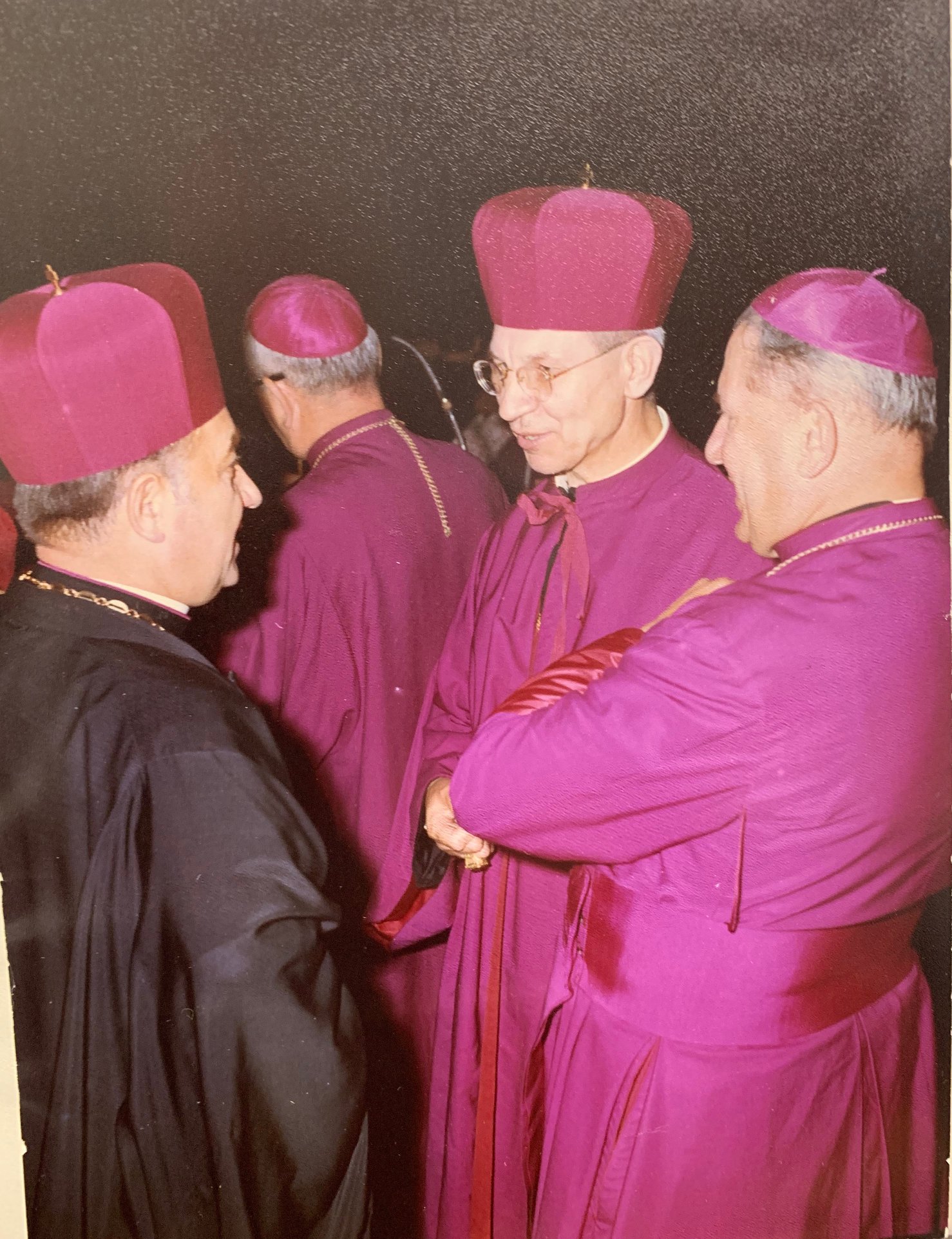
Hermaniuk, Savaryn, Boretsky and Roboretsky all served as “Fathers” of the Second Vatican Council. Although, Hermaniuk was most involved in its preparation and work, Savaryn made a significant number of interventions during the Council sessions: three on the Blessed Virgin Mary, three on the Eastern Catholic Churches, four on the office of bishops in the Church, and eleven proposals concerning religious orders. In his observations which the Vatican had elicited before the opening of the Council, in 1959, Savaryn touched on the problem of the Church calendar and feast days that were working days for the faithful.
Nil Savaryn served as exarch and later eparch of Edmonton until his death on 8 January 1986. After the release of Cardinal Yosyf Slipyi from the Soviet Gulag, Savaryn strongly supported him in his quest for a Ukrainian Catholic Patriarchate. During the last two years, the eparchy was administered by his successor, Bishop Demetrius Martin Greschuk.

